Every artist needs a way to perceive the world worth putting on canvas, and losing that channel entirely could easily collapse a story into pure tragedy. This one uses that exact premise as its foundation instead. Its chapter-based mystery structure repeats its own rhythm a little too closely more than once, but the moments in between clues, two people building a shared way of seeing between them, land often enough to make the repetition worth forgiving.
The closest comparison might be an anthology mystery, a client-of-the-week structure borrowed from procedural fiction, dispensing emotional revelations case by case rather than building one continuous arc. Unlike those looser anthologies, though, Lilja and Natsuka: Painting Lies keeps circling back to the same two people at its center. The final chapter finally turns that investigative lens inward rather than outward, onto the relationship the whole structure was quietly building toward the entire time.
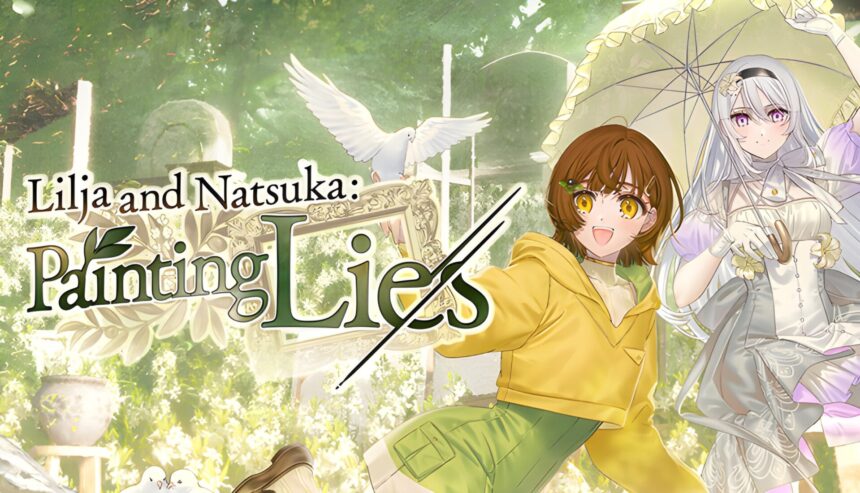
Lilja was already a genius before losing her sight to illness, gifted with a vision so precise that copying what she saw onto canvas produced masterpieces without much effort. Losing that sense, along with her mobility, could easily have collapsed the whole premise into simple tragedy. Instead, she hires Natsuka, a wanderer with little money and no particular direction, to become her eyes in the most literal sense, describing the world back to her in enough vivid, specific detail that Lilja can keep painting through someone else’s perception.
Character designer Kippu, previously known for Fire Emblem Heroes’ character illustrations and the No-Rin light novel series, gives both leads a painterly quality that suits a story so centered on visual art as a concept. This marks the first time a Frontwing release has come in Full HD. Composer Hijiri Anze, a veteran of Muv-Luv Alternative’s score, keeps the quieter emotional scenes weighted without ever overplaying the moment, and the opening theme, “The Stories of Tomorrow” by yanaginagi, pairs with an ending theme from Hina Aoki to bookend the whole experience.
That arrangement becomes the engine for a loose mystery structure, with a prologue and four chapters each built around a different anonymous client whose request for a painting turns out to be tangled up in some unresolved pain from their past. Natsuka does the legwork, wandering into these strangers’ lives and reporting back everything she notices, while Lilja pieces together the emotional truth those observations point toward. It’s a clever framing device for a mystery told almost entirely through secondhand narration. The format does start to show its seams by the third or fourth case, though, since each new client essentially resets the same rhythm of investigation, revelation, and painting without much variation in structure. What keeps that repetition from becoming a real problem is how well drawn each client’s backstory turns out to be given the limited time the novel spends on any single one. The final case, turning its investigative lens on the central relationship itself rather than an outside stranger, easily justifies the patient buildup that came before it.
Natsuka carries far more depth than her bubbly, scatterbrained introduction initially suggests, and the slow reveal of her own guarded history is handled with real restraint, letting her cheerfulness read as a real character trait rather than comic relief that eventually needs explaining away. Lilja, for her part, avoids the trap of playing blind genius purely for pathos, treating Natsuka’s chatter as equal parts exasperating and essential, and the prickly, teasing affection between them never once feels staged for an audience. Nothing here branches. The whole experience is fully guided from start to finish. That won’t suit anyone looking for agency in how the story unfolds, but it does let the pacing stay tightly controlled, never padding a chapter out to accommodate a choice that wouldn’t have mattered anyway.
Writer Asou Ei makes their Frontwing debut here after scripts for euphoria, Denno Tenshi Djibril, the Toritani Makoto route in Sakura no Uta, and Natsu no Kusari, and that background in tightly focused character writing shows in how little wasted space either lead carries. Tomoyo Takayanagi voices Lilja, also known for Sarina in Oshi no Ko and Francette in I Shall Survive Using Potions. Yurie Igoma voices Natsuka, having played Ruby in that same Oshi no Ko cast, with Minami Tanaka, known for Lily Hoshikawa in Zombie Land Saga, rounding out the wider supporting roles. That caliber of performance shows in how convincingly both leads sell their dynamic, Natsuka’s warmth in particular carrying scenes that could have felt thin on the page alone.
Frontwing released this in Japan before Frontwing USA and Bushiroad brought it to Steam on July 24, 2024, with Japanese, English, and Simplified Chinese text support built in from launch.
Given that the story touches on themes of suicide and loss in exploring its clients’ pasts, it’s worth flagging as sensitive material for anyone for whom that might hit close to home. If it does, reaching out to someone you trust or a mental health professional is a good next step rather than sitting with it alone.
Verdict
Lilja and Natsuka: Painting Lies turns a clever central conceit, a blind painter relying on her assistant’s eyes and words to keep creating, into a mystery structure that mostly succeeds despite some repetition across its client-of-the-week format. What elevates it past that structural weakness is how much care goes into Natsuka’s own hidden depths and the prickly, earned warmth between the two leads, culminating in a final case that finally turns the story’s investigative energy on the relationship at its center. Its lack of branching choices and occasional structural sameness keep it from being flawless. Between striking Full HD art from Kippu, Hijiri Anze’s evocative score, and a stacked voice cast delivering real chemistry, though, this is a short, focused visual novel that earns its emotional payoff.