Mortally Moonstruck Games established their voice years before this one with smaller, stranger interactive shorts, Making Friends chief among them, a queer visual novel about a lonely witch piecing together a companion of her own making, but Mushroom Musume feels like the fullest realization yet of everything that catalog has been building toward. The full commercial version, arriving on Steam in June 2025 a full three years after its original itch.io demo first put a pot of dirt in players’ hands, is back, and based on my time with it, it’s exactly as structurally ambitious and visually striking as that early demo promised it might become.
Somewhere between Princess Maker and a fairy tale gone slightly feral sits this odd little life sim, one that hands me a pot of dirt instead of a baby and asks me to raise whatever grows out of it into something resembling a person. The premise sounds like a joke on paper, a lonely recluse wishes for a child and a mischievous witch answers with fungal spores instead, but the game commits to that joke with enough sincerity and structural ambition that it stops reading as a gimmick almost immediately.
The first act puts me in the recluse’s shoes, making the early parenting choices, what to feed the growing spore, how strict or permissive to be, whether to steer her toward magic or something more practical, that determine which of over fifty mushroom species she’ll eventually become and what baseline stats she’ll carry into the second act. That’s where control shifts to the daughter herself, and the game opens up into a genuinely surprising range of daily events and choices as she heads out into a world that treats her arrival with everything from gentle curiosity to outright predation. It’s not shy about where things can go either. More than one path through the game ends in genuine horror, whether that’s a daughter slowly losing the ability to communicate as she dissolves into the forest’s mycelium network, or, for the more culinary inclined species, literally being eaten by people she meets along the way. The tonal whiplash between cute storybook framing and moments that turn genuinely unsettling is clearly intentional, and it’s one of the things that makes this stand out from tidier, safer entries in the raising sim genre.
What elevates the whole thing past a one-note curiosity is the roguelike structure wrapped around it. Losing a daughter, and losing several is basically inevitable given how unforgiving some outcomes are, isn’t really a loss in the traditional sense, since every completed run earns spores, the game’s meta-currency, that carry forward into a persistent garden, unlocking new species, new event branches, and steadily more control over what the next daughter might become. That progression loop gives failure real narrative purpose instead of just resetting me back to zero, and it means the writing gets to spend its limited scope on breadth rather than depth, over sixty distinct endings scattered across dozens of possible paths rather than one long, singular story. The tradeoff is that individual runs move fast, often under an hour, which means attachment to any one daughter tends to stay lighter than the game’s own warmth clearly wants it to be. I found myself wishing more than once that a particularly interesting daughter’s arc had more room to breathe before the run wrapped up.
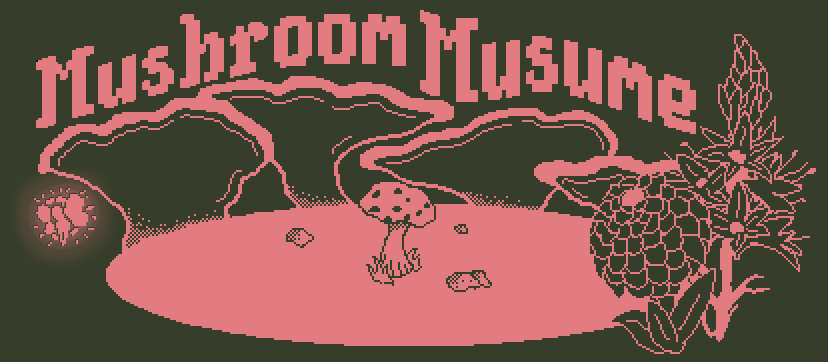
Visually, the mushroom girl designs carry real personality across their wide range of species, rendered in a deliberately limited pixel palette that shifts tone depending on which direction a given storyline is heading, and each design stays distinct enough in silhouette and color that filling out the Mushroom Almanac becomes a genuinely satisfying pursuit rather than empty completionism. An original soundtrack adds real texture to a game that could have easily coasted on reused stock music given its scope, though I don’t have confirmed detail on exact track counts or which specific pieces accompany rarer species, so I’d rather leave that vague than guess at numbers. There’s no voice acting, unsurprising for a project this text driven and built by a small team, and the writing carries that weight well enough that its absence rarely registers as a gap.
Raising a daughter whose quiet, specific traits clearly marked her as one of the more unusual species available, only to watch a single unlucky choice send that particular run somewhere I hadn’t braced for, did more to sell the game’s roguelike stakes than any of its friendlier, safer outcomes ever managed.
Verdict
Mushroom Musume takes a premise built for a single joke and turns it into a genuinely replayable, structurally clever life sim, one that earns its cute but unsettling reputation by refusing to pick a single lane between whimsy and real horror. The roguelike progression across daughters gives failure actual weight and purpose rather than treating it as a dead end, and the sheer range of species and event branches rewards the kind of player willing to chase down every strange corner the game has to offer. Its individual runs move quickly enough that any single daughter’s story rarely gets the room to fully land before the game moves on, but that trade buys real breadth across dozens of playthroughs, and the persistent garden mechanic makes returning to try again feel like genuine progress rather than a fresh restart every time.