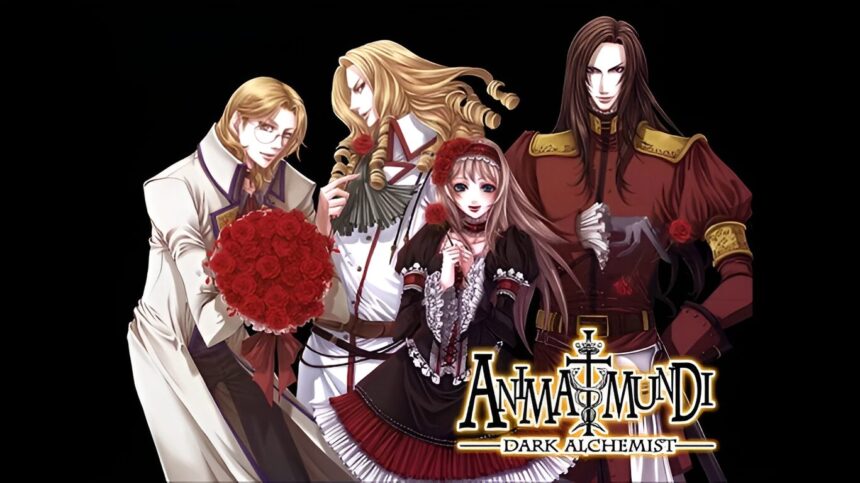
As someone who’s always drawn to the unsettling, uncompromising, and downright macabre, it took about five seconds for the horror at the center of Animamundi: Dark Alchemist to hook me completely. A severed head that keeps talking is an unsettling image to build an entire visual novel around, and this gothic boys’ love visual novel commits to that horror fully rather than softening it for easier consumption. With writing willing to dwell in real body horror, a story carrying more real grief underneath its gothic trappings than I expected, and fifteen branching endings that let a reader choose their own level of darkness, I had a hard time looking away even in its bleakest stretches.
Georik Zaberisk carries the whole story on his back, a former royal physician in his mid thirties who gave up a prestigious court position years earlier to care for his fragile younger sister in the countryside. He returns from a trip to the capital to find that sister, Lillith, beheaded by a mob convinced she’s a witch, her body burned to nothing, her head somehow, impossibly, still alive and able to speak with him. Despite starting the story about as broken as a protagonist can be, cradling a severed head and refusing to accept that grief should end his search for a fix, I found Georik’s desperation grow into something real and sympathetic rather than simply grim for its own sake.
Desperate to make her whole again, Georik descends into forbidden alchemy, striking a bargain with the devil Mephistopheles himself in pursuit of a way to build his sister a new body. Alchemy itself sits outlawed throughout the kingdom, which means every step of Georik’s research doubles as a crime he has to hide from the same court that once employed him. The fictional kingdom of Hardland, populated by vampires, homunculi, and literal demons, gives the story real gothic atmosphere well beyond a simple period setting dressed up with spooky trappings. Georik’s central quest carries body horror weight that few visual novels, in this genre or any other, are willing to sit with as directly as this one does.
Count St. Germant, Hardland’s greatest inventor and its Secretary of Science and Technology, complicates things as Lillith’s own fiancé and one of Georik’s closest friends. He’s distraught by news of her death in ways that ripple through the rest of the cast. Timothy, a mysterious boy with knowledge of forbidden alchemy, becomes an unlikely ally in Georik’s research. Mikhail, a rival swordsman convinced Georik outclasses him, develops feelings for Georik at one point without realizing who he’s actually falling for. Bruno Glening, Georik’s new employer back in the capital, treats his patients with real cruelty and indifference to consent. Count Sandwich, also known as Dashwood, runs a secret society called the Hell-Fire Club behind a mask of aristocratic respectability, manipulating the witch hunts that started this whole tragedy in the first place. Ruthberg, a broker trading organs and stolen goods on the black market, pesters Georik throughout while working his own angle inside that same club. That ensemble of allies and antagonists gives Hardland’s court real political texture beyond a simple backdrop for Georik’s personal tragedy. More than one of these men is working an agenda that only intersects with Georik’s own goals by coincidence.
Fifteen distinct endings branch out across the story depending on choices made and which of the game’s several men Georik ends up entangled with, and that structural density gives readers real reason to replay, chasing different outcomes across a story that treats its horror elements with sustained seriousness rather than using them purely as shock value dressing for a lighter romance underneath. None of the good endings resolve into anything close to pure happiness either. Even the versions of the story where Georik actually fixes what’s broken carry real cost, the kind of bittersweet resolution that fits a story built around a bargain with the devil far better than a clean happy ending ever could.
Where the game draws real, fair criticism is pacing and interactivity. The story leans heavily on dense, verbose dialogue that tests patience across a runtime that asks considerably more reading commitment than its choice structure delivers in actual agency. Choices throughout stay comparatively sparse for a genre built around meaningful branching, a real limitation given how much the fifteen ending structure otherwise promises in terms of replayability and consequence. That gap between reading commitment and actual player agency shows up most in stretches where several consecutive chapters pass without a single meaningful decision, testing patience even for readers otherwise invested in the gothic atmosphere carrying the story forward.
Presentation carries real strength across the board. The artwork carries real gothic elegance, sharp linework and period costuming that fits the story’s court-and-countryside setting throughout. Background art in particular leans into a painterly, slightly muted palette that separates Hardland’s court scenes from the story’s darker basement laboratory sequences, a visual distinction that reinforces which half of Georik’s life each scene actually belongs to. The musical score, built around symphonic and choral composition rather than the synth heavy scores common to the genre at the time, elevates even the story’s quieter scenes. Japanese voice actress Yui Horie performs Lillith specifically, and her work carries the emotional weight of a character who spends most of the story as a severed head still needing to feel like a person rather than a prop. That combination of craft elevated this well beyond what its extremely limited Western distribution, sold mostly through niche retailers and anime conventions, would suggest.
The Western localization carries its own separate, well documented legacy worth addressing honestly. Hirameki edited certain graphic and adult content for the American release, gore specifically and some of the game’s original intimate content, a decision that became controversial enough among the game’s Western audience that Hirameki eventually released limited copies of the original Japanese official game book as a kind of concession. Dedicated fan patches exist specifically to restore what the American edit changed. Bowdlerization is probably too strong a word for what actually happened either, since the American release stayed pretty gory and explicit even after the edits, the changes mostly took the sharpest edges off specific scenes rather than removing the content wholesale. Even with those edits in place, the localized release stayed explicit enough that Animamundi became the first game to carry the ESRB’s Sexual Violence content descriptor, a real first for the ratings board rather than just this one release.
Separately, and unrelated to the content edits, early copies of the English release shipped with a game-breaking text error triggered by a specific sequence of player choices. That bug locked players out of the items needed to actually save Lillith, permanently, no matter how the rest of the playthrough went. Hirameki eventually issued an official patch to fix it, but the damage to the game’s reputation among early adopters happened well before that fix existed, independent of any conversation about the localization’s content decisions. Patches meant to be quality of life fixes for a game this dense with branching choices instead became a matter of basic playability for anyone who happened to trigger that specific sequence before a fix existed.
Karin Entertainment developed Animamundi: Dark Alchemist in Japan, where it released in 2004, followed by a European release in 2005 and Hirameki’s American localization in 2006. Hirameki International has since gone defunct, which makes original physical copies of this specific release increasingly hard to track down for anyone hoping to experience it exactly as it launched at the time. Physical copies that do surface tend to command real prices among collectors specifically because of that scarcity, a modest but real footnote in the broader history of Western boys’ love game localization. That scarcity adds its own layer of difficulty on top of the story’s already demanding pacing for anyone trying to revisit it today.
Verdict
Animamundi: Dark Alchemist remains a significant, if deeply flawed, piece of visual novel history, one of the earliest attempts to bring serious, uncompromising gothic horror boys’ love storytelling to Western audiences, anchored by real artistic strength in its music, voice acting, and gothic art direction. Its slow, dialogue heavy pacing paired with a limited choice structure keeps this from being an easy, purely mechanical recommendation, and both its historically controversial localization edits and an early game-breaking bug speak to real, documented production troubles. This is severe, uncompromising material demanding real emotional readiness rather than casual curiosity, but for readers specifically drawn to gothic horror willing to sit with real darkness rather than a softened version of it, this stands as a cult classic whose ambition, for all its stumbles, still resonates decades later.