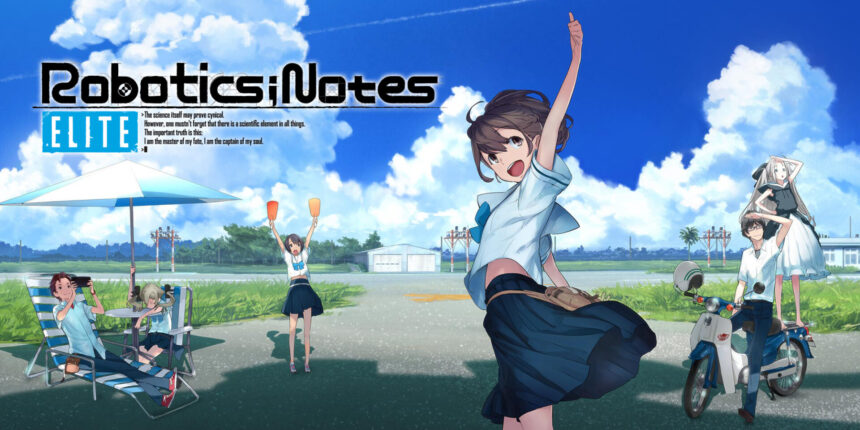
After leaning hard into world ending stakes across Steins;Gate’s lab of amateur time travelers, the Science Adventure series found its stride with something quieter, awesomely turning small personal stakes into stories that still land, a traumatized survivor untangling a string of murders in Chaos;Child, a robotics club fighting to avoid disbandment here. Now, in Robotics;Notes Elite, MAGES. gets to slow that formula down even further, building on 5pb.’s original 2012 release and following Kaito Yashio, a fighting game obsessed slacker who must deal with his own apathy toward a club he only stuck around for because of his childhood friend Akiho Senomiya, and the results are, hey, better than the low key setup suggests.
Robotics;Notes Elite breaks no real structural mold for the series, and the side content, the Kill-Ballad fighting minigame playable through Kaito’s PhoneDroid, the augmented reality app for hunting down scattered report files, shows the team clearly had fun building this world even when a given scene doesn’t fully deliver on its own. The sheer number of small character crises stacking up around this club are often the game’s best asset, quiet, specific struggles you can’t help getting invested in even when the larger conspiracy takes its time reaching you. But this also won’t replace Steins;Gate as the series’ defining entry. One patient playthrough is enough.
This entry is a latecomer in a long line of slow burn, science flavored conspiracy visual novels, from Steins;Gate’s lab of amateur time travelers to Chaos;Child’s survivors piecing together a string of murders. Written by much of the same core team behind those earlier entries, this one borrows some of its best traits from that lineage, since all three involve ordinary people stumbling into a much larger truth buried in old documents and half forgotten history. Kaito himself comes across as more approachable and easier to root for than Chaos;Child’s Takuru or Steins;Gate’s Okabe, though, no offense to Kaito and Akiho, this entry doesn’t chase the same kind of gut punch revelations that made Steins;Gate’s reputation.
Kaito and Akiho are the only two members left in Central Tanegashima High’s Robot Research Club, working to complete a life sized robot based on the anime Gunvarrel that Akiho’s older sister started years before. Their search for funding and members runs alongside Kaito’s discovery of the Kimijima Report, a set of augmented reality documents tied to the island’s actual JAXA space center that slowly reveal a conspiracy reaching well past a single high school club, or so I assumed before it pulled me in completely.
What sets this apart from its Science Adventure siblings is how committed it stays to a slower, more grounded register. This isn’t a story built around a new revelation every chapter, it’s about smaller, more relatable struggles: Subaru’s tension between his father’s demand that he give up robotics for good and his real talent for it, Junna’s fear of robots after a childhood accident that still shapes how she carries herself around the club’s whole project, Frau’s slow, halting relearning of how to actually talk to people face to face after years shut away from everyone. That focus, filtered through this ensemble rather than centering purely on Kaito and Akiho, gives the story real texture that pays off because the writing takes its time letting these characters exist together first.
The Twipo messaging system revives the branching mechanic Steins;Gate made its name on, letting me respond to character texts at key moments to steer which ending I ended up chasing. That system gave me real trouble though. The game offers next to no feedback about whether a given response actually triggered the branch I was aiming for, and the skip function doesn’t reliably stop at the exact points where these decisions matter, so reaching a specific ending without outside help usually meant repeating long stretches of story through pure trial and error. That’s a real structural flaw in an otherwise well paced narrative, and I’d recommend keeping a walkthrough open rather than trusting the game’s own internal signals.
Presentation marks a real visual departure from earlier Science Adventure entries, trading static 2D portraits for animated 3D models layered over traditional 2D backgrounds, a choice that gives even quiet dialogue scenes some actual movement instead of a static frame. The Kill-Ballad minigame tied to Kaito’s own established skill added an engaging diversion in its own right rather than feeling like a disconnected bonus mode, and the AR app for tracking down hidden report files gave exploring Tanegashima real, if occasionally fiddly, purpose beyond straight reading, which kept me invested in scanning the island more than I expected.
This particular HD remaster carries some real rough edges too. Certain animations show visible character model clipping, some UI and menu assets still look upscaled straight from the original PS Vita release this port is built on, and the localization carries inconsistencies with terminology and naming conventions already established in the previously localized Steins;Gate and Chaos;Child, a headache I ran into more than once while trying to track connections across the wider series. The core script itself still earns real credit for its localization quality otherwise, handling dense scientific technobabble and Kill-Ballad’s own fighting game jargon with clarity even at its most technical.
Voice acting carries the ensemble’s quieter, character focused stretches especially well, giving Subaru’s stubbornness, Junna’s nervousness, and Frau’s blunt detachment distinct enough textures that I never mixed up who was speaking even during longer group scenes.
The soundtrack leans into a warmer, more optimistic register than the rest of the franchise usually reaches for, matching the story’s grounded, hopeful tone rather than chasing the same dread the earlier entries built their identity around, which I appreciated for not just repeating the same mood each entry leans on.
None of Kimijima’s reveals mattered to me as much as watching this club stop barely tolerating each other and start actually depending on one another. That shift landed harder than any single conspiracy twist, and it’s exactly the trade off this entry is built around.
Verdict
Robotics;Notes Elite succeeds by trading the Science Adventure series’ usual high stakes melodrama for something quieter and more grounded, using a well realized ensemble cast and a patient, character first pace to earn real investment before its conspiracy plot fully kicks in. Its opaque, poorly signposted branching system remains a persistent frustration that all but demands outside guidance, and this particular HD remaster carries real technical rough edges inherited from its Vita origins. For fans of the wider series looking for a warmer, more down to earth entry than Steins;Gate or Chaos;Child typically offer, though, this stands as a rewarding, emotionally satisfying addition to the franchise.