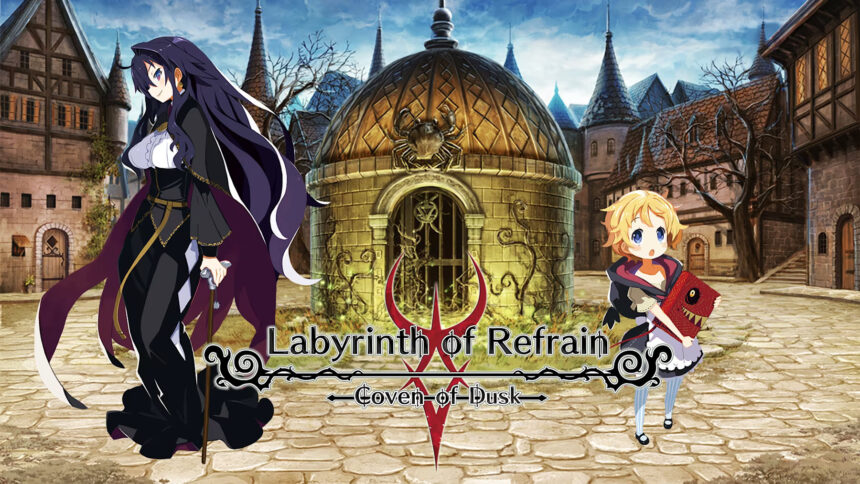
You’re not the hero of this story, and you’re not even human, because the first thing Labyrinth of Refrain: Coven of Dusk asks you to accept is that you’re a book, bound to a witch’s will and incapable of acting on anything you witness.
As the Tractatus de Monstrum, or Tractie for short, I exist purely to observe and record everything happening around me, never to act on my own initiative, bound to the will of Dronya, the self-proclaimed Dusk Witch, and her young apprentice Luca. Since the toxic miasma inside the labyrinth beneath the isolated town of Refrain kills any human who enters, Dronya commands an army of wooden puppet soldiers to do the actual exploring, directed by me through the dungeon while she and Luca chase rumors of untold treasure from the safety of the town above. That framing device is the single cleverest structural decision the game makes; because Tractie exists purely as a passive chronicler, the story can put its characters through genuine tragedy, cruelty, and moral compromise without the usual JRPG safety net of a heroic protagonist ready to step in and fix things. Watching Dronya and the wider cast make selfish, sometimes genuinely awful decisions, driven by pure avarice rather than any noble cause, gives this story a moral texture that a more conventional “chosen hero saves the world” framing simply couldn’t replicate.
That ambition comes with well-documented structural problems, though, and it’s worth being honest about them rather than glossing past. The narrative splits its attention between events happening down in the labyrinth and a separate, ongoing thread of vignettes unfolding up in Refrain itself, and I frequently felt like I was following two only partially related stories rather than one fully interwoven narrative. The overall pacing draws similar criticism; the plot moves slowly and somewhat unfocused for a substantial stretch of the game’s considerable runtime, testing my patience before character backstories and the larger mystery underneath Refrain’s labyrinth started clicking into place, generally somewhere around the halfway point. Once that shift happens, though, the emotional payoff by the game’s conclusion feels genuinely earned rather than manufactured, with earlier foreshadowing and scattered environmental lore paying off in ways that reward the patience the earlier hours demanded.
The comedic tone throughout is where my own reaction stayed the most mixed of any single element in the game. When the humor lands, it lands with real personality, sharp, irreverent, and clearly indebted to the same absurdist sensibility that made Nippon Ichi’s Disgaea series a cult favorite. When it doesn’t land, though, it lands badly; certain jokes and scenarios push well past dark comedy into material I’d call simply tasteless, and one particular early cutscene involving deeply uncomfortable subject matter between Dronya and another woman she meets stuck with me as a genuine low point regardless of how much I otherwise enjoyed the game. That’s a fair criticism worth taking seriously rather than dismissing as oversensitivity, and it colors the overall reception of a game that’s otherwise widely respected for its narrative ambition.
Mechanically, this is where Labyrinth of Refrain earns its most unreserved praise, and the scope of what’s on offer here is staggering for the genre. The signature Wall Breaker ability lets Tractie punch through an overwhelming majority of walls found throughout the labyrinth’s dungeons, turning traditional maze navigation into something considerably more freeform, opening up hidden paths and alternate routes that reward exploration well beyond what a standard grid-based dungeon crawler typically allows. The party-building system built around Covens, small teams of puppet soldiers bound together under specific magical pacts, offers an overwhelming degree of customization, up to forty individual party members across five coven slots, each built from scratch with adjustable class, gender, name, and growth curve, and each coven governed by different pacts offering different bonuses and costs. Character designer Takehito Harada’s art gives the whole cast a distinctive, Disgaea-adjacent visual identity, and composer Tenpei Sato’s score sets a steady, unobtrusive atmosphere for exploration without ever becoming a standout on its own. That depth is a genuine strength for dedicated genre fans looking for something to sink dozens of hours into, with completionist runs chasing every ending stretching well past fifty hours, but for more casual dungeon crawler fans, that same depth reads as overwhelming, requiring a solid hour or two of dedicated learning before the underlying systems click into place.
Repetition is the other consistent, fair critique I’d level against the gameplay loop. Because progress frequently requires exiting and re-entering the same dungeon sections multiple times, backtracking through already-explored territory becomes a recurring feature of the experience rather than an occasional inconvenience, and early-game difficulty spikes cost me real momentum more than once. That’s an access barrier worth flagging honestly; this is a game that asks for genuine patience and tolerance for old-school dungeon crawler difficulty before its stronger elements fully reveal themselves.
Full voice acting throughout, in both English and Japanese, adds weight to the game’s lengthy dialogue vignettes, and Luca’s performance in particular manages to stay endearing rather than grating despite how much screen time her energy demands.
Verdict
Labyrinth of Refrain: Coven of Dusk succeeds through sheer, uncompromising ambition, reworking the dungeon crawler genre around a passive, non-heroic protagonist to tell a story about greed and buried tragedy that few games in its space attempt, backed by a party customization system deep enough to swallow dozens, even hundreds, of hours for dedicated genre fans. Real structural problems hold it back from greatness, though: a disconnected dual narrative structure, a slow, unfocused first half, repetitive dungeon backtracking, and comedic material that crosses from dark humor into moments I’d call simply tasteless rather than edgy. This is a game that rewards patience and genuine investment in old-school dungeon crawler mechanics with a payoff that feels emotionally satisfying by its conclusion, but it demands real tolerance for its rougher edges to get there, and it won’t convert anyone who bounces off its opening hours or finds its humor more uncomfortable than clever.