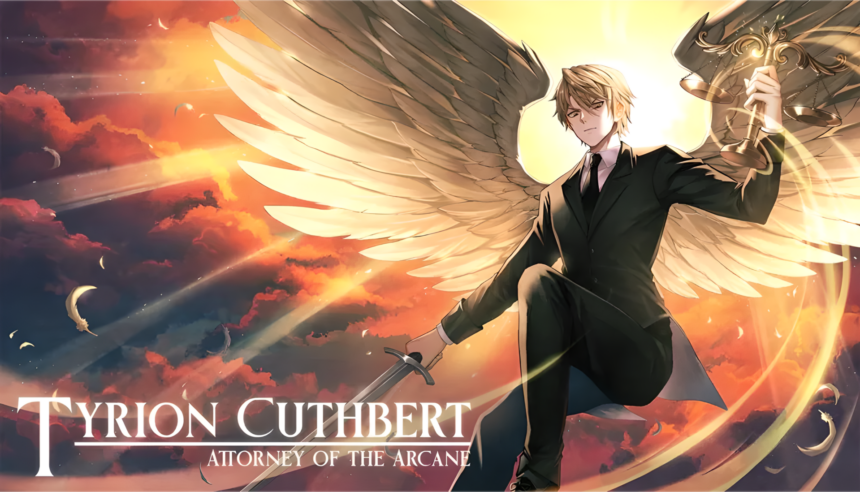
Some games hide their influences and hope nobody notices. Tyrion Cuthbert: Attorney of the Arcane puts its influence in the title practically and never once pretends otherwise. Developed by the small team at Diamondhenge Entertainment, this is, by its own creators’ clear design, an Ace Attorney clone dressed up in fantasy trappings, right down to a credits sequence that mirrors Capcom’s format beat for beat. What could easily have played as a shameless knockoff instead earned real, independent affection from me through thoughtful worldbuilding and a cast worth spending a dozen-plus hours with, proving that a familiar formula can still feel worthwhile in the right hands.
Set in the kingdom of Wyverngarde, where magic sits almost entirely in the hands of a ruling noble class and any accusation of illegal spellcasting gets processed with brutal efficiency by a fearsome inquisition, I played as Tyrion Cuthbert, apprentice to the seasoned defense attorney Ruby Tymora, taking my first case defending Celeste, the adopted daughter of a murdered innkeeper. From there, the structure runs almost exactly parallel to its inspiration, alternating between crime scene investigation and courtroom cross-examination, gathering evidence to poke holes in testimony and expose contradictions in an increasingly tangled series of magical murders.
What separates this from a shallow reskin is how seriously the game takes its own internal magic system. Rather than treating spells as vague, undefined plot conveniences, Wyverngarde’s magic operates according to strict, consistent rules the story expects you to actually learn and apply, turning “Spells” into their own evidence category alongside physical clues and witness testimony. That structural rigor gave the mysteries real teeth for me; figuring out how a specific spell’s documented limitations contradict a witness’s account became just as central to solving a case as spotting an inconsistency in spoken testimony, and the layered class tension between commoners, unregistered mages, and the nobility who monopolize legal magic gave the setting real texture beyond a simple coat of fantasy paint. The soundtrack backed that atmosphere well throughout, a thirty-five-track score mixing orchestral strings, jazz, and symphonic metal that gave each courtroom confrontation a distinct musical identity rather than one repeated theme.
The courtroom confrontations depart from a straight Ace Attorney template in ways that left me with mixed but generally positive reactions. Rather than a single consistent method for cross-examining witnesses, arguments shift approach case by case, sometimes hinging on reading a witness’s underlying emotional state, sometimes on separating what they say from what they actually think or feel, sometimes on straightforward evidence presentation. That variety kept the format from ever feeling too predictable for me, though it came at the cost of a clearly defined, consistent system; I noticed the lack of a unified through-line to these confrontations myself, with the specific mechanic in play changing enough from case to case that it felt more improvised than intentionally designed at points.
Character work stood out as one of the clearest strengths of the whole game for me, with distinctive, visually memorable designs and a central Tyrion-Celeste dynamic that earned real, unforced romantic tension without leaning on lazy gender-role gags to get there. That said, the game’s five-case structure struggles with something Ace Attorney’s tighter, more disciplined writing generally avoids: side characters introduced with real apparent significance to Tyrion’s personal history sometimes vanish after their featured case without meaningful follow-up, leaving loose threads that a genre this reliant on connective character arcs generally doesn’t leave dangling. The back half of the game, particularly the transition from the fourth into the fifth and final case, tightens considerably, delivering the strongest, most cohesive material in the entire game and building toward a well-constructed finale.
That finale draws real, substantive criticism on thematic grounds worth taking seriously. The story spends considerable time positioning itself as a critique of systemic corruption and class-based injustice within Wyverngarde’s legal system, only for its central villain, and the story’s ultimate resolution, to sidestep meaningfully engaging with those themes in favor of a more conventional legal-technicality victory that leaves the underlying systemic issues largely unaddressed by the epilogue. It’s a real, thoughtful critique rather than a nitpick, and one that speaks to real ambition in the writing outpacing its ultimate follow-through.
Technical rough edges do crop up here and there. The game uses short, signature “Objection”-style voice clips rather than full dialogue voice acting, and the audio balance on those clips ran uneven for me at points, alongside minor UI stumbles and occasional softlocks the developer has continued patching post-launch, small issues individually but frequent enough across my playthrough to be worth flagging honestly for a game this consciously built around a beloved, mechanically precise genre predecessor.
Verdict
Tyrion Cuthbert: Attorney of the Arcane wears its Ace Attorney inspiration proudly rather than apologetically, and mostly earns the comparison through a well-realized fantasy legal system, a charming central duo, and a back half that builds to a satisfying mechanical conclusion. Its handling of the systemic themes it spends so much time raising falls short of its own ambition, and some side characters and plot threads get dropped without real follow-through. Minor technical rough edges and an inconsistent confrontation format keep this from matching its inspiration’s polish, but for readers hungry for more of that specific genre after exhausting the games that popularized it, this remains a worthwhile, distinctive entry.