Two of the most acclaimed minds in murder mystery visual novels finally working on the same project sounds like exactly the kind of pitch that could collapse under its own hype, the way a long awaited collaborative album from two artists with wildly different styles sometimes does. The Hundred Line -Last Defense Academy- spends its opening hours daring you to worry about that collapse anyway. Kazutaka Kodaka, creator of Danganronpa, and Kotaro Uchikoshi, the mind behind Zero Escape, are exactly that pairing, and what starts as a fairly familiar high school kids thrown into danger premise gradually reveals itself to be something stranger, more ambitious, and more emotionally demanding than either creator’s individual back catalog suggests it has any business being.
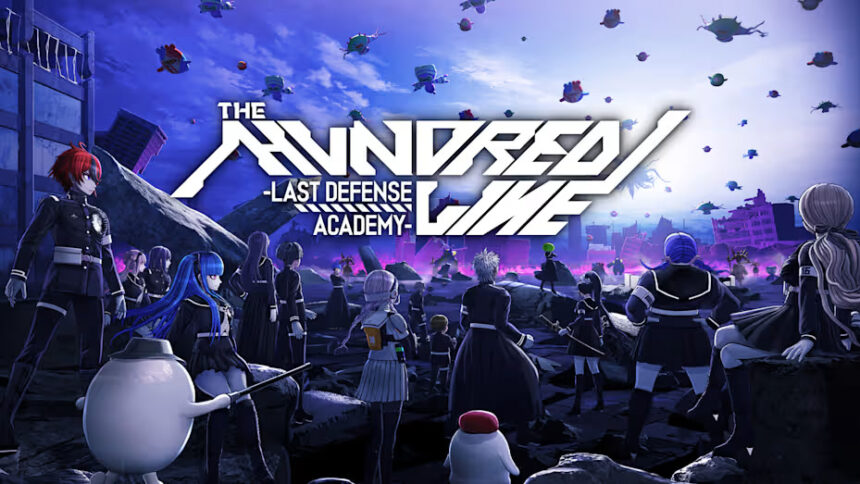
Takumi Sumino lives an unremarkable life inside the Tokyo Residential Complex, an underground shelter city, until an attack by strange invading creatures pulls him into contact with a mascot like entity calling itself Sirei. Sirei grants him a power called hemoanima, activated by stabbing himself with a special blade, then transfers him to the Last Defense Academy, a school surrounded by a wall of otherworldly violet flame. Fifteen students, Takumi included, get drafted into a Special Defense Unit tasked with protecting the school for exactly one hundred days against the invaders and their leader, V’ehxness. Fifteen is a specific number worth noting too, since a cast that size gives the writing room to let personalities clash and cohere across a runtime this long without leaning on a handful of leads to carry the whole thing.
Rui Komatsuzaki, the character designer behind Danganronpa, returns here alongside enemy designer Shimadoriru, who handles the invaders specifically. Komatsuzaki’s character sprites carry a huge range of expressions, more than his earlier Danganronpa work required, since Hundred Line lets sprites shift expression dynamically during exploration rather than relying on fixed portraits. Komatsuzaki has said his workflow started with a full cast draft before fine tuning individual designs for balance, the same process he used on earlier projects, adapted here for a much larger ensemble. The game backs that up with an enormous CG count, close to 600 distinct illustrations by some counts, alongside dozens of fully animated 3D cutscenes. That gives key story beats real visual weight on top of the text carrying them.
That hundred day countdown gives the whole game its structural backbone, but treating this as a straightforward tower defense story sells short just how many detours, betrayals, and genre bending swerves the plot takes along the way. Reaching day one hundred, somewhere around forty hours in for me, reveals that everything up to that point was really just a prologue, opening onto a sprawling web of more than twenty branching routes on top of it. That reveal reframes everything that came before it, turning what felt like the whole game into scaffolding for something considerably larger still ahead.
Kazutaka Kodaka penned the central “true” scenario, while Kotaro Uchikoshi designed the surrounding branch structure that spins out from it. Kodaka’s original demand wasn’t just for a hundred endings. It was that every single one of them be substantial and meaningful rather than a copy pasted variation. The ambition behind that mandate shows, for better and occasionally for worse. Not every one of those hundred routes comes from Kodaka or Uchikoshi directly either. A wider writing team contributed several of the branches, and some of the strongest material in the whole game comes from those less famous names rather than either director’s own pen. That structure, one true scenario surrounded by dozens of alternate paths, mirrors the kind of branching Uchikoshi built his own reputation on, transplanted into a setting closer to Kodaka’s usual register.
The opening stretch asks for real patience. I found it the single most consistent friction point across my entire time with the game. Several early characters lean hard into grating, exaggerated archetypes before the writing gives them room to develop past their surface level introductions, and the pacing during quieter, connective days can lull in ways that test commitment before the plot’s larger mysteries fully kick into gear. That friction shows up most in how quickly the story asks a reader to invest in fifteen distinct personalities before most of them have earned that investment.
That patience gets rewarded considerably once the cast grows into itself. Watching this eclectic, initially abrasive group develop real chemistry and depth across dozens of hours becomes one of the game’s clearest strengths, and the sheer scale of the story gives even minor characters room to shine, or spectacularly fall apart, in ways a tighter, more conventional narrative simply couldn’t accommodate. Even characters I found actively annoying during the opening stretch eventually earned real investment from me once the story gave them enough room to actually breathe.
Splitting writing duties across more than twenty distinct routes inevitably produces real unevenness. Quality varies noticeably between paths, certain characters read slightly differently depending on which route I was currently following, and some branches forget or contradict details established elsewhere in ways that occasionally undercut the sense of a fully unified whole. One route in particular reads to me like an intentional final capstone that raises more new questions than it resolves, the kind of deliberate setup that feels built for future downloadable content rather than a satisfying stopping point on its own. None of that derails the experience overall, but it does mean the sheer density of content, a real selling point on its own, comes with real quality control costs baked in.
The tactical RPG combat layered underneath all that narrative ambition holds up as a satisfying system in its own right rather than a simple obligation between story beats. Defending a central target, a shield generator or an injured ally depending on the scenario, rewards careful positioning and prioritizing high value targets over grinding through fodder. Attacks build Voltage, a resource that unlocks powerful special attacks. Voltage can also come from an ally going down mid fight, since the Academy’s own technology resurrects every student after each battle regardless of outcome. That resurrection mechanic opens up real tactical range, letting a wounded ally throw everything into one last powerful attack rather than playing purely defensively once their health runs low. None of that demands the kind of granular optimization that turns off more casual strategy fans either, which keeps the tactical layer approachable without feeling shallow.
Composer Masafumi Takada, another Danganronpa veteran and a Too Kyo Games co-founder in his own right, delivers a score that shifts fluidly between eerie unease and driving battle intensity as the situation demands. Some individual tracks land close enough to his earlier Danganronpa work that longtime fans will recognize the register immediately, though the best material here stands on its own rather than reading as pure recycling.
English voice acting comes from London based studio Outsource Media, with Jay Rincon voicing Takumi, Andrew Wheildon-Dennis as Takemaru, Nezar Alderazi as Eito, Leader Looi as Nozomi, and Joseph May as Sirei. Performances land inconsistently across a cast this large, but the standouts carry real range given how much tonal whiplash the script asks of them. Dialogue isn’t fully voiced throughout either, which limits how much time I actually spent hearing any single character’s voice across a script this massive, especially outside key story beats. That gap in voice coverage matters less than it might in a shorter game, since so much of Hundred Line’s runtime rests on text and choice rather than performance regardless.
Too Kyo Games, founded in 2017 by Kodaka, Uchikoshi, Takada, and Komatsuzaki together, went into real debt during Hundred Line’s development, eventually taking out a loan to keep the project funded through to release. The writing team wasn’t even fully staffed until Uchikoshi and Kodaka hired additional writers as late as September 2023, well into a project this scope. Development stretched back to 2018, when Too Kyo Games first announced the project under a different working title, meaning the finished release capped off nearly seven years of work before it actually reached players. That gamble paid off commercially at least. The Hundred Line -Last Defense Academy- released on April 24, 2025, for Nintendo Switch and Windows through publisher Aniplex, and became the best selling new Switch release in Japan during its launch window.
Verdict
The Hundred Line -Last Defense Academy- carves out a distinct identity from both of its creators’ most beloved work while still earning the comparisons, delivering a sprawling, emotionally ambitious story backed by tactical combat that’s satisfying enough to stand on its own merits. A slow, occasionally grating opening stretch and real inconsistency across its more than twenty branching routes keep it from feeling fully polished throughout, and the sheer scale of the project means not every one of its hundred endings lands with equal weight. For readers and strategy fans willing to commit real time to it, though, few recent releases in either genre attempt anything close to this level of ambition, and even fewer manage to pull off nearly as much of it. Too Kyo Games took on real financial risk to get here, and the finished game mostly justifies that gamble.