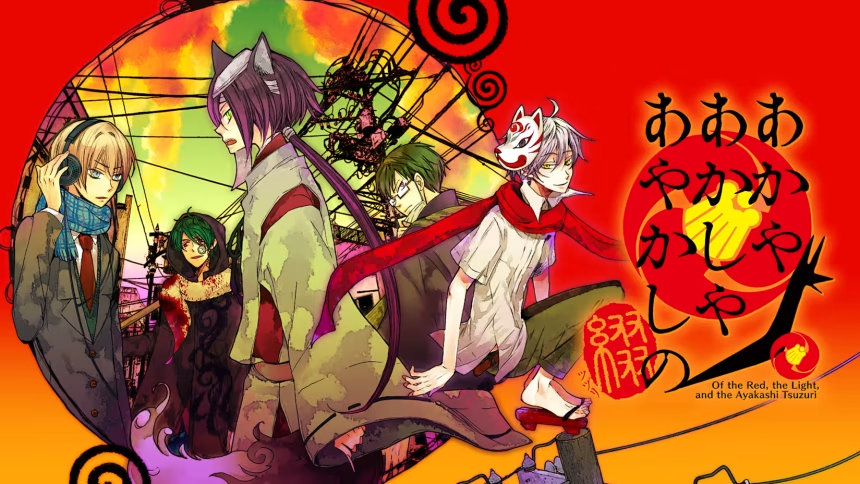
Reading Lafcadio Hearn’s old collection of Japanese ghost stories taught me that the best folklore doesn’t always resolve into a tidy moral, some tales just trail off once they’ve made their point. Of the Red, the Light, and the Ayakashi Tsuzuri reads like that same kind of collection stretched into a single continuous story, and it commits to that shape more fully than almost any other supernatural visual novel I’ve spent time with. Yue, a boy raised his entire life within the walls of a mountain shrine on the outskirts of Utsuwa, gets his first real exposure to the outside world during a winter festival, and the ripples from that single night carry the whole story. The doujin circle HaccaWorks*, five creators working together on this as their second release, put the original out in Japan back in 2011 before a fuller PSP revision added full voice acting, a prequel, and a new ending; Dramatic Create later brought that expanded version west.
What sets this apart almost immediately from typical genre expectations is the complete absence of romance anywhere in the story. Given the heavily male cast and Yue’s growing closeness with the two boys he meets at the festival, Togo and Akiyoshi, it would be easy to assume this is a stealth boys’ love title dressed up in supernatural trappings. It isn’t. What’s here instead sits closer to shounen-ai in spirit without ever crossing into actual romantic territory, an earnest, sometimes awkward friendship between three boys navigating secrets none of them fully understand yet, and that friendship carries specific warmth even without any romantic payoff attached to it.
Yue himself makes for an unusual lead. Low-energy almost to a fault, more interested in napping or eating than in urgently pursuing answers, his passivity initially reads as a strange choice for a protagonist carrying this much narrative weight. That passivity does real thematic work, though; it reinforces just how sheltered and disconnected from ordinary human concerns Yue actually is, someone raised entirely within a shrine’s boundaries encountering basic aspects of the outside world for the first time. Watching him slowly wake up to both the wider world and the truth about his own nature gave the story a dreamlike quality that reminded me of picking through an old folk tale rather than following a conventionally structured plot.
Presentation is where this game commits fully to that same unsettled quality. Rather than settling into a single consistent visual style, it shifts between shadow work, watercolor, and paper-puppet-theater-inspired UI design, giving Utsuwa a constantly unsettled, slightly uncanny visual identity that never lets me get too comfortable with what the game is going to look like from scene to scene. Character designs carry a lanky, hand-sketched quality, and the full Japanese voice cast, including Kei Shindo as Kurogitsune and Takahiro Sakurai as Akiyoshi, adds texture to even the quieter, more meandering stretches. A small interactive map letting Yue move between shrine grounds and various Utsuwa locations gives the exploration some light mechanical texture too, even if figuring out which locations unlock which specific interactions takes a bit of trial and error at the start.
That dreamlike quality cuts both ways, and it’s worth being honest about the cost of the approach. Important plot threads get dropped without warning, only to resurface much later once a more dramatic moment calls for them, and the pacing regularly interrupts itself with Yue simply needing a nap or a snack right when tension seems to be building. That’s clearly a deliberate stylistic choice reinforcing the story’s folklore-adjacent tone, but it also makes the plot difficult to follow at points, and the thread involving Togo’s family history in particular gets set up with real significance early on only to go largely unexplored by the time the credits roll. Individual character routes vary in strength as a direct consequence; Kurogitsune’s and Sagano’s paths land with considerably more emotional weight and clearer resolution than Togo’s or Akiyoshi’s, whose family backgrounds and connections to the wider ayakashi mythology deserved more room than a single route could give them.
Verdict
Of the Red, the Light, and the Ayakashi Tsuzuri succeeds by committing fully to a dreamlike, folklore-inspired atmosphere rather than a conventionally paced plot, using Yue’s own passivity and sheltered worldview to give the whole story a distinctive, unsettled tone that few other supernatural visual novels attempt. Its refusal to include romance despite an almost entirely male cast is a deliberate, welcome choice that lets its central friendships breathe on their own terms, even as important plot threads get dropped and picked back up in ways that make the overall story hard to follow at points. Individual routes vary considerably in how satisfyingly they resolve, with Togo’s and Akiyoshi’s family mysteries left frustratingly underexplored compared to the stronger material elsewhere. For readers drawn to atmospheric, slow-burn fantasy that prioritizes mood and friendship over tight plotting, this remains a distinctive, memorable read.