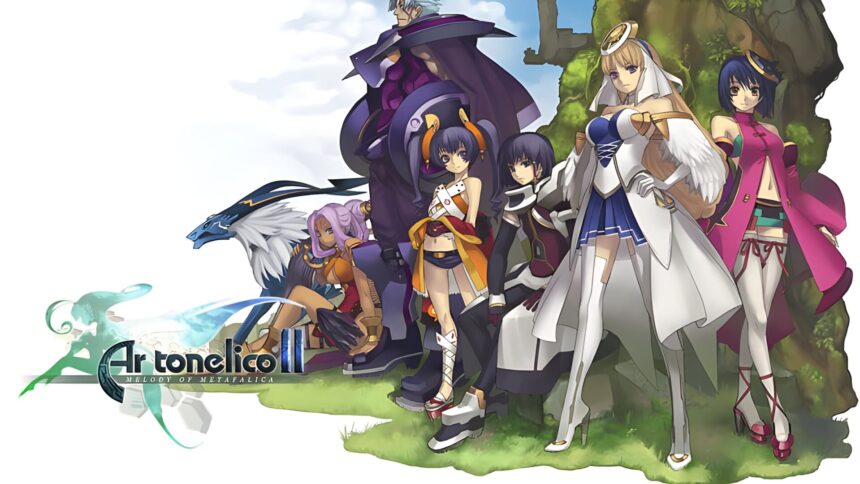
Somewhere around hour thirty, I realized the Reyvateil I hadn’t chosen was never going to get the ending she deserved, and that regret followed me for the rest of my time with Ar tonelico II: Melody of Metafalica. This sequel keeps the original’s signature Dive system, letting the player descend into the literal subconscious of a Reyvateil, a magical, song-powered being bonded to the protagonist, and explore her memories, fears, and hidden desires across multiple layered stages, each one rendered as its own fully realized micro-story with distinct art, personality shifts, and emotional stakes. It’s less a bonus feature bolted onto a JRPG and more an entire visual novel stacked inside a role-playing game, and that idea alone kept me hooked long after the battle system stopped surprising me.
Croix Bartel, a young knight tasked with protecting the Reyvateil maidens Luca and Cloche, finds himself thrown into a story about warring ideologies, corrupted magic, and the looming threat of Metafalica, a mythical land promised by ancient song. That plot, when the game commits to it fully, digs into real political and philosophical territory, questioning what genuine happiness actually costs and who gets to decide it on someone else’s behalf, and the game’s late-game Cosmosphere sequences, forcing my two central Reyvateils to confront each other’s buried resentment and trauma directly, delivered some of the most intense, uncomfortable, well-constructed character writing I’ve read from this genre. This isn’t subtle material, and the game doesn’t pretend otherwise. Entire Cosmosphere levels descend into legitimate psychological horror, characters turning cruel, manipulative, or self-destructive in ways that recontextualized everything I thought I understood about them.
The structural decision underpinning all of that ambition is also where the game draws its most consistent, deserved criticism, and it’s the choice I opened with. You can only fully explore one Reyvateil’s deepest Cosmosphere layers per playthrough, locked behind an early romantic choice between Luca and Cloche that the game frames as a genuine either-or rather than something you can revisit without starting over. Whichever maiden you don’t choose gets a shallower, less satisfying arc by comparison, capped early regardless of how much time you’ve already invested in her, and I felt that exclusivity actively working against the emotional investment the Cosmosphere system otherwise does such a good job building. It’s a real structural tension: the game wants you to deeply care about both women, then punishes you for it by forcing a hard cutoff that leaves one of them permanently underdeveloped unless you commit to a full second sixty-hour playthrough.
The wider cast draws real, divided reactions from me too. Some of the game’s supporting Reyvateils earned consistent praise from me for genuinely engaging arcs, while Luca and Cloche themselves, the two central figures the whole story revolves around, split my own reaction sharply depending on the scene; there were long stretches in the later chapters where I found both women more grating than sympathetic, which feels worth admitting honestly against the game’s broader reputation for strong character writing. Battle design carries its own frustrations too, with a small handful of story-mandated fights that are simply unwinnable regardless of preparation or skill, offering no in-game explanation for why my vastly overpowered party suddenly couldn’t land a scratch, a design choice that reads as narratively lazy rather than intentionally humbling.
Presentation holds up well across the board, with charming, expressive 2D character portraits and sprite work that age better than the murkier, harder-to-parse 3D world map surrounding them. The soundtrack draws close to universal acclaim, particularly the layered, evolving vocal themes tied to each Reyvateil’s song magic, and I’d put it among the strongest scores the JRPG genre produced in this era. This North American localization carries its own separate, well-documented baggage worth flagging honestly. NIS America’s English release became notorious in its own right for translation liberties and altered content, including cut voiced dialogue trimmed to fit both English and Japanese audio tracks on a single disc and a scripted late-game boss fight that could freeze the console outright due to a bug introduced during localization. A dedicated fan relocalization project eventually released a full patch addressing many of these issues in 2016, but the official 2009 PS2 release remains, as of this writing, the only version NIS America ever put out, with no modern remaster or port to speak of.
Verdict
Ar tonelico II: Melody of Metafalica remains a genuinely singular JRPG experience, using its Cosmosphere system to deliver character writing with a depth and psychological intensity the genre rarely attempts, even as its rigid romantic exclusivity, a handful of unwinnable mandatory battles, and a contentious Western localization keep it from being a clean recommendation. Luca and Cloche’s central conflict won’t land for every player the same way, and choosing between them means genuinely losing content rather than simply picking a preference. For JRPG fans willing to accept those real structural costs, though, this delivers one of the most ambitious, emotionally demanding takes on character-driven storytelling the genre has ever produced.