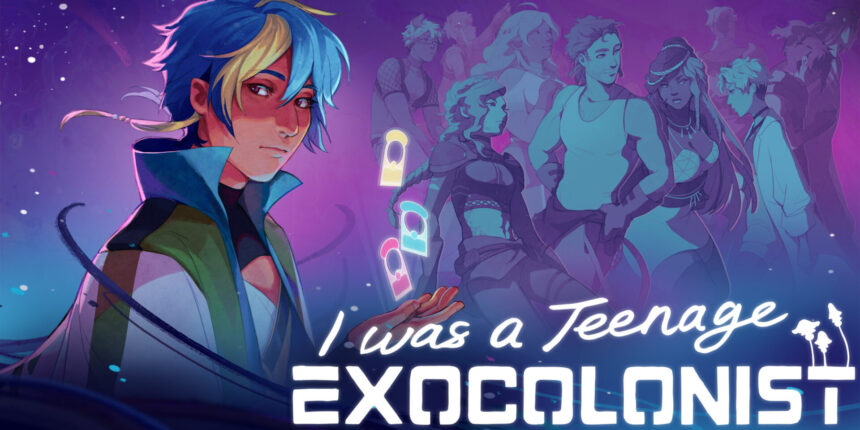
Three genres shouldn’t fit together this cleanly, and yet I Was a Teenage Exocolonist keeps its visual novel storytelling, life-sim structure, and card-battling RPG mechanics working toward the same goal for the entire ten years the story covers. Northway Games built this, Finji published it, and the premise drops player character Sol onto the alien planet Vertumna at exactly ten years old, the first generation born after twenty years spent aboard a colony ship living on recycled soy rations. From there the game asks you to live through the next decade month by month, season by season, until Sol turns twenty, and by the time I reached that ending I understood why this design keeps getting singled out as something rarer than the sum of its parts.
Sol actually being a child at the start, rather than a child in name only, is the detail that stuck with me first. Early activities revolve around genuinely childhood things, exploring, playing, tagging along after older colonists, and the character sprites change twice over the course of the story, once around puberty and again near sixteen, so the years actually show on Sol’s face rather than sitting quietly behind a stat sheet. Watching the other colonist kids grow up alongside Sol, forming and breaking friendships, catching feelings, drifting apart and sometimes finding their way back, gave the whole decade a sense of lived time that most life-sim structures never commit to this seriously.
The card system underneath nearly every activity earns real credit for staying out of its own way. Building a deck out of Sol’s accumulated memories, actual playable cards representing specific past events, and drawing from that deck whenever a month’s challenge shows up ties the mechanics directly into the story’s own preoccupation with how memory shapes who a person becomes. Losing a hand doesn’t function as a dead end either, it usually just redirects the story down a different but still meaningful path, and the option to swap the whole system for a simple coin flip means anyone here purely for the story never has to touch deck-building if they don’t want to.
Character writing is where this game does its heaviest lifting, and reading through Sol’s relationships made that obvious fast. Every colonist carries motivations and relationships that keep moving whether Sol is around to see them or not, and the writing never smooths over anyone’s rough edges to make them safely likable. I fell for a character whose worldview turned out to be more troubled than I expected going in, and finding real dialogue paths that let Sol push back, challenge, and slowly soften someone’s harder instincts rather than just accept them gave the whole colony a messiness that a tidier approach would have flattened out completely.
Replayability here goes further than most games attempt. Twenty-nine distinct endings exist, and because so much of the story carries forward specific choices, relationships, and knowledge from earlier runs, a second or third playthrough turns up entirely different content, characters who lived this time, career paths that never had room to open up before, rather than just reshuffling the same handful of scenes. I put well over eighty hours into this and kept finding dialogue I hadn’t seen, which is a rare thing for any game built around replaying the same ten years over and over.
Where the story stumbles is in how its consequences actually land. This game is willing to depict real tragedy, colonists dying, the colony itself facing existential threats, but danger tends to resolve more cleanly than the stakes it builds up would suggest it should, and I noticed that gap pulling some of the tension out of crises that deserved to sit heavier. It’s a fair complaint about a story that otherwise commits fully to difficult material everywhere else.
Verdict
I Was a Teenage Exocolonist succeeds by refusing to simplify what growing up actually looks like, using a card system that reinforces its own themes about memory and identity while building a cast of colonists whose lives extend well past their function as romance options. Its handling of heavy subject matter is thoughtful and clearly signposted, giving players real control over what they run into, even when some threats resolve more easily than the stakes surrounding them suggest they should. For anyone who wants character-driven storytelling built for repeat playthroughs and willing to sit with real emotional weight, this stands as one of the most fully realized coming-of-age stories the medium has produced.