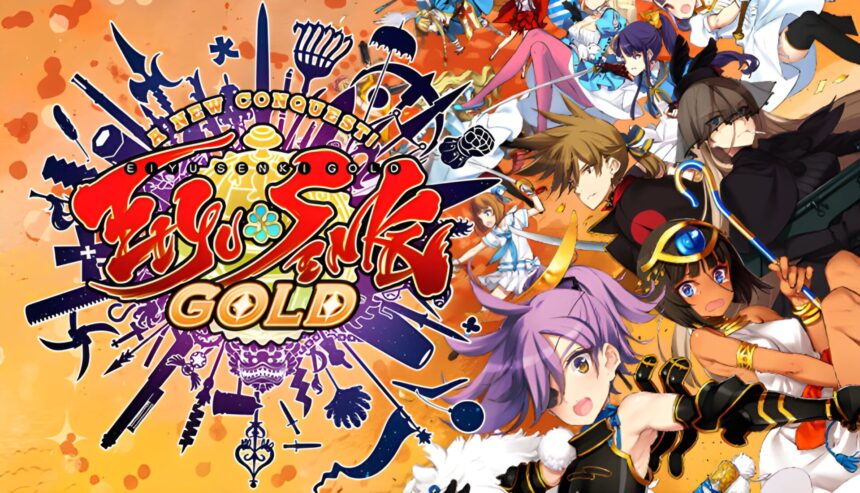
Let’s get one thing out of the way first: there’s no need to worry about whether seventy-plus historical and mythological figures, reimagined as gender-swapped anime heroines and thrown into one collective army, will actually hold together as characters worth caring about rather than a gimmick that runs out of steam by hour three. They do, and the game knows exactly how to keep that joke funny for the entire runtime rather than letting it curdle.
Eiyu Senki Gold – A New Conquest never pretends to be anything more ambitious than that premise suggests. Developed by Tenco and localized by JAST USA for a February 2021 release, with an 18+ PC edition alongside an all-ages version on Steam, this standalone follow-up to Eiyu Senki – The World Conquest drops an amnesiac protagonist onto the shores of the isolationist island nation of Zipang, where he gets adopted as an honorary sibling by a genderbent version of the historical warlord Date Masamune and promptly pointed toward a goal of conquering the entire globe. No prior knowledge of the first game is required going in, and the narrative justification for any of this stays deliberately thin throughout, functioning as connective tissue between character introductions and battles rather than a story built to be taken seriously on its own terms.
That thinness is by design rather than a shortcoming worth dwelling on. What actually anchors the experience is the sheer scale and personality of its cast, spanning wildly different historical eras, cultures, and fields of accomplishment, from Napoleon and King Arthur to Da Vinci, Achilles, and Beethoven, each rendered with detailed, colorful character art from Ashito Oyari and distinct comedic personalities. Watching legendary figures interact in deliberately anachronistic, irreverent ways generates real, consistent comedic value, and the writing leans fully into that irreverence rather than trying to smuggle in unearned gravitas. Individual character vignettes play historical and mythological reputation against exaggerated, often silly modern personality quirks for a steady stream of light entertainment that rarely runs dry.
The turn-based strategy layer underpinning all that character collection provides a structural backbone without demanding much genuine tactical depth. Battles unfold on a compact 6×3 grid, deploying up to six recruited heroes at a time, and while the system offers real, if lightweight, engagement through funding troop replenishment and boosting stats between fights, the overall difficulty stays low enough on standard settings that repeatedly using strong skills carries most encounters without much need for careful planning. That accessibility works in the game’s favor for a project this openly focused on character collection over combat challenge. The strategy layer exists to give structure and pacing to recruitment rather than to test genuine tactical skill, and it succeeds well enough at that specific job even if it won’t satisfy anyone chasing a deep, demanding SRPG.
Full Japanese voice acting runs throughout, drawing on a large cast of actresses to cover the sheer size of the roster, and subtitles carry every line, including battle commentary, so nothing gets lost for readers who don’t follow spoken Japanese. That commitment to voicing dozens upon dozens of distinct characters gives even minor recruits a stronger sense of personality than the writing alone would manage on its own.
Where the experience shows real, tangible growing pains is in its production polish. The English localization carries a meaningful number of typos and grammatical rough edges throughout, frequent enough to be a consistent, noticeable presence across a script and character roster this large, even accounting for post-launch patches addressing some of the worst offenders. World map visuals and in-battle sprites also lag noticeably behind the quality of the character portraits and CGs, functional rather than particularly polished, a gap that becomes more apparent given how much time gets spent navigating those less refined elements between the stronger character scenes.
Content density and pacing around the game’s illustrated highlights draws a fair, specific criticism too. Despite the game boasting a genuinely large number of illustrated character scenes across its full roster, individual playthrough stretches can go for dozens of hours without encountering a new one, an uneven distribution that makes those visual highlights feel sparser in practice than the raw count would suggest. The soundtrack fares considerably better as a consistent strength, offering distinct regional and situational themes across the game’s various conquered territories that add real personality to what would otherwise be a fairly repetitive string of battles.
Overall length runs substantial by any measure, with a full first playthrough stretching somewhere in the neighborhood of sixty hours, and additional New Game Plus incentives on higher difficulties extending that considerably further for anyone chasing full character and event completion. That scope, combined with the sheer size of the collectible cast, gives the game real staying power for anyone who enjoys its specific brand of lighthearted, character-focused conquest fantasy, even as the core gameplay loop itself stays fairly repetitive across such a long runtime.
Recruiting a favorite historical figure for the first time and watching their introductory scene play the gap between legendary reputation and modern-day personality for a genuine laugh does more to sell this game’s whole appeal than any amount of battle mechanics ever could, and that specific pleasure repeats often enough across seventy-plus characters to carry the whole runtime.
Verdict
Eiyu Senki Gold – A New Conquest succeeds entirely on the strength of its enormous, colorful cast and its willingness to treat its own premise with total comedic irreverence rather than any pretense of narrative ambition, backed by an accessible strategy layer that prioritizes character collection over tactical depth. A rough localization, visually uneven presentation outside its strongest character art, and a runtime that stretches its content thinner than its raw scope suggests hold back a fully polished experience. For anyone drawn specifically to lighthearted, character-collection-driven strategy games unbothered by a paper-thin plot, this delivers a substantial, genuinely entertaining package built almost entirely around the charm of its cast.