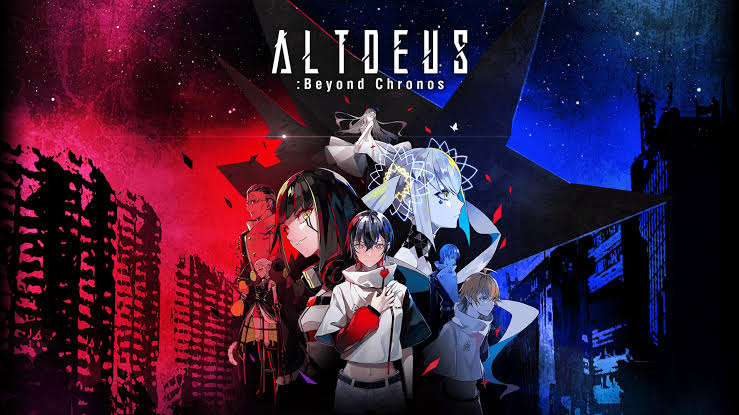
MyDearest, that’s the name of the developer by the way, who brought elevated VR immersion to Tokyo Chronos as their first attempt at proving visual novels could work outside a flat screen, is back with the studio’s next VR-exclusive experiment as developer and publisher of ALTDEUS: Beyond Chronos. Despite spending its opening hours on a patient, deliberately withholding mystery structure and short-sheeting its lead character’s personality a bit in the process, ALTDEUS is genuinely engaging once it opens up, working best as a slow-burn character study wrapped around a full-scale mecha war. It may not feel like a traditional visual novel experience at first, given how much of it happens standing up with a headset strapped on, but it does occasionally feel like a proper anime series compressed into interactive form, complete with idol concerts and giant robots, and that’s not a bad thing.
Two hundred years after mysterious alien creatures called the Meteora drove humanity underground, Tokyo has become a sprawling subterranean bunker city held together by digital projections standing in for a natural world that no longer exists on the surface. Lieutenant Chloe pilots one of the massive Makhia mechs defending what’s left of humanity, and the story opens in the immediate aftermath of losing her closest friend Coco, killed and devoured by a Meteora during combat, a loss that’s already reshaped Chloe into someone running almost entirely on vengeance by the time the game hands control over to me.
This entire project builds itself around a genre-defining question worth stating plainly: can a story format built almost around reading and listening actually justify strapping on a headset to experience it. The answer lands somewhere between yes and not entirely, and the shape of that answer changes considerably depending on which stretch of the story is currently unfolding.
The opening route moves through roughly three to four hours establishing the setting’s rules and its central cast with minimal actual characterization behind any of them. Chloe reads as guarded to the point of blankness, flashback scenes with Coco carry a wistful tone without much specific personality attached, and the wider supporting cast, a mad scientist ally, a partner pilot, assorted side characters, largely exist as functional placeholders during this stretch rather than fully formed people. That opening asks for real patience, and it’s a genuine structural risk for a game this dependent on emotional investment to land its bigger moments later.
Everything shifts considerably once subsequent routes and playthroughs kick in. The narrative structure here isn’t linear in the conventional sense. Branching choices lead toward different outcomes across multiple runs, and it’s specifically through those later branches, revisiting earlier scenes with new context and unlocking previously withheld character development, that the cast finally gains the depth the opening hours withhold. Once that development kicks in, momentum builds considerably, and what initially reads as a hollow sci-fi mecha premise reveals itself to be an engaging character study wrapped around themes of identity, loss, and what it actually means to be human when large parts of a person’s existence were deliberately engineered rather than chosen. A mechanism tied to reincarnation and multiverse logic ties the branching structure directly into the story’s own themes, giving the format’s inherent replayability real narrative justification rather than functioning as a simple gameplay convenience.
Chloe herself carries the whole experience once she’s finally allowed to, moving from that guarded blankness into someone genuinely worth following as her grief gets complicated by new information she can’t easily process. Noa, the AI companion built in Coco’s image who provides battle support from inside the cockpit, ends up being the strongest supporting presence in the cast by a wide margin, an artificial intelligence chasing something closer to humanity even as doing so would make her worse at her actual job, and that particular tension gives her far more depth than her pop-idol side gig might initially suggest. The rest of the roster, a mad scientist figure among them, mostly stays functional rather than memorable, present to move plot forward rather than to earn real investment on their own terms.
Interactivity throughout stays deliberately minimal, and that’s worth understanding clearly before diving in. Movement between locations happens through selecting hotspots rather than any kind of free exploration, environments transition through simple fades rather than continuous traversal, and even the signature mech combat sequences function closer to elaborate quick time events, aiming and firing through VR motion controls, than anything resembling a genuine action game. Some environments render with real detail and atmosphere. Others feel flat and underdesigned, particularly stretches meant to represent the underground city’s more mundane daily spaces, which can undercut the sense of scale the story’s stakes are reaching for.
Music and combat spectacle earn the most consistent, unqualified praise here. The mecha battle sequences carry real weight through sound design and visual scale, giving VR headset wearers a genuine sense of piloting something massive and dangerous, and musical sequences built around Noa performing concerts for the underground population stand out as some of the most memorable individual moments in the entire experience, blending idol-performance spectacle with the story’s central emotional throughline in a way that elevates a fairly familiar mecha-anime premise into something with real identity of its own.
Voice acting draws more mixed reception depending on language chosen. The Japanese performances carry real conviction throughout, while the English dub, included as a genuine rarity for a VR visual novel at the time of release, reads as comparatively flat and occasionally mismatched against its Japanese counterpart in emotional tone. Full playthrough length runs somewhere in the fifteen to twenty hour range depending on how many branches get chased down, and that runtime butts up against a practical reality of VR as a medium: extended headset sessions built around dense reading material grow physically tiring in ways a traditional screen-based visual novel simply doesn’t, regardless of which specific headset gets used.
Watching Noa work through what becoming more human would actually cost her, set against everything Chloe is simultaneously unpacking about Coco, gives the back half of this story an emotional throughline that the flat, guarded opening hours never once hint is coming.
Verdict
ALTDEUS: Beyond Chronos makes one of the strongest cases yet for visual novels as a legitimate VR genre, using elevated immersion and minimal interactivity to deliver a mecha-anime story that earns real emotional investment once its patient, initially hollow opening gives way to genuinely engaging character development across multiple branching playthroughs. Flat early characterization, uneven environmental design, and the real physical toll of long VR sessions keep this from being a flawless showcase.