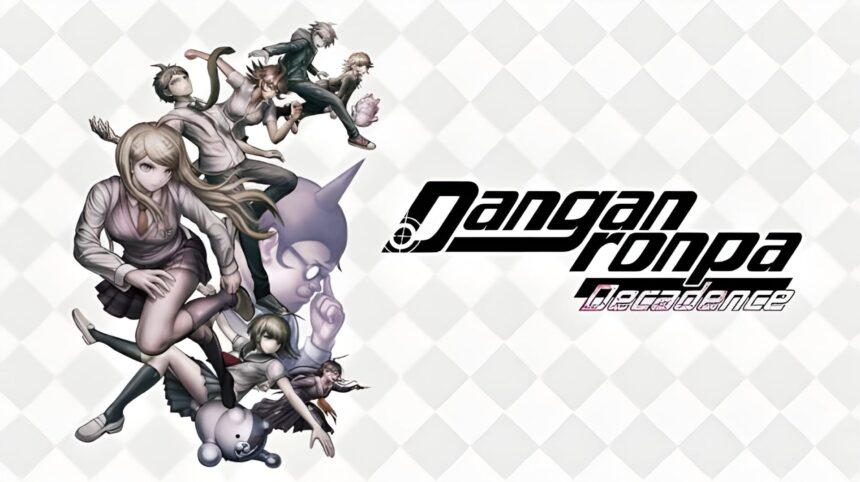
Danganronpa is back on Switch, and for the first time, it brought its entire mainline trilogy under one roof with it. So in that sense, Danganronpa Decadence is a welcome way to finally experience this series’ best highs in one place. But for as much unfiltered momentum comes from playing three killing games back to back, can the bundled extras included alongside them hold up their end of the deal?
The prospect of replaying Trigger Happy Havoc is always a little exciting to me, since the series is one of gaming’s more purely inventive murder mystery formats and needs no introduction to anyone who’s spent time with it. That this bundle brings the entire mainline trilogy back with a fresh fourth entry attached is even more exciting, and not something I can overlook in the calculus of reviewing this collection. I will never argue against more Danganronpa, especially when it comes packaged with so many of the series’ most distinctly Danganronpa touches.
There’s a familiarity to this format that’s maybe unfair to hold against it at this stage in the series’ life. Danganronpa is such an influential structure at this point, its trial and investigation loop imitated by an entire wave of mystery visual novels since, that it’s easy to forget this is the series that actually invented the shape everyone else is still copying. Playing all three mainline games back to back isn’t an imitation of that format for me, it’s the format itself, over and over, distilled down to the more than a hundred hours I sank into Monokuma’s rules, class trials, and increasingly elaborate murders. It’s all there and it’s all extremely Danganronpa.
Starting with Trigger Happy Havoc felt like coming home even on a first playthrough for me. Watching Makoto Naegi and fourteen other Ultimate students get trapped inside Hope’s Peak Academy by a sadistic bear demanding murder as the price of freedom remains a gripping opening chapter, and the writing stays sharp enough that even characters built on broad archetypes earned real investment by the time I lost the first of them.
Moving straight into Goodbye Despair afterward made the two games’ similarities land harder than I expected. Same core loop, same rhythm of investigation followed by chaotic trial, same structural beats dressed up in a new tropical setting with a new cast. I still fell for Goodbye Despair’s ensemble, Nagito Komaeda in particular stuck with me as one of the more magnetic, unsettling characters I’ve read in this kind of story, but reading it immediately on the heels of the original made the formula’s seams considerably more visible than they’d have been with a few years of distance between playthroughs.
V3: Killing Harmony is where this collection surprised me most. I’d braced myself for disappointment going in, half expecting a series running on fumes by its third mainline entry, and instead found something that plays real, uncomfortable games with the audience’s own relationship to the franchise itself, prickly and self aware in a way I won’t spoil beyond saying it earns comparisons to some of anime’s most notorious meta narrative deconstructions. It’s worth knowing this isn’t actually a direct continuation of Goodbye Despair’s story, that thread gets picked up elsewhere, outside this collection entirely, in an anime series not included here. Approached on its own terms rather than as a sequel, though, V3 delivered what I’d call the single best individual ending across the whole trilogy, and its expanded post game content gave me real reason to keep playing well after the credits rolled.
Then there’s Danganronpa S: Ultimate Summer Camp, and I need to be blunt about this one. It’s a board game style spinoff where I moved collected characters across a game board, played minigames, and unlocked short interaction scenes, and the fundamental structure wouldn’t bother me much on its own if not for how it’s set up around unlocking content. Characters get unlocked through gacha pulls at in game vending machines, and while Spike Chunsoft has said everything can technically be earned through play alone, the drop rates are slow enough that the option to spend real money sits right there anyway, a gross inclusion in a full priced physical release that has no business behaving like a free to play mobile game even with an all through play option attached. Beyond the monetization, the actual content disappointed me too. Interaction scenes repeat more than they should, and the whole experience reads as filler dressed up with the Danganronpa name rather than something that respects the fans buying into it. I’d go so far as to call the gacha system exploitative given the asking price when purchased separately, and I mean that as a real criticism, not hyperbole.
Technical performance across Spike Chunsoft’s collection varies more than I expected too. The first game ran cleanly throughout my playthrough, but I noticed small framerate hiccups creeping into the second, and V3 gave me a rough patch of its own, a stretch of noticeable slowdown during one of its heavier trial sequences that pulled me out of a moment that deserved better after everything building up to it. That’s a real, disappointing technical stumble for a collection explicitly marketed as a definitive, modern way to experience these games.
Character designs, courtesy of longtime series artist Rui Komatsuzaki, still carry real personality across all three games, exaggerated enough to telegraph a personality trait at a glance but distinct enough that even a cast this large in Goodbye Despair and V3 never blurred together in my head. The murder scenes and trial backgrounds lean into gorier, more disturbing imagery than the cheerful color palette elsewhere might suggest, and that contrast is very much the point.
What ties the good parts of this package together, and what kept me coming back even through the rougher stretches, is just how consistently strong the writing across all three mainline games actually is. Masafumi Takada’s soundtrack earns every bit of its reputation, shifting fluidly from bouncy school life melodies into properly unnerving tension the moment things go wrong, and the voice casting, in both Japanese and English, gave even the most exaggerated characters real, lived in personality.
I also can’t responsibly write this review without repeating the same honest flag I’ve raised with other entries in this series before: the recurring sexually charged humor throughout all three games goes beyond harmless fan service more than once, and it’s worth knowing that going in rather than discovering it partway through a story you’re otherwise loving.
Verdict
Danganronpa Decadence delivers three excellent, twist filled murder mysteries in a single package, and reading them back to back gave me a clearer picture of both what makes this series so addictive and where its formula starts to show real strain. Ultimate Summer Camp is a legitimate low point, padded, repetitive, and monetized in a way I found honestly off putting for a full price physical release, and V3’s technical hiccups on Switch specifically are a real, avoidable disappointment. None of that stopped me from staying up far later than I meant to chasing the next reveal across all three mainline titles. For anyone who hasn’t experienced this trilogy yet, this remains one of the most complete, worthwhile ways to do it, provided you go in with realistic expectations for the bonus game tacked onto the end.