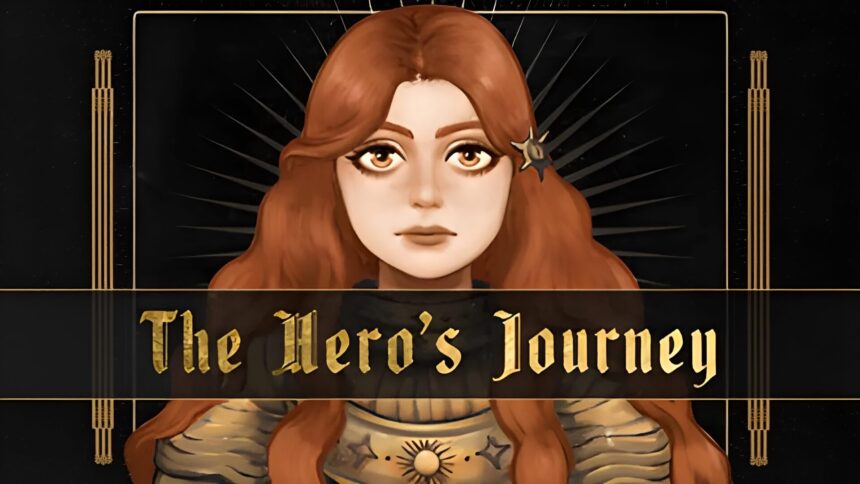
I have a confession to make. I finished The Hero’s Journey twice. Actually, it’s worse than that: I was three hours into a third playthrough before I made myself stop and sit down to actually write this review. Seren, “the Hero,” had already slain the villain terrorizing the land by the time I stepped into her shoes for the first time. She’s already famous, already engaged to a woman I apparently loved deeply, and I remembered none of it. Five years of my life had simply vanished, and everyone around me kept referencing a legend I couldn’t recognize as my own.
Solo creator maneki_mushi built and released this medieval fantasy otome for free on itch.io in 2022, and that scale shows in how personal the whole thing feels despite covering four separate romance paths across two distinct branching structures, a “Sun” path and a darker “Star” path, each reshaping how the same underlying events play out. What struck me almost immediately is how uninterested this story is in letting me feel comfortable being “the Hero.” Every companion I traveled with treated Seren like a legend, but the flashes of memory she recovered along the way kept complicating that image rather than confirming it, and by the time I’d pieced together enough of what actually happened during those missing five years, I found myself genuinely uncertain whether I liked the person she used to be.
That discomfort felt entirely intentional. This is a story explicitly interested in picking apart the “perfect hero” archetype rather than celebrating it, and every choice I made toward the end forced me to actually reckon with actions that weren’t clean or heroic in the way the surrounding legend claimed they were. Nothing here resolves into simple good or evil, not even Ikemma, the supposed villain whose own perspective complicates everything Seren had been told about him. Every difficult decision carried weight because I understood exactly why a less admirable version of her might have made it.
Structurally, I appreciated that my two playthroughs, built around different romance choices and the Sun and Star path split, told the same underlying journey from genuinely different angles rather than just reshuffling the same content. My first run centered heavily on Aerona, Seren’s fiancée and one of the sharpest, most layered characters in the whole cast, a battle-hardened warrior whose hardened exterior kept cracking to reveal tenderness underneath every time I pushed past her guardedness. My second run pulled me toward Rhain instead, Seren’s closest friend from before the amnesia, and I found myself just as invested, watching a quieter, longer-simmering devotion finally get the space to breathe that Aerona’s more immediate intensity didn’t always leave room for. Emrys and Ikemma round out the remaining two romance options, and both routes I didn’t personally pursue still left an impression on me just from how much the writing invested in their perspectives elsewhere in the story.
The writing carries emotional specificity throughout, describing small gestures and shifting facial expressions with enough precision that every companion felt like an actual person reacting in the moment rather than a character reciting scripted dialogue. I got attached to nearly everyone in this cast, even side characters I didn’t romance, which speaks to how much care went into the writing across the board rather than concentrating all the effort on the four romanceable leads. If I have one criticism of the plot itself, it’s that a handful of the bigger reveals felt telegraphed well before the story formally confirmed them. That didn’t ruin my enjoyment, since the emotional weight of finally understanding what happened mattered more than being surprised by it, but I did find myself a step ahead of the story more than once.
The heavier subject matter woven throughout deserves a direct, honest mention beyond the upfront content warning. This is not a gentle fantasy story. Themes of abandonment and manipulation surface as real plot elements rather than incidental references, and several of the choices I was asked to make landed as morally reprehensible options rather than clearly correct or incorrect ones. That’s clearly by design, reinforcing the story’s larger point about how messy and compromised real heroism actually looks up close, but anyone sensitive to that kind of content should know it’s handled with narrative weight rather than gratuitousness, and it’s present throughout rather than confined to a single dark chapter.
Verdict
The Hero’s Journey takes the tired “chosen one saves the world” premise and finds something thoughtful in showing what comes after, using amnesia not as a cheap plot device but as a real mechanism for interrogating whether the person everyone calls a hero actually deserves that title. Its branching structure delivered real emotional investment across both of my playthroughs, its cast earned my attachment across the board, and its willingness to sit with morally gray, uncomfortable choices gave the whole story genuine weight. Some reveals telegraph themselves earlier than they probably should. None of that stopped this from becoming one of the more memorable fantasy visual novels I’ve read in a while, and for anyone drawn to morally complex storytelling willing to sit with real discomfort, this is well worth the time.