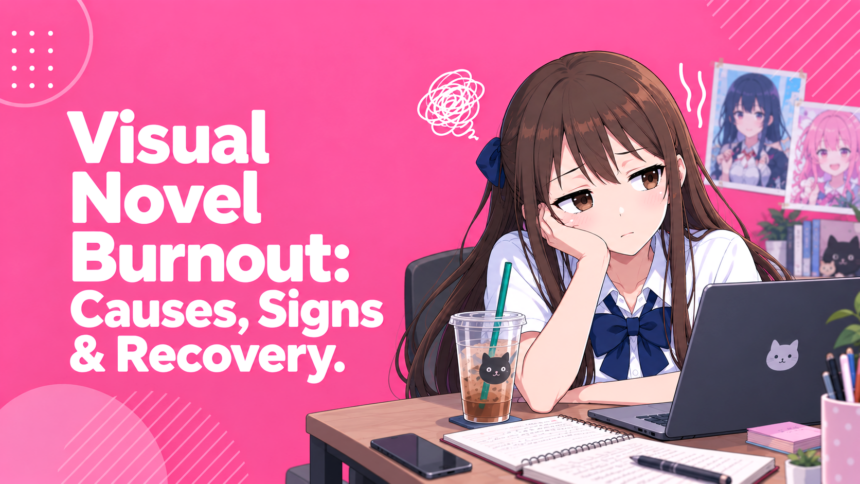
Burnout happens when a hobby that used to feel rewarding starts feeling like a chore, and visual novels are far from immune to it. Reading dozens of emotionally intense stories back to back, chasing every route in a favorite title, or binge-reading an entire genre in a short window can all wear down the exact enjoyment that drew someone to the format in the first place. Recognizing burnout early, and knowing how to actually recover from it, matters more than pushing through on willpower alone.
What Causes It in the First Place
Emotional exhaustion sits at the center of most visual novel burnout. Many of the genre’s most acclaimed titles lean heavily on grief, trauma, or high-stakes drama to generate their impact, and reading several of those back to back without a break asks a lot of a reader’s emotional bandwidth. A story that would have hit hard on its own can start to feel numbing when it’s the fourth heavy narrative in a row, not because the writing got worse, but because there’s less emotional room left to actually feel it.
Route fatigue is a more specific version of the same problem. Chasing every route in a single title, especially a longer one, means re-reading overlapping content, sitting through familiar early chapters again, and sometimes working through routes for characters you were never that invested in to begin with just to see the full story, something worth weighing against a title’s actual route count on VNDB before committing. Genuine replay value exists in the format, but forcing completion of every branch out of obligation rather than genuine interest turns a strength of the medium into a source of fatigue.
Volume alone can also do it without any particular title being to blame. Reading visual novel after visual novel in quick succession, treating the hobby more like a checklist to clear than an experience to sit with, tends to flatten the impact of each individual story. The tenth game in a month rarely lands the way the first one did, even if it’s objectively just as well written.
Recognizing the Signs Early
A few patterns tend to show up before burnout becomes full-blown disinterest, and catching them early makes recovery a lot easier than waiting until the hobby feels completely dead.
- Opening a visual novel feels like an obligation rather than something you’re looking forward to
- Skipping through dialogue faster than usual just to reach the next choice or the credits
- Feeling emotionally flat during scenes that would normally hit hard
- Comparing every new title unfavorably to ones you’ve already played, even when the comparison isn’t really fair
- Starting titles and abandoning them within the first hour more often than usual
None of these on their own is necessarily a sign of burnout. Everyone skips dialogue occasionally or bounces off a game that just isn’t clicking. It’s the pattern across multiple titles in a row, rather than any single instance, that tends to indicate something bigger going on than one bad pick.
Why Genre Matters More Than People Expect
Reading exclusively within one heavy genre is a common, specific path into burnout. A reader who moves from one psychological drama to another to another, chasing the same kind of intense emotional payoff each time, tends to burn out faster than someone who mixes genres more freely. The range of genres visual novels actually cover is wide enough that lighter, lower-stakes stories, easy to browse by tag on VNDB, are always available as a palate cleanser, and deliberately reaching for something in that lighter range after a heavy run is one of the simplest preventative habits available.
Comedy and slice-of-life titles specifically tend to work well for this, since they ask far less emotional labor from a reader while still delivering the character writing and interactivity that made the hobby appealing in the first place, and plenty of lighter, shorter options are freely available on platforms like itch.io for exactly this purpose. Treating these lighter genres as a lesser or filler category, rather than a legitimate part of a healthy reading rotation, is part of what pushes some readers toward burnout faster than necessary.
Recovery Starts With Stepping Away, Not Pushing Through
The instinct to force through a slump, hoping the next title will be the one that reignites interest, usually backfires. Reading through burnout tends to produce shallower engagement with whatever comes next, which then reinforces the sense that nothing is landing anymore, even when the actual writing quality hasn’t changed. A deliberate break, doing something else entirely for a week or two, does more to reset genuine interest than any specific title choice does.
When you do come back, starting with something short and low-stakes works better than diving straight back into a lengthy, emotionally heavy epic. A shorter title lets you test whether your interest has actually returned without the sunk-cost pressure of a long game you’d feel obligated to finish even if the burnout hasn’t fully lifted.
Rediscovering Why You Started
Part of recovering from burnout is reconnecting with whatever specifically drew you to visual novels before volume and habit took over. The reasons people gravitate toward the format vary a lot, from character-driven romance to branching narrative choice to sheer variety of art and voice work, and revisiting whichever of those reasons mattered most to you personally can help identify what kind of title is actually worth reaching for during recovery, rather than defaulting to whatever’s currently trending or highest rated.
For some readers, this means going back to a comfort title they’ve already finished rather than starting something new at all. Re-reading a favorite route in a game you already loved carries none of the uncertainty of a new title, and that lower-stakes familiarity is sometimes exactly what’s needed to remember why the format felt fun in the first place.
Building Habits That Prevent It Going Forward
Once recovery has actually happened, a few habits tend to keep burnout from creeping back in as quickly. Deliberately alternating between heavy and light genres, rather than reading purely by hype or ranking, keeps emotional load spread out instead of stacked. Giving yourself explicit permission to drop a title that isn’t working, rather than forcing completion out of habit, keeps the hobby feeling like a choice rather than an obligation. And treating getting into visual novels as an ongoing, flexible relationship with the format, rather than a race to clear a backlog, keeps the pressure that fuels burnout from building back up in the first place.
The Short Version
Visual novel burnout comes from emotional overload, route fatigue, and treating the hobby like a checklist rather than an experience to actually sit with, a struggle real enough that “burnout from reading VNs” threads come up regularly on r/visualnovels. The signs show up gradually: skipped dialogue, flat reactions to scenes that should land, obligation replacing anticipation. Recovery means stepping away rather than pushing through, then easing back in with something short, familiar, or lighter in tone before returning to anything demanding. Burnout isn’t a sign the hobby stopped being worth it. It’s usually just a sign the pace needed to change.