There’s no universal right answer, but the strongest case leans toward keeping honorifics when a story is culturally rooted in Japan and dropping or adapting them when it isn’t, with plenty of legitimate disagreement about exactly where that line sits. Honorifics carry social and relational information that English doesn’t reliably encode any other way, which is why so many readers push back hard when a localization removes them. At the same time, dropping them isn’t automatically laziness or disrespect, and understanding both sides of the argument matters more than picking a side reflexively.
What Honorifics Actually Communicate
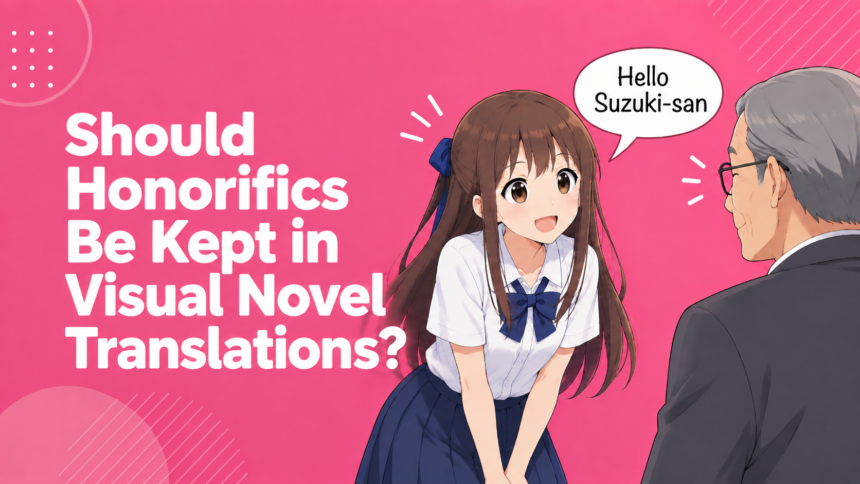
Japanese honorifics like -san, -chan, -kun, and -sama attach directly to how characters address each other and shift depending on the relationship between speakers, their relative social standing, and how that relationship changes over the course of a story. A character switching from calling someone by their last name with -san to using their first name with no honorific at all, or moving to something more intimate like -chan, signals a meaningful shift in closeness that a reader fluent in the cultural context picks up on immediately.
English doesn’t have an equivalent built into its grammar the same way, a gap covered in more depth by Wikipedia’s broader overview of honorific speech. A translator working without honorifics has to find another way to signal that same relationship shift, usually through changes in dialogue tone, more explicit narration, or simply losing some of that nuance entirely if no natural substitute presents itself in the specific scene. This loss is exactly what drives a lot of the frustration behind honorific-removal debates: something genuinely meaningful in the original often doesn’t survive the translation cleanly.
The Case for Keeping Honorifics
Preserving relationship information intact is the strongest argument in favor. A scene built around a character nervously deciding whether to drop an honorific with someone they’re falling for loses its entire emotional weight if the translation never had honorifics to drop in the first place. For visual novels where this kind of gradual intimacy shift is a genuine plot or character beat, not just incidental dialogue flavor, removing honorifics removes real narrative content, not just stylistic texture.
Honorifics also communicate character personality efficiently. A character who insists on formal honorifics even with close friends signals something different about their personality than one who drops formality immediately with everyone they meet, and that characterization detail often gets flattened or requires substantially more explicit writing to convey once the honorific itself is gone. For readers already familiar with how these terms function, from years of exposure to anime, manga, or other Japanese media, keeping the original terms doesn’t create confusion. It preserves information they already know how to read correctly.
The Case for Removing or Adapting Honorifics
The strongest counterargument centers on accessibility for readers without existing familiarity with Japanese social conventions. A reader with no prior exposure to honorifics encountering “-senpai” or “-sama” for the first time in a visual novel has to either infer meaning from context or stop to look up an unfamiliar term, and localization teams making decisions for a broad audience reasonably weigh how much unexplained foreign vocabulary a general reader can absorb before it becomes a barrier rather than a texture.
Setting also matters considerably here. A visual novel explicitly set in a fictional European kingdom, using honorifics purely because the game was written and voiced in Japanese regardless of its actual setting, creates a genuine inconsistency if the English text retains Japanese-specific honorifics in a story that has nothing culturally Japanese about it otherwise, a mismatch that rarely comes up in genres that don’t have to use anime-style art or setting in the first place. Keeping “-san” in a story where every other cultural marker points to medieval France produces a strange mismatch that adapting or removing the honorific arguably resolves more cleanly than literal preservation would.
There’s also a real risk of over-localization working the other way. Piling on Japanese terminology beyond just honorifics, in a story that isn’t meaningfully about Japan or Japanese culture, can read as unnecessarily exoticizing rather than accurately preserving anything genuinely important to the narrative.
Why This Debate Gets So Heated in VN Communities
Visual novel readers, as a community, tend to skew toward deep familiarity with Japanese media more than mainstream gaming audiences do, and that familiarity shapes strong opinions about what “authentic” localization should look like, part of why people gravitate toward the format in the first place. Many longtime readers already understand honorifics fluently through years of exposure, and localization choices aimed at a broader, less experienced audience can feel like they’re deliberately simplifying content for people who weren’t actually the game’s core audience to begin with.
This tension shows up explicitly whenever an official localization removes honorifics that an earlier fan translation had kept, since it highlights a real difference in target audience assumptions between commercial publishers hoping to reach a wider market and dedicated fan translators working specifically for an audience that already shares their own cultural fluency. Neither group is wrong about who their translation is for, but the mismatch in assumed audience is exactly what generates so much of the ongoing friction around this specific localization choice, a friction visible in nearly every thread about it on r/visualnovels. Checking how to actually translate a visual novel, whether officially or as a fan project, usually surfaces this exact tension as one of the first major decisions a translator has to make.
Does the Answer Change Based on Genre?
To some extent, yes. Visual novels leaning heavily on Japanese school life, workplace hierarchy, or family dynamics tend to benefit more from retained honorifics, since those social structures are woven tightly into how Japanese honorific usage actually works in practice, and stripping the honorifics out risks losing texture that’s genuinely load-bearing for how those relationships are meant to read. Titles set in fantasy worlds, science fiction settings, or explicitly non-Japanese contexts, spanning the wide range of genres visual novels actually cover, have a much weaker case for keeping honorifics intact, since the cultural framework the honorifics originally depended on isn’t really present in the story to begin with.
This is part of why a blanket policy, either always keeping honorifics or always removing them, tends to produce worse outcomes than evaluating the specific story’s setting and how load-bearing the honorific system actually is to its characterization and plot. A rule applied uniformly across every title a publisher localizes, regardless of each individual story’s actual cultural grounding, ends up serving some titles well and others poorly by design.
What About Voiced Dialogue?
Voice acting complicates this debate in a way that pure text translation doesn’t have to deal with. When a character’s spoken Japanese line clearly includes an honorific audible to any listener, and the English subtitle or text removes it entirely, the mismatch between what’s heard and what’s read becomes noticeable even to readers with only basic familiarity with spoken Japanese. This disconnect doesn’t happen with fully text-based visual novels lacking voice acting, since there’s no spoken audio to create a contradiction against.
Some readers specifically prefer keeping honorifics in translations of fully voiced titles for exactly this reason, since it keeps the English text aligned with what’s actually audible in the performance rather than creating a distracting gap between what a reader hears and what they’re reading on screen at the same moment.
Consistency Matters More Than Which Side You Pick
Whichever approach a translation takes, applying it consistently throughout the entire script matters more than which specific policy gets chosen. A translation that keeps honorifics for some characters but drops them for others without clear reasoning, or that switches policy partway through a long script, creates confusion regardless of which underlying philosophy the translator started with. Readers can generally adapt to either a fully honorific-inclusive or fully honorific-free translation without much friction, provided the choice holds steady across the whole work rather than shifting unpredictably scene to scene.
The Short Version
Honorifics carry real relational and characterization information that English doesn’t naturally replicate, which makes a strong case for retaining them in stories where Japanese social structure is genuinely load-bearing to the plot or character dynamics. Removing or adapting them makes more sense in settings without meaningful cultural grounding in Japan, or when a publisher is deliberately localizing for a broader audience less familiar with the convention. Neither approach is objectively correct across every visual novel, and the strongest translations tend to make this decision deliberately based on a specific story’s setting and needs, rather than applying one fixed policy uniformly across every visual novel regardless of fit.