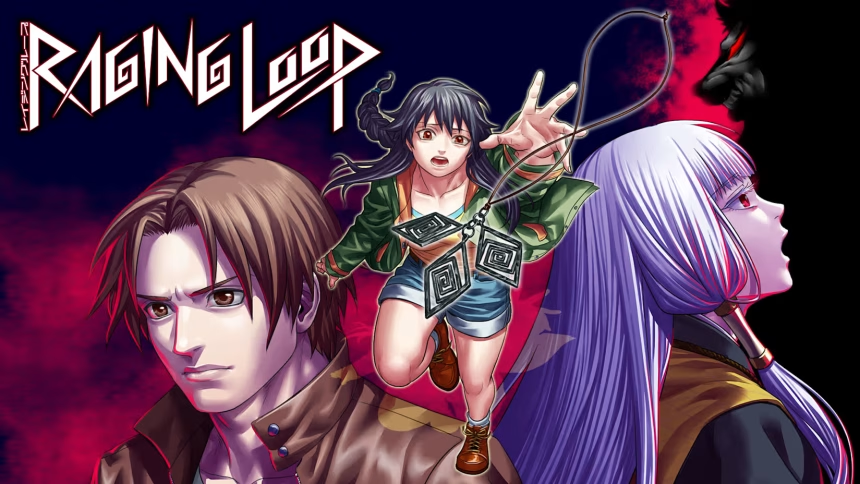
As a horror game built on the bones of a party game, Raging Loop mostly succeeds at a mission that could have gone embarrassingly wrong. Kemco developed the whole thing in partnership with Dwango, with a scenario written and directed by amphibian, a pen name I hadn’t come across before this game but one I’d trust again after seeing what got built here. The story here follows Haruaki Fusaishi, a twenty-four-year-old grad student working through a bad breakup who crashes his motorcycle near a village called Yasumizu. The population eleven of this place is just eleven…..just eleven, and the villagers explain the rules bluntly once a strange mist rolls in and traps everyone. Hidden among them are wolves who need to kill and consume the village’s human residents to survive during a ritual called the Feast of the Yomi-Purge, and breaking the customs governing that standoff results in grotesque death by corruption.
The Werewolf-inspired social deduction backbone gives the story distinctive structure, folding bluffing, accusation, and desperate alliance-building directly into its horror rather than treating the folklore as simple set dressing. Multiple loops through the same core scenario, each one granting me slightly more knowledge and agency than the last, escalate the stakes considerably as the story progresses; what starts as a fairly gentle introduction to the village’s rules and cast grows into something far more morally compromising by the time later loops ask Haruaki to actively participate in deception, manipulation, and worse to survive. That escalation is where the game earns its sharpest material, delivering some of its most gripping, uncomfortable stretches once the deduction turns personal rather than academic.
Reaching that strong material takes real patience, and it’s the most consistent, credible complaint I have about the whole experience. Long stretches of the middle chapters lean heavily on dense exposition and dialogue that revisits information already established, testing my patience considerably before the plot’s stronger, more twist-driven stretches arrive. Player choice, meanwhile, stays fairly limited in practice; unlike Zero Escape’s more mechanically involved investigation sequences, this remains a comparatively passive visual novel experience, closer to reading a long, branching story than actively solving a mystery myself, a design choice that reads as intentional, mirroring Haruaki’s own position as someone trapped inside a folk tale he can’t meaningfully steer, but frustrating regardless when I wanted more genuine agency.
The mystery itself carries real ambition, and the eventual explanations tying together the village’s rules, its history, and the true nature of the threat land with satisfaction, even if I noticed a few plot holes and moments where believability takes a backseat to generating an interesting situation in the moment. One particularly memorable stretch, easily the game’s most intense and morally compromising material, pushes Haruaki into active deception and violence in ways that felt shocking for the format, before the writing’s overall consistency noticeably loosens in the story’s final stretch, with plot logic growing shakier the closer the game gets to its conclusion. A specific structural quirk worth flagging: several key revelations hinge on wordplay and linguistic clues rooted in Japanese, and while the localization does real work explaining the relevant context, it remains functionally impossible to solve those specific puzzles independently without native fluency, an unavoidable limitation of adapting this kind of culturally specific mystery for international audiences.
Character art, drawn by Kageyoshi, and the fully voiced cast, including Haruaki himself, bring real personality to a small, tightly focused ensemble, and the performances carry a lot of the tension during the village’s tribunal scenes especially. The game’s origins as a 2015 mobile release show clearly in its more static, workmanlike backgrounds, though, which read as merely functional rather than striking, and backdrops get reused often enough by the later chapters that a few emotional scenes lose some impact sitting against the same bare wall I’d already seen a dozen times.
A useful flowchart system, similar in spirit to Zero Escape’s own navigation tools, makes revisiting choice points and chasing the game’s numerous alternate endings considerably more manageable than it would be otherwise, a welcome quality-of-life feature given how many distinct endings, ranging from quick, occasionally darkly funny bad ends to substantial character-specific conclusions, the full experience offers.
Verdict
Raging Loop delivers an inventive mashup of Shinto horror and social deduction gameplay, escalating its stakes across multiple loops into some of the most morally uncomfortable, gripping material the mystery-horror visual novel space has produced. A sluggish middle stretch, limited actual player agency, and a back half where plot logic loosens noticeably keep this from matching the tightest genre benchmarks, and puzzles rooted in Japanese wordplay remain unsolvable without outside knowledge regardless of localization effort. For patient readers willing to push through its slower stretches, though, this stands as a distinctive, often unnerving entry that earns its comparisons to genre heavyweights like Danganronpa and Zero Escape.