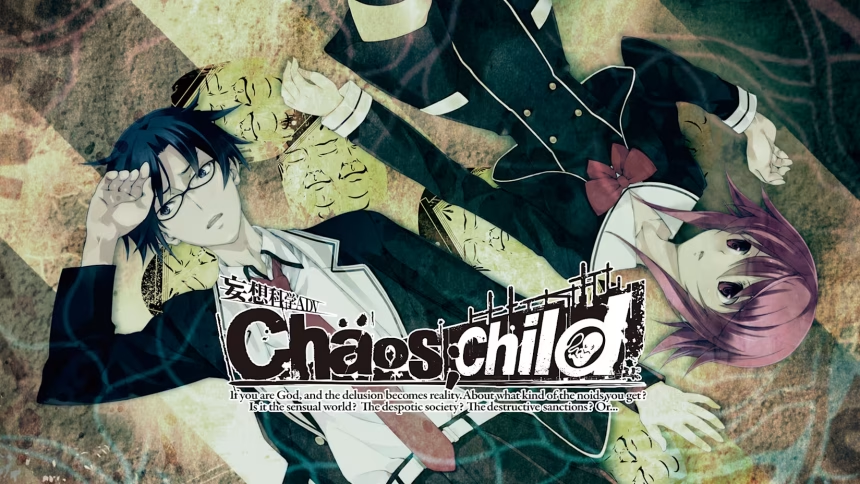
Making a protagonist’s own delusions part of the actual storytelling mechanic is a bold move, and Chaos;Child leans into that idea hard enough that figuring out where reality ends and Takuru Miyashiro’s fractured perception begins became the real puzzle of my whole playthrough. This murder mystery picks up six years after the earthquake that tore through the events of Chaos;Head, following a new cast of students at Hekiho Academy as a fresh wave of killings starts echoing a set of murders from that earlier story.
I played as Takuru, who runs his school’s newspaper club and looks down on most of his classmates, an arrogant, socially anxious kid quick to write off anyone he considers normal. When a string of bizarre, ritualistic murders starts terrorizing Shibuya, matching the exact pattern of killings from six years back, Takuru and his club members get pulled into an investigation that turned out to be far more personal, and far more dangerous, than any of them expected going in.
The central mystery is built with real cleverness. Key information gets withheld from both Takuru and me as the reader in a way that made straightforward deduction basically impossible, which forced me to just experience the story rather than try to solve it ahead of time. I can see why that splits people. If you go in hoping to piece together the killer’s identity through careful logic, you’re working with an incomplete hand on purpose. I let myself get carried along by the escalating dread instead, and the reveals hit me hard because of it. The back half in particular goes to some genuinely dark, disturbing places once the supernatural and conspiratorial threads click into place, and specific twists recontextualized earlier scenes for me in ways I wasn’t expecting.
Getting to that payoff took a lot of patience, though, and this is where my biggest frustration with the game lives. The plot crawls for the first several hours, weighed down by Takuru’s dense, often self-indulgent internal monologue narrating every passing thought at length instead of trusting me to pick up on character and mood from the dialogue and action alone. I’ve seen the joke among longtime fans that there’s maybe seven hours of actual plot stretched across a thirty-plus hour runtime, and while that’s obviously exaggerated, it captures exactly how much verbosity stood between me and the mystery I actually wanted to keep reading. Not having played Chaos;Head beforehand added another layer of difficulty too, since this game assumes you know that earlier story’s events at several points without fully re-explaining them.
Takuru himself is a hard character to like at first, and that’s clearly intentional. His condescending, self-important narration tested my patience well before the plot gave him any reason to soften. The character work pays off eventually, though. Once his backstory and the trauma underneath his arrogance and social anxiety came into focus, he turned from an insufferable narrator into someone I actually cared about, still deeply flawed, but sympathetic in a way I didn’t expect from how he opens the story. The wider newspaper club held up well across the board too. Every member carries enough personality and stake in the mystery that none of them felt like filler, and a few heroine-specific routes gave individual characters real depth once their personal storylines took over.
The delusion system, where Takuru’s imagination spirals into vivid, often deeply unsettling fictional sequences that only he experiences, unnerved me specifically because his friends have no idea any of it is happening inside his head. Some of these sequences read as darkly comic exaggeration, and others go somewhere disturbing enough that I started questioning how reliable Takuru even was as a narrator. I’ll admit the mechanic felt more decorative than essential in a few spots though. Which delusions triggered didn’t seem to change much about how the actual plot unfolded, and I noticed that gap the more of them I saw.
When the writing commits fully to its central conspiracy and horror elements, it’s genuinely strong stuff, the kind that reminded me of Higurashi’s slow-burn dread and Steins;Gate’s careful plotting. It tackles real anxieties around social media, online radicalization, and the isolating effects of modern technology with a seriousness that pushed this well past a simple slasher mystery for me. The back half’s turn toward more explicit supernatural and sci-fi territory felt earned rather than random, and the story never lost sight of the grounded, societal concerns driving its conspiracy from the start.
The pacing problems I mentioned earlier come down to a writing issue more than a structural one, and that dense, over-explained internal monologue was easily my most consistent complaint across the whole runtime. I also ran into a handful of continuity errors and script inconsistencies, small enough that they didn’t derail anything, but noticeable enough to pull me out of the moment a few times. There’s also a late-game twist that worked well as a horror beat for me, but it ended up reshaping one other character’s arc in a way that felt awkward rather than earned.
The background art quietly impressed me the whole way through. Shibuya’s various locations get rendered with a moody, atmospheric level of detail that did real work setting the tone even during the slower, dialogue-heavy stretches. Character art held up fine too, if less memorable to me than some other entries in this series. The soundtrack matched that same atmosphere, leaning into a slower, more unsettling register than a typical visual novel score, and the vocal tracks land at exactly the moments they needed to for the story’s heaviest beats.
The opening sequence sets a tone of visceral, unflinching horror that the game keeps returning to at key moments throughout, and that willingness to commit to genuinely disturbing imagery gave the horror real teeth compared to plenty of other visual novels that only gesture at darkness without following through. I also ran into a few minor text formatting hiccups here and there, though nothing severe enough to actually pull me out of a scene for long.
By the time I reached the back half, the emotional and psychological weight this story builds toward hit me hard, in a way that reminded me directly of how Steins;Gate lands its own hardest punches. There are specific scenes here that are going to stay with me for a while, graphic and heavy enough that I’m still thinking about them days after finishing. Takuru’s arc resolves with real catharsis after a long, deliberately uncomfortable build, and getting there felt like it actually meant something by the end.
Verdict
Chaos;Child asks for a lot of patience before it pays off, and I’ll be honest that the first several hours tested mine more than once with Takuru’s dense internal monologue slowing everything down. Once the mystery around the murders and Takuru’s own fractured mind fully clicked into place for me, though, this turned into one of the more unsettling, emotionally heavy visual novels I’ve sat through, with a back half that earns every comparison to Steins;Gate’s own gut-punch ending. The delusion mechanic feels more like set dressing than something that actually shapes the plot, and a late twist reshapes one character’s arc in a way that didn’t sit perfectly with me, but neither issue came close to undoing what this game builds toward. If you can push through the slow opening stretch, the payoff here is real.
Verdict
Chaos;Child delivers a genuinely dark, disturbing murder mystery with real thematic ambition, tackling anxieties about technology and social isolation through a horror-inflected sci-fi lens that earns its place as a worthy entry in the Science Adventure series. Its punishingly slow opening hours, bloated with dense internal monologue that tells rather than shows, remain its clearest and most consistently cited flaw, and the delusion system that defines its central gameplay hook ends up feeling more decorative than essential to how the plot actually unfolds. For readers with the patience to push through those early frustrations, and ideally some familiarity with the still-unlocalized Chaos;Head beforehand, this delivers a genuinely memorable, disturbing mystery with real emotional weight by its conclusion, even if it never quite matches the tighter, more consistently paced heights of Steins;Gate.