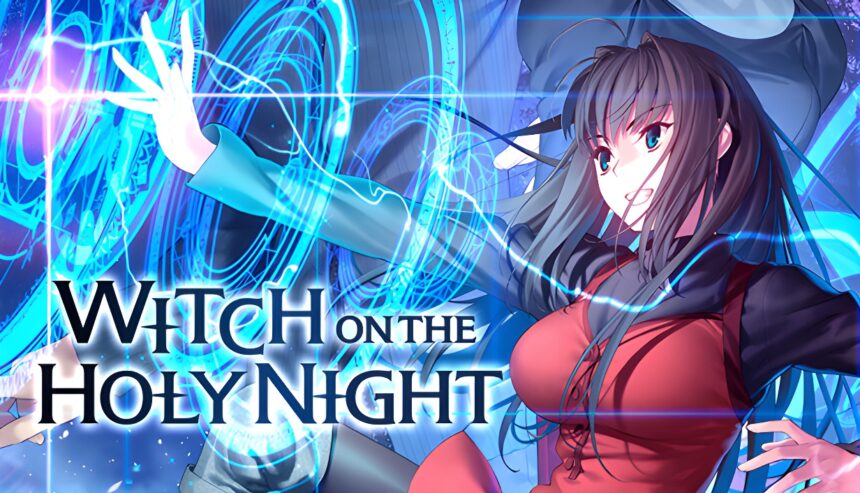
With an anime film adaptation finally landing in theaters in 2026, I figured it was past time to go back and actually read the visual novel it’s drawn from, and Witch on the Holy Night turned out to be well worth that decade of catching up. Originally released in Japan in 2012 as Mahoutsukai no Yoru, this prequel to Tsukihime finally reached Western audiences ten years later as the first TYPE-MOON visual novel to ever receive an official English localization, and the wait mostly paid off: a small, intimate story built around three characters, gorgeous presentation, and prose from series creator Kinoko Nasu that shows why this studio’s reputation extends well beyond the Nasuverse’s more famous entries.
Soujuro Shizuki comes down from the mountains to attend school in 1980s Japan, still adjusting to city life when he stumbles across two witches, Aoko Aozaki and Alice Kuonji, in the middle of a magical confrontation he was never supposed to see. Rather than silencing him permanently, Aoko takes an unexpected liking to the awkward newcomer, and the two witches end up bringing him into their sprawling mansion to keep an eye on him, setting up a story that felt far more grounded and personal to me than the world-ending stakes typically associated with this universe.
Keeping its scope small is this game’s smartest decision. Rather than reaching for the apocalyptic stakes common across the wider Nasuverse, the plot stays focused on a family conflict between mage relatives and the personal growth of its three central characters, and that intimacy gave the story room to breathe in ways a larger-scale plot wouldn’t have allowed. The opening hours ask for real patience, though. I spent considerable time watching the cast’s daily rhythms get established before the central conflict fully kicked into gear, and chapter length varies noticeably throughout, with some segments moving briskly and others lingering longer than their content strictly earned from me.
Being a single-route kinetic novel without the branching structure found in later Nasu works limits the story’s replayability somewhat, and anyone specifically hoping for otome-style romance options between the cast will come away a little disappointed, since the game insinuates rather than commits to that kind of relationship dynamic. What’s here worked well enough as a self-contained story for me that those structural limitations rarely felt like a real loss by the time I finished.
Aoko carries the story with real charm, a sharp-tongued tsundere energy that gave her scenes genuine comic bite without sacrificing the vulnerability underneath her family obligations. Alice provides an effective counterbalance as the more deadpan, reserved half of the witch duo, and the dynamic between the two of them, prickly but clearly caring, gave the small cast plenty to work with despite there being so few named characters overall. Soujuro rounds out the trio as an earnest, if occasionally dim, everyman whose fish-out-of-water perspective worked well as my entry point into the witches’ hidden world, even if his passivity in certain scenes tested my patience at points. Because the cast stays so tightly focused on these three characters, the story earns a level of intimacy that larger-cast visual novels in this universe don’t always achieve, and getting to know each of them in detail paid real dividends by the time the plot’s stakes escalated.
Nasu’s prose balances tension and humor with real skill here, letting genuinely creepy, atmospheric moments sit comfortably next to lighthearted banter between the leads without the tonal shifts ever feeling jarring to me. The dialogue captures a sense of everyday texture around the central mystery, small jokes, mundane domestic scenes, that made the eventual magical confrontations land with more weight once they arrived.
This English localization shows some real rough edges, though. A handful of translation errors and awkward phrasing crop up throughout, enough that I’d recommend checking for a text patch before diving in, and pacing across individual chapters can feel uneven, with some plot points landing as a little forced given how much time the story otherwise spends on quieter character beats.
Few visual novels manage to simulate this much motion within a fundamentally static medium. The engine behind this remake pushes character sprite manipulation and visual effects further than most of the genre attempts, and the magical battle sequences in particular use dynamic lighting and color choices that make for some of the most visually striking action scenes I’ve seen a visual novel produce. The overall presentation quality stands as one of the strongest the genre has to offer, elevating even quieter dialogue scenes with thoughtful staging and scenography. Full Japanese voice acting rounds out the package well, giving the small central cast real dimension across a story that leans heavily on their chemistry to carry it, and the soundtrack complements the atmosphere effectively, shifting between unsettling and warm depending on what a given scene calls for.
The intimacy of focusing on just three characters gives the story’s emotional beats real specificity, and watching this particular found family form under strange circumstances landed with genuine warmth by the story’s conclusion. The stakes never reach the world-ending scale of other Nasuverse entries, and that restraint worked in the story’s favor for me, letting personal growth and quiet connection carry the emotional weight rather than manufactured grandiosity.
Verdict
Witch on the Holy Night delivers an intimate, visually stunning prequel that stands comfortably among the best entry points into TYPE-MOON’s wider catalog, anchored by a small but genuinely charming cast and some of the most striking presentation the visual novel medium has produced. A slow opening, uneven chapter pacing, and rough patches in the English localization keep it from being flawless, and the lack of branching routes will disappoint anyone hoping for more replayability. For a self-contained story built on atmosphere and character chemistry rather than epic stakes, it delivers exactly what it sets out to.