I’ve played through Aselia the Eternal more than once, including the fan translation years before JAST ever got an official release out the door, and I’ve since gone back to poke at the assorted spin-off material and soundtrack releases that trickled out around it in the years since. I like this particular hybrid of turn-based tactics and dense fantasy melodrama, is what I’m saying, as one of the more ambitious attempts to marry a real strategy layer to visual novel pacing rather than treating the combat as decoration bolted onto a dating sim. But I can’t recall ever wondering whether that formula needed a full multiverse’s worth of new worlds, new casts, and new gods stacked on top of what the original already delivered. As an answer to a question I’d probably never have asked on my own, this sequel is a genuinely ambitious, occasionally excellent expansion that stretches its own foundation thinner the longer it goes.
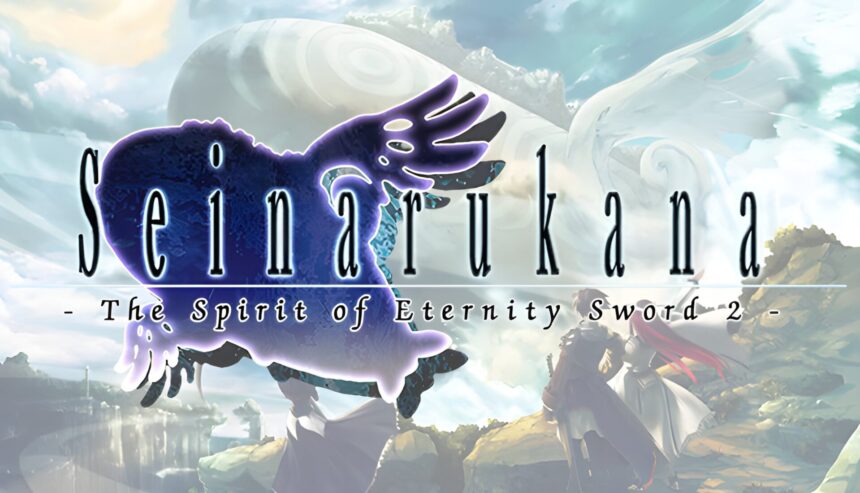
A boy carrying the dormant soul of an ancient god inside him, watched over by rival factions who need him either controlled or destroyed, has been a reliable fantasy hook for decades, and Seinarukana -The Spirit of Eternity Sword 2- builds an entire multiverse-spanning adventure around exactly that premise. Developed by Xuse and localized by JAST USA as a successor to Aselia the Eternal, this hybrid visual novel and tactical RPG follows Nozomu Setoki, an ordinary high school student plagued by violent dreams, whose entire school at Mononobe Academy gets pulled into another world during an attack by an invading force of sword-wielding assailants, setting off a journey across the branching worlds of the Time Tree as Nozomu and his classmates fight to find their way home while uncovering the true nature of the god sealed within him.
The scope here is ambitious in a way that’s genuinely rare for a follow-up to expand into rather than shrink away from. Rather than staying within the single-world stakes of its predecessor, the story hops between distinct realities, each populated by their own factions, conflicts, and potential allies, and that structural ambition pays off in real, tangible worldbuilding. Each new world introduces enough distinct flavor and stakes to keep the overarching journey feeling fresh rather than repetitive, even as the sheer number of new characters introduced along the way, upward of fifteen treated as functionally main cast members, occasionally outpaces how much individual development any single one of them actually receives.
A regal, honor-bound knight and a girl fighting to protect elemental spirits on her home world both stand out as memorable additions to an already sprawling roster, though the broader cast of secondary characters and antagonists thins out in quality the further the story stretches, with several late-game threats reading as forgettable compared to the stronger, more carefully developed figures from earlier chapters. Every scene visibly works to give this many characters some sliver of spotlight, and that effort shows in how thin individual moments end up once the cast size catches up with the runtime.
Combat carries real depth once its systems click into place, organizing fighters into small squads with elemental strengths and weaknesses adding a genuine tactical layer to positioning and team composition across sprawling, top-down battle maps. That depth comes at a real cost in accessibility. The combat system throws a substantial amount of interconnected mechanics at players early on, and getting comfortable with formations, elemental matchups, and skill interactions takes real, sustained effort before battles start feeling manageable rather than overwhelming. One specific change from the predecessor’s system stands out as a genuine step backward: rather than learning new skills predictably as characters level up, this entry ties skill acquisition to random drops from defeated enemies, a shift that trades some of the original game’s satisfying sense of steady growth for a system that feels considerably less within the player’s control.
Where the story shows real signs of diminishing structural ambition compared to its predecessor is in how its branching paths actually function. Rather than offering fully distinct routes shaped by different narrative choices, the vast majority of the plot stays linear regardless of which heroine a given playthrough favors, with individual character paths typically limited to a single dedicated story mission and epilogue rather than a genuinely divergent overall arc. The climactic events and broader plot beats remain consistent across every route, which means replaying the game specifically to see meaningfully different content offers diminishing returns beyond a second or third pass, a step down from the structural variety a fully realized multi-route visual novel typically promises.
The writing carries a lighthearted, classic JRPG sensibility throughout, blending comedy and high fantasy stakes in a way that mostly succeeds at keeping a lengthy runtime, well over fifty hours for a full playthrough, entertaining rather than exhausting. One specific recurring comedic beat draws fair, direct criticism worth flagging honestly: an early running gag frames physical violence from the childhood friend character toward Nozomu as comic slapstick, a genre convention common enough in anime-adjacent storytelling of this era but one that reads as considerably less charming by modern standards, especially given how bluntly it’s played for laughs rather than treated with any self-awareness.
Presentation marks a real, noticeable improvement over the previous entry in the series, with more consistent, polished character art and CGs throughout, even if the underlying style still carries visible signs of its original release era by today’s standards. Voice acting covers most of the major cast in Japanese, with Nozomu himself left unvoiced as the player’s stand-in, and the soundtrack includes several genuinely strong individual tracks, even if a meaningful portion of the background music blends together into fairly forgettable filler across such a long runtime. Combat visuals fare less favorably, with muddy, low-resolution textures and rough camera movement during battle sequences that undercut the otherwise stronger visual presentation found in dialogue scenes.
A midgame stretch built around one particularly hateable set of antagonists carries more tension and momentum than almost anything else in the runtime, and the specific satisfaction of watching that arc’s conflict finally resolve does more to justify the game’s length than any of the surrounding multiverse-hopping structure manages on its own.
Verdict
Seinarukana -The Spirit of Eternity Sword 2- delivers an ambitious, multiverse-spanning fantasy epic with genuinely deep tactical combat and a substantial amount of content for the price, even as it falls short of its predecessor’s structural ambition by keeping its branching routes largely superficial and padding its back half with a bloated, less memorable cast of new characters. A steep combat learning curve, dated battle visuals, and at least one recurring comedic beat that hasn’t aged gracefully keep this from being a fully polished successor.