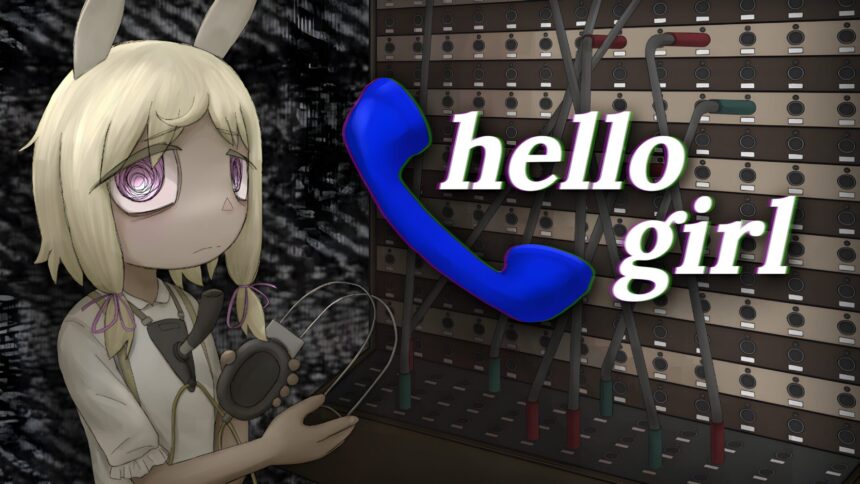
A quiet telephone switchboard job during wartime doesn’t sound like the setting for anything especially gripping, and Hello Girl uses that stillness deliberately, building an entire short story around what happens when isolation gets interrupted by unexpected connection. This kinetic visual novel follows Ana Lapine, a bunny eared switchboard operator living a simple, routine existence, connecting calls, occasionally eavesdropping despite knowing it’s illegal, making trips to the post office and ration lines, while her unnamed nation remains fractured by an ongoing conflict referred to only as the Great Effort. That quiet routine shifts once an unexpected new presence enters her life, and the entire story unfolds from watching that relationship take shape against a backdrop of national uncertainty. That restraint pays off precisely because the story never oversells its own stakes, letting the quiet accumulate its own weight rather than reaching for melodrama to compensate for a small, contained setting.
The setting draws specifically on World War I iconography and history despite never naming a real country or conflict directly. That’s a deliberate alternate history angle, letting the story evoke specific historical weight without being bound to strict factual accuracy. Content here leans queer throughout too, Ana and Courier’s connection reading unmistakably as a romance between two women rather than staying ambiguous the way some kinetic novels prefer.
The repair technician sent to fix Ana’s equipment, a woman named Courier, ends up talking with her far more than either expected, giving Ana a real connection for the first time since her older sister Clara left to serve as a medic in the ongoing war. That absence sits over the whole story quietly, Ana’s routine built around waiting for news that never quite arrives, and Courier’s presence becomes the first real disruption to that waiting in longer than the story ever states outright. Small, specific rituals fill in the rest of Ana’s world too, the exact walk to the post office, the particular hush of a ration line, details that ground the setting in lived routine rather than abstract wartime backdrop. Yuno, a soldier who crosses paths with Ana and Courier partway through, brings the war’s actual violence into direct contact with their otherwise sheltered corner of the story. That contrast sharpens the stakes without ever needing a full battle scene to do it.
As a purely linear kinetic novel with zero choices, the entire experience lives or dies on the strength of its writing and atmosphere rather than any interactive structure, and it succeeds convincingly on both fronts. The prose commits fully to establishing a melancholic, lived in world through small, specific details rather than heavy exposition, and the growing bond between Ana and Courier develops with real patience, giving even a comparatively short runtime real emotional weight by its conclusion. That patience shows up most clearly in how little dialogue actually needs to happen before a given scene lands emotionally, the writing trusting silence and small gesture as much as it trusts direct conversation to carry a moment.
The bunny girl aesthetic applied to the entire cast serves a clear purpose beyond simple visual charm too. Character designs, scrawny frames, expressive ears functioning almost as an extension of hairstyle and personality, work together to communicate wartime scarcity and youthful vulnerability without needing the text to state either outright. Each character’s ears carry their own shape and positioning too, Ana’s standing straight up, Courier’s drooping to her sides, small physical variation that gives even a small cast real individual distinction. Ana and Courier each get two distinct outfits across the story too, small wardrobe variation that helps track time passing without the game needing to state a date directly. That level of individual attention to a small cast is exactly the kind of choice a longer, more sprawling visual novel usually can’t afford to make.
Presentation choices throughout show real, deliberate craft, alternating between an NVL style full text layout for quieter, more contemplative scenes and a more traditional ADV dialogue format for direct character interaction, a shift that reinforces the emotional register of whatever scene is currently unfolding. VHS style visual filters and flickering, degraded framing around phone conversation sequences add real atmospheric texture, selling the era and the sense of static, distant communication central to Ana’s job, even if that specific visual choice sits at odds with the story’s period setting closer to older switchboard technology than the VHS adjacent iconography it evokes. That’s a small tonal mismatch that doesn’t meaningfully undercut the effect it’s clearly reaching for. Even knowing the anachronism going in, I found the choice easy to forgive once the story’s own mood took over, the visual language mattering more in the moment than strict period accuracy. The choice to render this experience in a 4:3 aspect ratio stands out as an unusual, divisive decision by modern standards. It fits comfortably within a tradition of older, foundational visual novels built for that format, and it does lend the smaller, more intimate story a cozy, contained feeling, even if it’s a stylistic choice that won’t universally read as necessary on today’s widescreen displays.
Music and CGs both get deployed with real intentionality rather than functioning as simple decoration, reserved specifically for moments the story wants to emphasize rather than scattered evenly throughout, which makes their appearances land with more weight when they do arrive. The full soundtrack is available separately on Bandcamp for anyone who wants to hold onto specific tracks after finishing, and the score leans into that same worn, melancholic register the rest of the presentation reaches for. Backgrounds throughout mix painterly illustration with filtered photography, a combination that gives the world a texture close to reality without ever fully committing to it, evocative rather than strictly representational.
The overall runtime stays short, closer to a focused, singular piece of short fiction than a sprawling epic, and that brevity works entirely in its favor. The story says what it sets out to say without padding, delivering a complete emotional arc within a tightly controlled scope rather than stretching modest material past its natural length. That scope traces back to its origins as a submission for VN Cup number two, a two month long visual novel jam built around the theme of trans, queer, and gendery storytelling. Hello Girl won that competition’s grand prize, the Diamond Heart Prize, before its original free itch.io release ran somewhere around two to three hours depending on reading speed. That jam origin shows in how tightly focused the final product stays, a small, deliberate story rather than one padded out to fill a longer runtime just because a Steam release demanded it.
Imo Team credits several people across this project, merilynn f. paisley directing, scripting, and programming alongside contributions from Mentha Nolana, SoapDrip, and mara esper welsley. Weekly small patches followed the original jam release too, the team clearly staying engaged with the project well past its initial two month competition deadline. A remastered version followed on Steam on March 3, 2025, featuring an overhauled script, new CGs, and updated sprites, sound, and music compared to the original 2023 build. That kind of full script overhaul for a remaster, rather than a simple visual polish pass, suggests something real. The team used the Steam release as a real opportunity to refine the story rather than just repackaging the original jam build unchanged. The team has said they considered expanding Hello Girl into something longer but ultimately decided the story works best staying where it currently sits.
I did come away wanting a little more closure on a few of the threads the story raises early on. Several names and plot points get introduced with real weight, only to stay unresolved by the time the credits actually roll, and the tonal shift in the bonus epilogue specifically felt like a real departure from the careful, restrained mood the main story spends its whole runtime building. Rabbit Zero specifically gets raised early with real narrative weight behind it, only to fade from the story’s attention well before any explanation actually arrives. That’s the kind of dropped thread that stands out precisely because everything else feels so carefully placed. Ana’s sister Clara specifically remains an open question by the credits too, her exact circumstances left deliberately vague in a way that reads as intentional restraint more often than narrative oversight. That’s a minor complaint relative to everything else working here, but it’s worth knowing going in that not every thread the writing raises gets tied off.
Verdict
Hello Girl succeeds as a quiet, atmospheric piece of short fiction, using deliberate presentation choices and patient, specific writing to build real emotional investment in a brief wartime story about connection breaking through isolation. Its unconventional 4:3 aspect ratio and VHS inspired filtering won’t land as an obvious fit for every reader given the story’s period setting, but neither undercuts the effectiveness of the writing and atmosphere carrying the experience. For readers drawn to short, melancholic kinetic novels that use every element of the format with real purpose, this stands as a well crafted, memorable read. Few short kinetic novels commit this fully to letting quiet routine carry real emotional stakes without ever reaching for a bigger, louder story to justify itself.