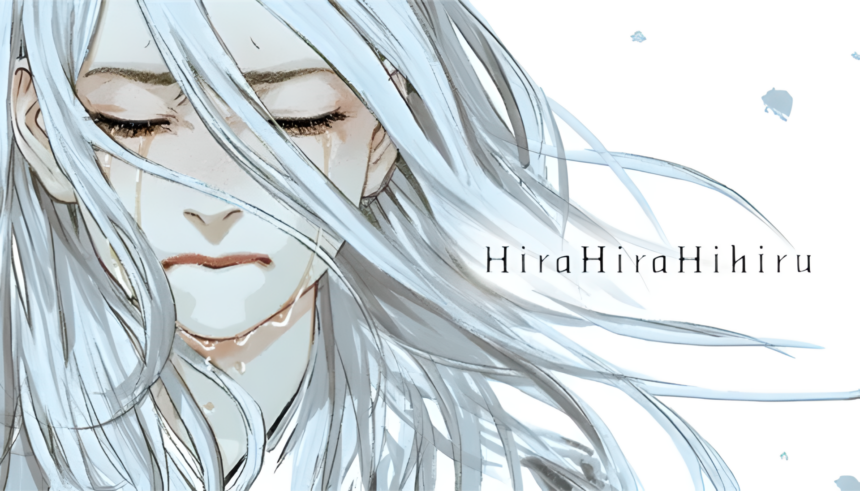
Have you ever watched someone you love change into a person you no longer recognize, and kept showing up anyway? That question sits underneath everything Hira Hira Hihiru is actually interested in, even though its premise dresses it up as horror fiction first. Written by Renya Setoguchi, known for tackling difficult social realism in titles like Black Sheep Town, and developed by BA-KU under the ANIPLEX.EXE banner, this fully voiced visual novel uses its fantastical setup, a condition called Aerodema that leaves the afflicted medically dead before returning with degraded cognition and decaying bodies, as a lens for examining something far more grounded: what chronic illness actually does to families forced to care for a loved one with no real institutional support, and how quickly a sick person can stop being seen as a person at all. Zennosuke’s character illustrations carry a distinctly painterly quality that set this apart from more conventional anime-style visual novel art for me right from the opening scenes.
Set in a fictionalized Taishō-era Japan, I split my time between Dr. Shūhei Katori, a physician conducting field studies to improve conditions for Aerodema patients, and Takeo Tenma, a high school student whose personal connection to the disease pulled him into the same orbit. Rather than treating the “hihiru,” as afflicted patients are known, as monsters to be feared or destroyed, the writing insists on their basic humanity even as society around them increasingly refuses to extend the same courtesy, and that insistence is where the game does its most powerful, uncomfortable work. Families forced by government policy to construct literal cages, euphemistically called “home cells,” to contain relatives who can no longer be trusted or afforded proper care gave the story a disturbing real-world parallel to how societies have historically handled mental illness, disability, and chronic disease when institutional support fails, and the writing draws that parallel with real, deliberate weight rather than treating the disease as pure fantasy horror set dressing.
The choice structure stays comparatively light by visual novel standards, a handful of pivotal decisions across two intertwined protagonist storylines rather than dense, constant branching, but those choices carry real, meaningful consequences; a single wrong call partway through can lock you into a genuinely different, worse outcome for one of the two central threads, and the ending I received for each protagonist’s story felt earned rather than arbitrarily assigned. That restraint in choice frequency suited the material well, letting the story build its social commentary patiently rather than fragmenting my attention across dozens of minor decision points that might otherwise have diluted the emotional through-line running underneath both perspectives.
Where the writing earned its strongest praise from me was in how thoroughly it commits to depicting suffering without exploiting it. The scenario avoids leaning on shock value despite genuinely difficult, occasionally violent subject matter, choosing instead to sit with the slow, grinding toll that caregiving under an unjust system takes on everyone involved, patients and family members alike. That patience did come with a real, specific cost by the story’s conclusion for me; the ending arrived somewhat abruptly, with credits rolling sooner than the emotional buildup seemed to be pointing toward, leaving at least a few threads feeling like they deserved more room to fully resolve.
MANYO’s score, released as a twenty-track soundtrack alongside the game, backs up the quieter, more atmospheric scenes well, and subtle facial animation alongside small environmental effects, wind, shuffling feet, distant knocking, gave even static scenes real atmospheric life for me. The full Japanese voice cast elevated the material’s heaviest emotional beats consistently, and the overall audiovisual package came together cohesively enough that the whole experience felt closer to watching a well-produced anime than reading a typical visual novel.
Verdict
Hira Hira Hihiru takes a fantastical premise and uses it with real discipline to examine chronic illness, caregiving, and institutional neglect, delivering its social commentary with a patience and sincerity that elevates it well beyond typical horror or fantasy trappings. Its choice structure stays intentionally light, and an ending that arrives somewhat abruptly relative to the story’s careful buildup keeps this from feeling fully complete by the time the credits roll. For readers drawn to grounded, emotionally serious storytelling wrapped in a striking, painterly presentation, this stands as one of the more quietly powerful visual novels to release in recent memory.