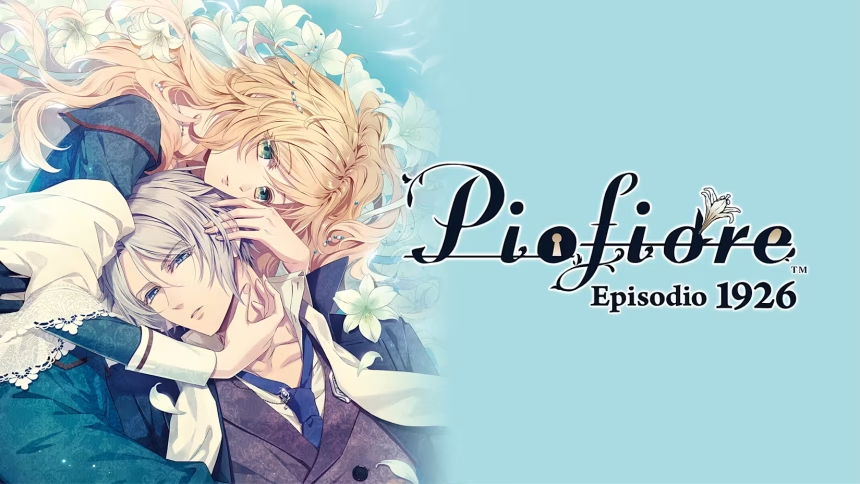
Mafia romance is common enough in otome games that I’d stopped expecting real consequence from any of it. They always involve characters who talk tough about danger while their happy endings stay safely bulletproof. Piofiore: Episodio 1926 is the first sequel in the genre I’ve played that actually treats its predecessor’s hard-won endings as fragile rather than settled. I picked this up as a follow-up to Fated Memories, a game I already regarded as one of the genre’s finest achievements, and this entry picked up a year later in the port city of Burlone, where the temporary truce between three warring mafia families holds just long enough for a stolen church relic, and the looming shadow of Mussolini’s rising fascist regime, to threaten everything the previous game’s cast fought to secure.
Structurally, this is framed as a fandisc, additional stories building directly on each love interest’s best ending from the first game, but the writing treats that framing as a floor rather than a ceiling. Rather than coasting on established relationships with light, low-stakes epilogue material, each returning route digs into real new conflict, deepening backstories for characters like Orlok, Nicola, and Yang in ways that recontextualize decisions they made in the original game, giving their earlier, sometimes questionable choices real added context they didn’t have room for the first time around. That deepening work elevated this well beyond a typical victory-lap sequel for me, and it’s the clearest reason I’d call this a real continuation rather than simple bonus content.
The game’s structure splits across two main chapters plus a hidden third, Episodio Burlone covering the five returning love interests, Episodio Alternativa offering a parallel storyline, and a secret Henri route that only unlocks after completing Alternativa. A flowchart system in the Alternativa section made navigating that specific branch considerably more manageable for me, letting me jump between story points and interchange the order of most routes freely, save for Dante’s storyline and the two content-locked entries that benefit from being played last for maximum narrative payoff. Lili herself continues to anchor the whole experience with real visual and character consistency, and her growing agency alongside each partner, rather than simple passive devotion, kept the romance grounded even as the surrounding political stakes escalated considerably. RiRi’s returning CG work carried real detail and emotional impact throughout this stretch of the story, giving Lili’s growth visible weight scene to scene.
Those stakes escalate in real dark directions, and this is where the game’s reputation as harder-hitting than its already-intense predecessor gets earned. Bad endings here land with devastating weight, and Henri’s route specifically pushed further into sexual violence and graphic bloodshed than anything in the first game. That’s a legitimate escalation from the original’s already mature content, and it’s presented with real narrative seriousness rather than gratuitousness, treating these outcomes as tragedy rather than shock value, but the intensity is real enough that readers sensitive to this kind of material should weigh that carefully before committing.
Where the writing draws its most persistent, avoidable criticism from me is in localization quality. The original Fated Memories was already notorious among fans for grammar errors and typos breaking immersion at inopportune moments, and while this sequel improves somewhat, meaningful text issues persist, particularly, frustratingly, in scenes tied to unlocking each route’s best possible ending, exactly the moments where clean, precise writing matters most.
Composer Shunsuke Wada’s score continues to elevate the game’s period Italian setting, and the addition of composer Myu, known for work across several other prominent Otomate titles, to the music production team added further polish to the opening and ending themes specifically. The weaving of real historical tension, Mussolini’s rise, Prohibition-era organized crime, into the fictional Burlone conflict gave the political backdrop unusually specific texture for the genre, grounding the story’s fictional mafia intrigue in unsettling historical context that I found more resonant than the first game managed. The full Japanese voice cast returned intact from Fated Memories, and that continuity mattered; hearing the same performances carry these characters into darker material made the escalation land harder than a recast would have.
Verdict
Piofiore: Episodio 1926 earns its reputation as more than a simple fandisc, delivering real character growth and real narrative stakes for a cast that’s already earned their happy endings once, while pushing into darker, more intense territory than its predecessor without losing the emotional sincerity that made Fated Memories a genre standout in the first place. Persistent localization errors and content intense enough to require real, serious content warnings keep this from being a flawless follow-up, and it remains entirely dependent on having played the original first. For fans of that first game specifically, this delivers a genuinely worthwhile, thoughtfully constructed continuation rather than a cynical cash-grab sequel.