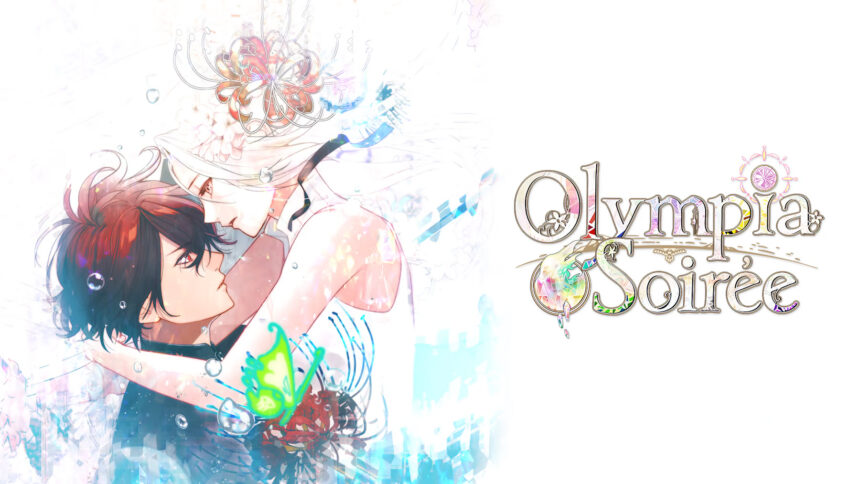
While not part of the usual pantheon of Otomate’s greatest hits, Olympia Soirée is one of the most striking, ambitiously world built otome titles Aksys has localized in years. The game reimagines the reverse harem formula as a rigid, color based caste system where the shade of a person’s soul determines their social standing, their permitted marriages, and in the case of its heroine, an actual religious obligation to keep the sun rising over an island that, until she turned eighteen, had only ever needed one woman to perform that duty. But the last woman capable of doing it, Olympia’s own mother, has been dead for thirteen years by the time the story begins.
The sudden responsibility of finding a husband from any color she chooses, in order to preserve her bloodline and keep the ritual going, prompts Olympia to leave the sheltered mansion she grew up in and actually meet the six men eligible to become that husband. Riku, a rigid Blue clan soldier who can’t quite reconcile his own prejudice with his growing feelings, Tokisada, a marebito outsider adopted into the Green clan and one year Olympia’s junior, Yosuga, the purple clan bathhouse owner who runs Yomi’s underground district in everything but official title, and Kuroba, a doctor from the Black clan researching a cure for a disease that’s rotting the island’s most inbred bloodlines, all become available from the start, with Himuka and eventually Akaza unlocking only once the others are cleared.
Olympia soon discovers that the island’s entire social order rests on a myth even its own leaders no longer fully believe, and she becomes entangled with figures like Kanan, a Yellow clan schemer whose manipulation of Tokisada and his twin brother Kaina drives some of the story’s darkest turns, and Yosuga himself, whose flirtatious front hides a man carrying real weight for everyone living under his protection in Yomi.
The Color Caste system itself is what makes this fantasy setting feel properly realized rather than decorative. Primary colors like Red, Blue, and Yellow govern secondary and mixed colors beneath them, and anyone displaying multiple traits or falling into Black gets exiled to Yomi, an underground settlement whose name literally means hell. The story spends real, sustained time exploring how that hierarchy actually damages the people trapped inside it rather than treating the setting as a backdrop for romance alone, and by the time later routes start connecting individual character arcs back to the wider mythology involving marebito, souls who drifted from other worlds and got reborn into the island’s color system, the world building pays off with real, earned complexity.
That density comes at a real cost, though. The common route runs long before any meaningful choices arrive, and the sheer volume of lore delivered through flashback tested my patience considerably even though I came around on the overall story eventually. I lost track more than once of exactly how much time had passed reading through accumulating exposition, and the sense that this game simply front loads too much information too fast is a fair, real limitation rather than me being an impatient reader.
Character work across the six romanceable leads varies in both quality and how directly each one engages with the story’s heavier themes. Tokisada’s route, following the youngest of the group, digs into the marebito mythology with real narrative purpose, and the slower burn friendship first structure of his romance gives it a specific charm distinct from the more immediately intense routes elsewhere in the cast. Yosuga’s route unravels meaningful plot threads tied to the game’s overarching mystery while giving one of the more melancholic love interests real depth once his guarded exterior starts cracking.
Where the writing draws its sharpest, most serious criticism from me is in how it handles sexual violence as a dramatic device. More than one route leans on assault specifically for shock or emotional weight without always following through on a meaningful resolution to that trauma, and that’s a legitimate, recurring problem rather than an overreaction to difficult material handled with real care. It’s worth knowing exactly which routes carry that risk before starting, since it isn’t evenly distributed across the cast.
Olympia herself gave me mixed but largely positive reactions as a lead, self conscious and inexperienced at the story’s outset but growing into someone stubborn and properly opinionated by its conclusion, giving her arc real coming of age shape independent of whichever route a given playthrough follows. She stays more passive within certain individual routes than the broader narrative’s insistence on her growing agency would suggest, which is a fair, specific inconsistency in how thoroughly that character growth actually carries across every path rather than just the common route framing it.
Developed by Otomate and published in Japan by Idea Factory before Aksys Games brought it west, this release carries presentation that stands out even against Otomate’s own back catalog. Character art gives the cast real visual distinction between color clans without ever feeling like a simple palette swap, and the soundtrack complements the fantasy setting with real atmospheric weight, leaning toward something more grounded and folklore inflected than typical genre music usually reaches for.
Full Japanese voice acting throughout adds real texture to a script this dense, missing only for Olympia herself per genre convention, and performances from actors like Yuma Uchida as Yosuga and Yuto Uemura as Tokisada carry real weight during the story’s heaviest confrontations.
The game’s runtime stretches considerably once every route gets factored in, and the world building earns real room to breathe once the common route’s slower stretches give way to the individual character paths. By the time I reached Akaza’s route, the game’s true finale, the accumulated weight of everyone else’s stories made the island’s central mystery land with far more force than it would have carried on its own.
Verdict
Olympia Soirée earns its reputation as one of the more ambitious, world building forward otome titles to receive an official localization, using an intricate color based caste system to ground romance routes that occasionally reach for real social commentary about discrimination and inherited privilege. An overlong, exposition heavy common route and a fair, real critique around how the writing handles sexual violence as dramatic shorthand keep this from being a flawless recommendation, and Olympia’s own agency doesn’t always track consistently across every individual path. For readers drawn to dense, mature fantasy otome willing to sit with difficult subject matter and a demanding runtime, this delivers a distinctive, visually striking world worth the considerable time investment.