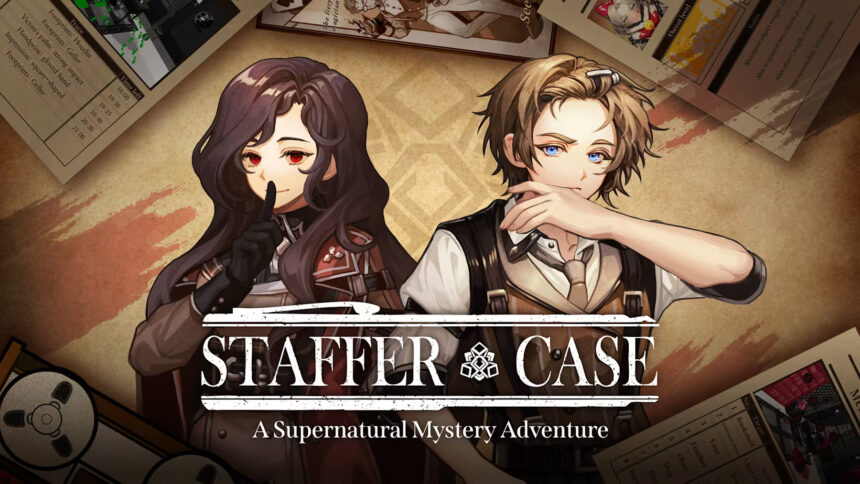
Things start rockier than they should in the meticulous detective drama Staffer Case: A Supernatural Mystery Adventure, which follows Notrick Case, the newest and only non-powered investigator inside a division built to handle crimes tied to supernatural ability. A cast of pun heavy names and character art with a soft, generic quality make the opening hour a real test of patience before the mystery underneath gets any room to breathe.
Muted watercolor backgrounds and a deliberately noir tinted color palette give the investigation scenes real atmosphere despite the shakier character portraits, staging alternate 1960s London as somewhere worth spending five full cases inside. The soundtrack leans on a mix of licensed and stock tracks that stay competent without turning into a signature the way genre touchstones sometimes manage, understated enough that it never fights a testimony scene or a quiet office aside for attention. Voice acting wasn’t part of the picture at launch. That came two years later with a Nintendo Switch edition featuring a full Japanese dub, since folded back into the PC version through a 2025 update, and it adds real weight to scenes that otherwise rest entirely on text.
Team Tetrapod, the small Korean studio that released Staffer Case on PC in 2023, builds its supernatural conceit around bureaucracy rather than spectacle. Pheno-Mana, the ability roughly ten percent of this alternate London’s population carries, gets treated as a regulated, paperwork heavy fact of life. Staffers are registered and monitored, and their abilities only produce specific, limited evidence, emotional distress readings, trace photography marking when contact occurred, memory fragments pulled from objects at a scene, material Note and his colleagues have to interpret and cross reference rather than accept outright.
Five self contained cases carry the whole game, Backstage, Pet Shop, The Wizard’s Room, Mistletoe, and an unnamed fifth case that closes out the overarching mystery threaded beneath them, plus two extra substories built around specific characters’ backstories. Each case runs a couple of hours toward one of two outcomes, a true ending that actually resolves the mystery and a false ending triggered by a wrong turn somewhere along the way, which keeps reaching a conclusion and correctly solving a case from being the same thing. Most of that runtime goes to absorbing dialogue and testimony before the evidence loop kicks in, gathering clues, arranging them into structured documents, and hunting contradictions between competing accounts, a loop with a clear family resemblance to Ace Attorney’s own evidence system, minus the courtroom theatrics in favor of something closer to procedural bureaucracy. Across all five cases and both substories, the whole thing runs close to twelve hours.
Very few of the five cases resolve into a clean right or wrong answer, and even the culprits get reasoning that plays as sympathetic rather than simply villainous, which kept me turning a case’s outcome over well past the credits on more than one occasion. Staffers occupy an uneasy social spot in this version of London too, regulated and quietly looked down on despite what they can do, and that tension gives the alternate history setting real weight beyond its premise. The earliest cases feel thin against what comes later, but threads planted from the very first letter Notrick receives from the Pheno-Mana Bureau pay off by the fifth case in a way that retroactively recontextualizes an early, mid-story detail without spelling out exactly how that final case resolves.
The deduction system itself isn’t flawless. Trivial, obvious observations sometimes get forced through the same formal structure built for far more meaningful conclusions, and certain clues can reasonably answer more than one prompt while the game only accepts its one predetermined answer regardless of how sound an alternate read might be. Neither issue derails the difficulty curve, which stays fair across all five cases without tipping into hand holding or blind guesswork.
Even the pun heavy character names that make the first hour rough going read differently by the end, less like weak writing and more like a joke the game was in on from the start, the kind of small detail that only clicks once the larger mystery threaded underneath all five cases finally resolves.
Verdict
Staffer Case: A Supernatural Mystery Adventure wins back the goodwill it spends early with a disciplined, bureaucratic take on supernatural crime solving that keeps five cases feeling fair and actually solvable rather than magically convenient. Soft character art and clunky early pacing keep the first hour from making a strong impression, and the deduction system has a few rough edges of its own, but the moral complexity running through every case and a fifth case payoff worth the wait make this one worth pushing past its unassuming start.