Okay, i believe i need to clarify two main things before i jump on anything else in this review. This visual novel carries a genuinely heavy content list, including references to human trafficking, child abuse, substance abuse, self-harm, and suicide woven into its crime drama, alongside general violence throughout, and I want that said plainly rather than buried. Second, this is a direct sequel picking up immediately after the first BUSTAFELLOWS’ ending, with zero in-game recap of prior events, so playing the original first is essentially mandatory going in, and I found myself wishing I’d refreshed my memory of specific plot details before starting even as someone who’d already finished it.
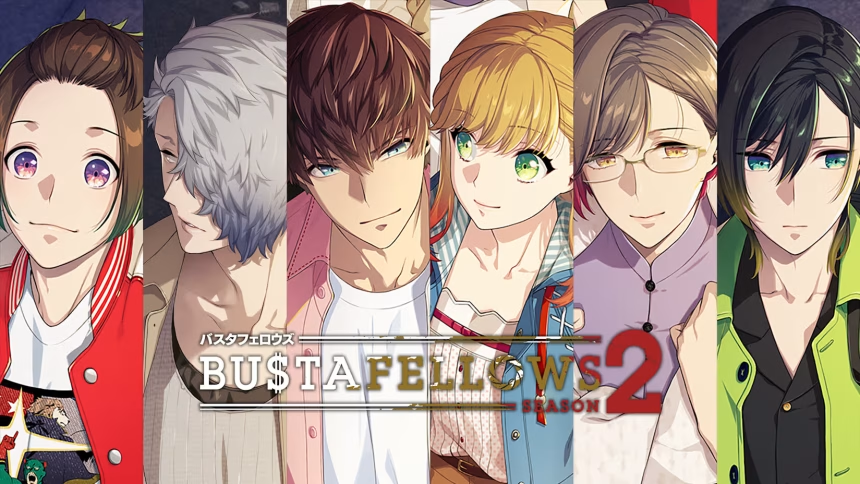
Sequels to beloved otome titles usually take one of two paths: a short, epilogue-style fandisc with the survivors, or a full-blown continuation that risks diluting what made the original special in the first place. BUSTAFELLOWS Season 2 swings hard for the second option, and largely justified that ambition for me. Developed by Nippon Cultural Broadcasting Extend and localized by PQube, releasing in the west on July 17, 2025 for Switch and PC, this is a substantial follow-up rather than a victory-lap epilogue, running somewhere around forty-five hours if you’re seeing every character’s episode and the game’s true conclusion, and it picks up Teuta Bridges and her found family of morally gray allies in the aftermath of the first game’s dramatic finale.
Teuta, a journalist with the unusual ability to time-leap backward shortly after death, spends this sequel navigating already-established relationships with lawyer Limbo, surgeon Helvetica, coroner Mozu, hacker Scarecrow, and sniper Shu, rather than the will-they-won’t-they courtship structure that defined the original. That’s a meaningfully different otome proposition, and it’s one the game handled with real care as far as I could tell. Watching a couple navigate genuine emotional maturity, jealousy, insecurity, the friction of actually building a life together, gave the romance a texture that a typical “will she pick him” structure rarely attempts. A small, oddly charming addition helps steer that choice: rather than an obvious upfront selection screen, you pick a cat’s name at the start, and that seemingly trivial decision quietly locks you into whichever love interest’s route corresponds to it, an unconventional system I found genuinely functional once I understood what I was actually choosing.
The mystery plot carries over the series’ defining willingness to dig into genuinely dark, socially grounded material, corruption, organized crime, immigration politics, and institutional violence woven directly into the central case rather than treated as background texture. That’s the throughline that’s made this series stand out from Western otome expectations from the start, and Season 2 leans into it just as hard, if not harder, than its predecessor. The trade-off is real, though. Because the crime drama carries so much narrative weight across every route, the romantic beats occasionally read as comparatively small stakes by contrast, a structural tension I noticed even while still enjoying the game overall. Route quality also varied for me depending on which character I was following, with certain storylines landing as tightly paced highlights and at least one main route dragging in ways that didn’t match the strength of the writing elsewhere, alongside characters occasionally making decisions that felt engineered for drama rather than earned by their established personalities.
Where this entry earned its most consistent praise from me is in production polish. Character portraits and CGs are striking across the board, voice acting draws near-universal acclaim, including for Teuta herself, an unusually rare choice to give an otome protagonist her own voiced performance, and the atmospheric sound design does real work selling New Sieg as a lived-in, specific place rather than a generic city backdrop. That same ambitious sound design creates its own friction, though. Background ambient conversations meant to reinforce the city’s atmosphere competed audibly with the primary dialogue at points for me, distracting rather than immersive, and voice-only side dialogue without accompanying subtitles remains an issue carried over unaddressed from the first game, a real accessibility gap worth knowing about going in.
The structural decision to offer zero recap of the original’s events is this sequel’s single most consistent flaw, from my own experience with it. Given the years-long gap between the original’s Western localization in 2021 and this follow-up, expecting players to remember specific character arcs, relationship history, and plot details in full is a genuinely steep ask, and the game’s reference archive helped with setting terminology but did nothing to refresh route-specific emotional context for me. It’s a real usability oversight in an otherwise thoughtfully constructed package.
Verdict
BUSTAFELLOWS Season 2 earns its place as a genuine, full-scale continuation rather than a lightweight fandisc, delivering the series’ signature blend of grounded crime drama and morally complex romance with real production polish and a cast worth spending another forty-five hours with. Uneven pacing across individual routes, romance occasionally taking a back seat to plot stakes, and a complete absence of any recap for returning players keep it from being a flawless sequel, but for fans of the original who’ve been waiting years for this cast’s story to continue, this delivers a substantial, well-crafted return to New Sieg.