The history of visual novels begins in Japan in 1983 and stretches across four decades to reach a global medium with over 50,000 catalogued titles, a market valued in the billions, and a cultural presence that extends through anime, merchandise, and development communities on every continent. It is a history shaped by specific hardware, specific cultural conditions, specific studios that raised the creative ceiling of the medium, and specific titles that changed what the format was understood to be capable of.
This article covers that history chronologically, from the earliest adventure games that gave birth to the format, through the landmark eras of growth and transformation, to the current state of a medium that is simultaneously thriving in some sectors and facing new challenges in others.
For readers who want to understand what visual novels are before reading their history, our guide to what a visual novel is covers the format’s definition, structure, and conventions.
Before the Visual Novel: The Adventure Game Roots
Any accurate history of visual novels must begin slightly before visual novels existed, in the American adventure game tradition that directly inspired them.
Western interactive fiction, specifically text-based adventure games produced in the United States in the late 1970s and early 1980s, reached Japan through gaming magazines and imported software. Japanese developer Yuji Horii encountered these games and was drawn to their approach to narrative, their combination of puzzle-solving with a story driven by player interaction. He set out to create something similar but adapted for Japanese players and the hardware available in Japan at the time.
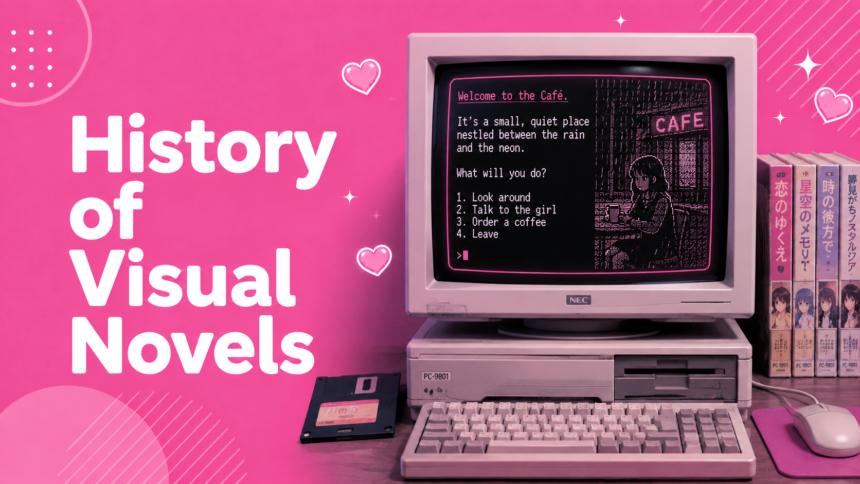
The result was The Portopia Serial Murder Case in 1983, produced by Horii for Enix and released for the NEC PC-6001. Horii later created the Dragon Quest series, but Portopia was his first major achievement and the game most consistently cited as the origin point of the visual novel format. It was a murder mystery that combined detective investigation with text commands and rudimentary graphics, allowing players to move between locations, question characters, and pursue the case through a branching structure with one true resolution. Its commercial success was significant enough to prompt a Famicom port in 1985, bringing the format to a console audience.
The VNDev Wiki notes that visual novels following Portopia developed in a similar vein to adventure games and lacked the sprite-on-background presentation now familiar today, instead sequencing most visuals shot to shot like manga. This original manga-like compositional approach is an important distinction from what later became the defining visual language of the format.
The term visual novel itself did not exist in 1983. Fukuyama, a Japanese video game journalist, wrote that the expression emerged in the mid-1990s and has been applied retroactively to earlier games by Western communities. Some games from the late 1980s promoted themselves as novel games first in the Japanese PC market, with DOME by System-Sacom in 1988 being marketed as Novelware. The retroactive application of the visual novel label to earlier games creates definitional complications that historians acknowledge have no clean resolution.
The 1980s: Foundational Years
With Portopia establishing that narrative-driven games could find substantial audiences in Japan, other developers moved quickly to build on the format. Square, before it became famous for Final Fantasy, was among the first companies to follow Horii’s model, producing adventure games in the Portopia tradition.
Hideo Kojima, who would later create Metal Gear Solid, produced Snatcher in 1988 for the PC-88. Set in a cyberpunk future where biomechanical robots called Snatchers are replacing humans, it pushed the cinematic ambitions of the adventure game format further than most contemporaries. Its rich visual presentation and ambitious science fiction narrative demonstrated what the format could achieve with stronger production values and genuine creative investment. It was later ported to multiple platforms, including PC Engine in 1992, reaching wider audiences.
The adult game market, known as eroge, was already a significant presence in Japanese PC gaming by the mid-1980s. Tenshi-tachi no Gogo by JAST in 1985 was an early example of the illustrated adult game format that would fund much of the visual novel industry’s infrastructure development across the following decade. The commercial viability of adult content on Japanese home computers created a market that supported the production skills, illustration techniques, and distribution networks the broader format later depended on.
Chunsoft released Otogirisou in 1992 under its Sound Novel trademark, a label the company used to distinguish its atmospheric text-heavy titles from other adventure games. Sound Novels placed particular emphasis on audio design and dense textual narration with limited visual elements, creating a distinct aesthetic tradition parallel to but connected with the broader visual novel format. Chunsoft’s Sound Novel series produced several landmark titles and the trademark itself contributed to the naming conversations that eventually produced the term visual novel. The PDF academic source on visual novel history notes that the company Leaf, in order not to use Chunsoft’s trademark Sound Novel, named their series games Visual Novels, which is one documented origin point of the term entering wider use.
The 1990s: Genre Definition and the Bishojo Boom
The 1990s were the decade in which visual novels became a distinct and commercially dominant force in Japanese PC gaming, shaped by three converging developments: improved hardware enabling better illustration and full voice acting, the emergence of dedicated visual novel studios with serious artistic ambitions, and the rise of romance-focused games that created a massive dedicated audience.
CD-ROM storage changed what was possible in visual novel production. Where floppy discs had constrained illustration quality and excluded voice acting from most titles, CD-ROMs provided enough storage for high-resolution character art, full voice casts, and music libraries of genuine quality. The step change in production values that followed attracted both more investment and more creative talent to the format.
Tokimeki Memorial, released by Konami in 1994 for the PC-Engine, established the romance simulation game as a commercially significant subgenre. Its combination of stat management, time allocation, and relationship cultivation across a fixed high school timeline attracted enormous audiences and generated a franchise that continued for years. Dating simulation games drew on visual novel conventions while adding simulation mechanics, and the distinction between the two formats was not always clear to audiences or even developers. The commercial success of romance-focused games accelerated the development of the broader visual novel market by demonstrating the scale of the audience available.
Leaf was among the studios most responsible for elevating the artistic ambition of the format. Shizuku in 1996 and Kizuato in the same year developed the emotional visual novel in a more serious literary direction. To Heart in 1997 achieved mainstream recognition for its character writing quality and warm emotional register, setting a standard for the format that influenced everything that followed. Leaf deliberately used the term visual novel rather than Sound Novel to distinguish their format from Chunsoft’s trademark, and their consistent use of the term contributed to its adoption as the genre’s standard label.
Key was founded in 1998 as a division of Visual Arts, bringing together the team that produced Kanon in 1999. Kanon combined a melancholy winter setting, a cast of girls with hidden backstories, and emotional payoffs that arrived with a restraint that made them more affecting rather than less. Its commercial and critical success established Key as the studio most closely associated with the emotional drama visual novel and created the template the studio refined across Air, Clannad, and every subsequent title.
By the late 1990s, visual novels were the dominant format in the Japanese PC game market. The tools for production were becoming more accessible. NScripter, launched in 1999 by Naoki Takahashi, provided a scripting framework that enabled smaller teams to produce complex titles. KiriKiri, also available from 1999, offered similar accessibility and would go on to power some of the most important commercial visual novels of the following decade.
The 2000s: The Golden Age
The period from approximately 2000 to 2009 is described across community history sources and academic accounts as the golden age of visual novels. The concentration of landmark titles produced within this decade, each raising the format’s ceiling in different directions, has not been equalled before or since.
Type-Moon, founded by Kinoko Nasu and Takashi Takeuchi, self-published Tsukihime in 2000 as a doujin title sold at Comic Market. Produced using NScripter, it followed a teenage boy who can see the death lines of living things and his encounter with a vampire named Arcueid Brunestud. Its quality spread through word of mouth within the visual novel community and established Type-Moon as a creative force well before the studio had commercial resources.
07th Expansion’s Higurashi: When They Cry began in 2002 as a series of doujin titles sold at Comic Market with minimal production values, no voice acting, and amateur artwork. Its creator Ryukishi07 has described studying Key’s visual novels to understand why they were so emotionally effective, identifying the pattern of beginning with warm ordinary life before a sudden event produces shock and tears. He used a similar opening structure but replaced the emotional devastation with horror, producing the paranoia-based psychological structure that made Higurashi unlike anything else in the format’s history. The title grew through fan community engagement into anime adaptations, manga, stage productions, and a transmedia franchise that continues into the 2020s.
In 2004, three titles arrived that would prove among the most significant in visual novel history. Fate/stay night by Type-Moon became one of the most successful visual novels ever produced and the origin of a franchise that grew into one of the highest-grossing media properties in the world. Clannad by Key told the story of a teenage boy from high school through adulthood with an emotional depth and patience unmatched in the format, before its After Story arc delivered what many readers describe as the most affecting narrative sequence they have experienced in any medium. And Ren’Py was released as a free, open-source visual novel engine for English-speaking developers, a development whose long-term consequences for the global spread of the format were enormous.
Steins;Gate arrived in 2009 from 5pb. and Nitroplus, combining a time travel science fiction premise with a precisely constructed narrative that used the format’s slow first half as essential architecture for its devastating second. It won Famitsu’s Game of Excellence award and was voted the best adventure game of all time by Famitsu readers in 2017. Its anime adaptation, released in 2011, became one of the most watched and critically praised anime series in the medium’s history.
Throughout this decade, the format remained almost entirely inaccessible to Western audiences through official channels. Researchers Kretzschmar and Raffel described English-language ports of Japanese visual novels as basically non-existent in the 1990s and early 2000s. Western readers who encountered the format did so through fan translations, through anime adaptations of visual novel source material, or through the handful of titles that reached Western game distribution through conventional channels.
Phoenix Wright: Ace Attorney was the most significant of these. Released in Japan in 2001 and brought to Western markets in 2005 by Capcom, it introduced the courtroom drama and investigation gameplay format to Western players who had no awareness of visual novel conventions. GameSpot credited it with revitalising the adventure game genre in the West. Its success led directly to increased publisher interest in bringing Japanese visual novels to Western markets.
By 2006, visual novels accounted for upward of 70 percent of the PC game market in Japan according to available data, reflecting the extraordinary domestic dominance the format had achieved. The same period saw what Automaton later described as a subsequent shrinking of that market, with digital distribution eventually providing a revival.
The 2010s: Western Growth and the Indie Revolution
The 2010s were the decade in which visual novels became a genuinely international medium rather than a Japanese cultural export with a small dedicated Western audience.
Steam was the primary mechanism. When visual novels began appearing on Steam in volume, they occupied the same digital storefront as every other PC game, discoverable through the same recommendation systems and purchasable without specialist knowledge of import markets or fan translation communities. Publishers including MangaGamer, JAST USA, and Sekai Project established pipelines for bringing Japanese commercial titles to Western Steam audiences, with catalogues that expanded year on year.
Aksys Games demonstrated that the otome game market had Western commercial viability with the English release of Hakuoki: Demon of the Fleeting Blossom for PlayStation Portable in 2012. Its success opened the Western console market for otome games and prompted Idea Factory International to establish its own Western publishing operation for subsequent releases.
Katawa Shoujo, released in 2012 by the international volunteer team Four Leaf Studios, was produced in Ren’Py and distributed for free. It demonstrated that non-Japanese developers without commercial resources could produce visual novels of genuine emotional quality that found large international audiences. By 2024 VNDB had documented over 50,000 visual novel titles, up from 24,000 in 2019, and Ren’Py alone powered nearly 23,000 of those titles.
Doki Doki Literature Club in 2017 changed the trajectory of the format’s Western visibility more dramatically than any other single title. Released for free by Team Salvato, it reached between five and ten million Steam owners driven primarily by content creators on YouTube and Twitch who brought it to audiences with no prior exposure to visual novels. It used the specific properties of the format in ways that no passive storytelling medium could replicate, and it introduced the concept of visual novels to millions of Western readers who had not previously been aware the format existed.
VA-11 Hall-A from Venezuelan developer Sukeban Games in 2016 demonstrated that an English-first visual novel developed entirely outside Japan, without anime-style aesthetics and without Japanese cultural references, could achieve genuine critical and commercial success. It was the most significant early marker of what the Western indie scene would produce across the following years.
The 2020s: Global Industry and Open Questions
The visual novel entered the 2020s as a genuinely global medium with market data that reflected its scale. The global visual novel market was valued at approximately $9.4 billion in 2025 according to market research, with Asia Pacific accounting for 52.4 percent of total revenue driven by Japan’s mature ecosystem alongside South Korea’s growing otome mobile segment and China’s rapidly expanding indigenous development community.
Mobile became the dominant platform by revenue, accounting for approximately 38.6 percent of global revenue in 2025. The format’s compatibility with smartphone consumption, its minimal hardware requirements, and the accessibility of freemium monetisation models on iOS and Android brought it to demographic groups that PC and console distribution had not reached.
The VNDB catalogue exceeded 50,000 titles by 2024, with Ren’Py alone accounting for nearly 23,000 of those entries. Itch.io’s visual novel catalogue expanded to tens of thousands of titles across every genre, style, and length, with game jams producing hundreds of new visual novels annually. The barrier to creating and distributing a visual novel reached its lowest point in the format’s history.
Japanese creators began discussing the challenges of the traditional long-form PC visual novel in this period. Kazutaka Kodaka and Jiro Ishii spoke publicly about their concerns that neither recent title series had achieved the cultural explosiveness of earlier landmarks like Higurashi or Steins;Gate. A scenario developer at Key noted in 2026 that visual novel games for PC were beginning to disappear from the game market due to poor cost-effectiveness and changes in the entertainment landscape. Kodaka added that he hoped for a revolutionary work demonstrating a completely new way of storytelling comparable to what earlier landmark titles had achieved.
The arrival of generative AI introduced both production possibilities and anxieties across the community. In 2024 and 2025, AI tools enabled a significant increase in the quantity of indie AI-generated visual novels by facilitating easy generation of images, dialogue, and scenarios. Kodaka’s collaborator noted publicly that The Hundred Line: Last Defense Academy in 2025 might become the last large-scale visual novel story written entirely without AI, framing a question the medium is still working out how to answer.
Key Figures in Visual Novel History
Several individuals shaped the medium’s history in ways that deserve direct acknowledgment.
Yuji Horii created Portopia and established the foundational template. Chunsoft’s Koichi Nakamura and the Sound Novel team built the atmospheric text-heavy tradition that ran parallel to the visual novel mainstream. Kinoko Nasu and Takashi Takeuchi of Type-Moon created Tsukihime and Fate/stay night, originating a franchise of global scale. Ryukishi07 of 07th Expansion created Higurashi and Umineko, the most ambitious works in the format’s psychological tradition. Key’s scenario writers, including Jun Maeda, created Kanon, Air, Clannad, and the emotional drama tradition that defines one of the format’s most beloved subgenres. Kotaro Uchikawa created the Zero Escape series, producing some of the most structurally innovative thriller visual novels in the medium’s history. Tom Rothamel created Ren’Py, the open-source engine without which the Western visual novel development community would not exist at the scale it does. Team Salvato’s Dan Salvato created Doki Doki Literature Club, the title that did more than any other to bring the format to mainstream Western attention.
The Format’s Defining Characteristics Across Its History
What connects The Portopia Serial Murder Case in 1983 to the visual novels of 2025 is not visual style, which has changed enormously, or production scale, which ranges from solo bedroom projects to commercial productions with substantial budgets, or even interactivity, which spans from no choices at all in kinetic novels to extensive branching systems with dozens of endings.
What connects them is a commitment to storytelling as the primary purpose of the format. Visual novels exist to tell stories, and every development across the medium’s history, the improvement of illustration quality, the arrival of full voice acting, the development of branching narrative systems, the expansion of available genres, the democratisation of production tools, has served that purpose. The format asks something specific of its readers, patience, investment, willingness to read carefully for hours, and rewards that investment in kind.
For readers who want to explore the medium’s current state and its most celebrated titles, our top 10 visual novels of all time covers the titles most central to the format’s history and reputation. Our guide to how to get into visual novels covers where to start for readers new to the format. And the visual novels glossary defines all terminology that comes up in historical and critical discussion of the medium.