When someone asks how to translate a visual novel, they usually mean one of three quite different things. They might want to read a Japanese visual novel that has no official English release and need a way to understand it in real time. They might want to produce a proper fan translation patch — extracting the script, translating it, and reinserting it into the game files. Or they might have created their own visual novel and want to make it available in multiple languages for a wider audience.
Each of those situations has its own process, its own tools, and its own challenges. This guide covers all three, starting with the simplest and working through to the most complex. If you are new to visual novels entirely and want to understand the medium before diving into translation work, our guide to what a visual novel is is a good starting point, and our visual novels glossary covers the terminology you will encounter throughout.
Part One: Real-Time Translation — Reading a Visual Novel in Another Language As You Play
The simplest approach to translating a visual novel is not to modify the game at all, but to run a translation tool alongside it that reads the text as it appears on screen and displays a translation in a separate window. This is called real-time translation, and it is the standard approach for readers who want to experience a Japanese visual novel that has no English release.
Text Hooking
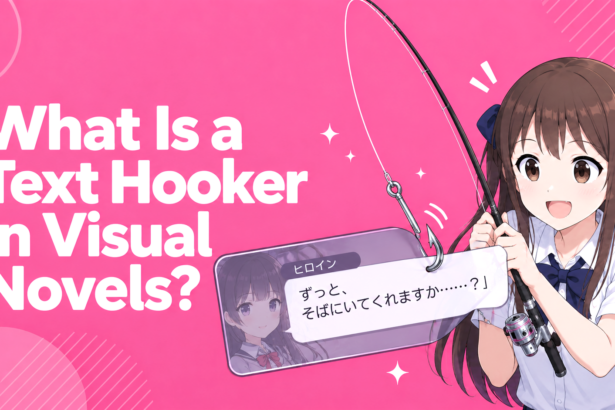
Text hooking is the most reliable real-time translation method for most Japanese visual novels. A text hooker is a program that attaches to a running game, reads the text data from its memory as each line is displayed, and passes it to a translation service or dictionary tool.
Textractor has been the most widely used text hooking tool for visual novels for years. It works by attaching to a running game process, automatically searching for the text hook — the specific memory location where dialogue is stored — and extracting it continuously as the game progresses. Once Textractor is extracting text successfully, it can send each line to a machine translation extension, display it in a separate window, or copy it to the clipboard for use with a dictionary lookup tool.
For most common visual novel engines — KiriKiri, Kirikiri Z, RealLive — Textractor finds the correct hook automatically. For games using less common or proprietary engines, it may require manually adding a hook code, which community members often document and share for specific titles. A searchable database of hook codes for many games exists at the VN Hooking Wiki.
Textractor itself has not been actively maintained for some time, and newer games occasionally present compatibility issues. LunaTranslator is the current community recommendation as a more actively maintained successor, with improved support for modern game engines including Unity, Ren’Py, and TyranoScript.
OCR Translation
For games that text hooking cannot reach — older titles, console emulators, games with unusual engines, or any situation where the text is rendered directly as part of the image rather than stored as extractable data — OCR (Optical Character Recognition) translation is the alternative. OCR tools capture a region of the screen visually, recognise the characters, and pass the recognised text to a translation service.
VNTranslator supports OCR alongside text hooking and clipboard translation, providing a unified interface for multiple translation approaches. Its OCR module handles the most common visual novel text presentations and includes pre-processing options for improving recognition accuracy on styled game fonts.
Machine Translation Quality
It is important to understand what real-time machine translation can and cannot do. Tools like DeepL and Google Translate have improved substantially in recent years and can give you a workable understanding of what is happening in a scene. However, machine translation handles tone, literary nuance, Japanese honorifics, wordplay, and cultural references poorly. A machine-translated visual novel is not the same experience as a human-translated one — you will understand the plot, but you will miss a great deal of the craft.
For readers learning Japanese, real-time text hooking is used differently: not to translate automatically, but to pipe extracted text into a dictionary tool like Yomitan that allows hovering over individual words for definitions. This approach is one of the most effective reading immersion methods for intermediate Japanese learners, combining genuine story engagement with vocabulary acquisition in context. The MoeWay Japanese learning guide covers this workflow in detail for anyone interested in using visual novels as a Japanese study tool.
Part Two: Fan Translation Patches
A fan translation patch is a fundamentally different undertaking from real-time translation. Rather than displaying a translation alongside the game, a patch modifies the game files themselves so that the translated text appears directly in the game, as if it were the original. The result, when done well, is indistinguishable from a professional localisation.
Fan translation has a long and significant history in the visual novel community. Many of the most celebrated English translations of Japanese visual novels — including the original Steins;Gate translation that later became the basis for JAST USA’s official English release, the Fate/stay night translation by Mirror Moon, and the Umineko When They Cry translation by Witch-Hunt — were produced by fan teams working voluntarily over months or years. As the Kotaku profile of the Steins;Gate fan translation team documents, fan translators are sometimes hired by publishers directly, with their work forming the foundation of commercial releases.
The Roles in a Fan Translation Team
A serious fan translation project typically requires at least three distinct skill sets, though individuals sometimes cover more than one role.
The translator is responsible for producing an accurate English rendering of the source text. For Japanese visual novels this requires genuine fluency — not textbook Japanese but the ability to read literary prose, casual speech, archaic language, and dialect simultaneously, while understanding the cultural context that shapes word choices. This is the central skill the project depends on, and it cannot be substituted.
The editor takes the translator’s output and shapes it into natural, readable English. Translation and editing are different crafts: a translator who produces accurate text may produce text that reads mechanically or awkwardly in English, and an editor fluent in the target language but not the source language can smooth this into something that feels written, not converted. The best fan translations involve close collaboration between translator and editor.
The hacker or technical lead handles extracting the game’s script files, understanding the game engine’s format, and reinserting translated text back into the game. This is genuinely technical work that requires comfort with hex editors, archive tools, script parsing, and sometimes writing custom tools. The hacker role is often the bottleneck in fan translation projects — finding someone with both the technical skills and the time to work on a specific game engine is frequently harder than finding translators.
Some projects also include image editors who translate any text embedded in CG artwork, UI screens, or title cards that cannot be handled through the script alone.
Step One: Extracting the Script
Before any translation can begin, the game’s text must be extracted from its archive or script files into a format the translation team can work with. The method depends entirely on the game engine.
For older Japanese visual novels using common engines, tools like VNTranslationTools support script extraction and reinsertion for a range of engine formats. For Ren’Py games, the engine’s built-in tools or unpackers like unrpa can extract script files directly. For games using proprietary engines, the hacker must reverse-engineer the file format, which may require significant time and technical skill.
Extracted scripts are typically cleaned up into plain text or spreadsheet format so translators can work through them without needing to handle technical formatting. Spreadsheets are popular because they allow multiple translators to work simultaneously on different sections while a project lead tracks progress.
Step Two: Translating the Script
With the extracted script in hand, translation begins. For a visual novel of meaningful length — even a relatively short one — this is an enormous undertaking. As our guide to how long visual novels are explains, a medium-length visual novel may contain 100,000 to 300,000 words. A long one can exceed a million. Translating that volume to a publishable standard takes months or years of sustained work.
The VNDev Wiki’s translation guide identifies several specific challenges that visual novel translation presents beyond raw volume. Cultural references — food, social customs, media, celebrity culture — do not translate directly and require decisions about whether to localise, adapt, or explain. Japanese honorifics (san, kun, chan, senpai) carry relationship information that English does not encode. Wordplay and puns built into character names or dialogue often need to be recreated entirely in the target language rather than translated literally.
Maintaining consistency across a long project is also a serious challenge. Character names should be rendered consistently. Technical terms, location names, and recurring phrases need to be tracked in a shared glossary so that different translators working on different sections do not produce inconsistent terminology. Many teams maintain a style guide alongside their translation document to standardise these decisions.
One decision that shapes the entire tone of a translation is where to position it on the spectrum between literalism and localisation. A literal translation preserves the structure and phrasing of the original as closely as possible. A localised translation adapts idioms, references, and speech patterns to feel natural in the target language, sometimes at the cost of fidelity to the exact source text. Both approaches have defenders in the visual novel community, and the right choice depends on the material and the intended audience.
Step Three: Editing and Quality Control
Raw translation output, even from skilled translators, requires editing. Dialogue must flow naturally when read at the pace a visual novel delivers it. Narration must have a consistent voice. Character speech patterns must remain distinct and recognisable across long stretches of story. Lines that are technically accurate but read awkwardly in English need to be reworked without losing meaning.
The editing phase also catches consistency errors — a character’s name rendered differently in two parts of the script, a technical term used inconsistently, a line that contradicts a translation choice made earlier. Beta readers who play through the patched game and flag issues are invaluable at this stage. Many fan translation teams use community beta testing to catch errors that internal review missed.
Step Four: Reinserting and Building the Patch
With translation and editing complete, the hacker reinserts the translated text into the game files and builds the patch — a distributable file that players apply to their copy of the original game to play the translated version.
Patches are distributed separately from the game itself specifically because the game’s original assets remain copyrighted. A patch contains only the translated content and the instructions for where to place it — it is useless without the original game, which the player must obtain separately. This distribution model is the standard approach in the fan translation community and has, as Wikipedia’s article on fan translation of video games notes, generally been tolerated by copyright holders even though its legal standing has never been definitively tested in court.
Font handling is a technical consideration that becomes important here. Games designed for Japanese text use fonts that do not include all Latin characters, and games translated to languages like Russian, Chinese, or Arabic need fonts that support those character sets. The hacker must ensure the game renders the translated text correctly, which may require font substitution or more complex technical solutions for languages with large character sets.
The Legal and Ethical Landscape
Fan translation exists in a legal grey area. The translated script is derived from copyrighted source material, and distributing modified game files technically infringes the rights of the original developer. The fan translation community has managed this for decades through the patch-only distribution model and by avoiding commercial activity.
Some Japanese developers explicitly permit fan translations. Others have issued cease-and-desist letters when they became aware of ongoing projects — particularly when the fan translation was for a title the developer intended to localise officially. The safest approach is to translate titles that have no announced official localisation, to avoid commercialising the work in any form, and to be prepared to take down the patch if the rights holder requests it. Some fan translators have been approached by publishers who then licensed and polished their work for commercial release, which is arguably the best outcome the community can hope for.
Part Three: Translating Your Own Visual Novel
If you have created a visual novel of your own and want to make it available in multiple languages, the process is entirely different — you have access to the source files, you do not need to hack anything, and the ethical picture is entirely clear.
Ren’Py’s Built-In Translation Framework
If your visual novel was built in Ren’Py — the most widely used visual novel engine — it has a comprehensive translation framework built in that handles most of the technical complexity for you.
Generating a translation template is done directly from the Ren’Py launcher. In the project, select “Generate Translations” and enter the target language name. Ren’Py will parse your script files and generate blank translation files under the game/tl/[language]/ directory. These files contain every translatable string from your game — dialogue, narration, interface text — laid out with the original lines as comments and blank entries where the translations go.
The Ren’Py translation documentation covers this process in detail and explains the options available: splitting or combining lines for languages where natural sentence breaks differ from English, including language-specific image variants for screens that contain text embedded in artwork, and customising fonts and styles per language to handle character sets that require different rendering.
Once the translation files are filled in, players can select their preferred language from the game’s settings menu, and Ren’Py handles switching automatically. This makes multilingual Ren’Py games straightforward to distribute — all language versions are contained in a single build.
Finding Translators
Unless you are yourself fluent in the target language, you will need to find translators. The Lemma Soft Forums — the central community hub for English-language visual novel development — have a recruitment section where translation help can be requested. The visual novel communities on Discord, Reddit’s r/vns, and itch.io comment threads are also places where translators can be found for projects that generate community interest.
For community-developed translations where volunteers translate into their native languages, maintaining a shared glossary and establishing consistent naming conventions from the start will save significant effort later. A shared document tracking character name translations, recurring terms, and style preferences is a minimum requirement for any multi-translator project.
Working With Machine Translation Responsibly
Machine translation tools like DeepL can produce a working first draft of a translation quickly, and for some languages at some quality levels, this draft may be closer to usable than for others. However, as the Lemma Soft community consistently advises, releasing a machine-translated visual novel as a finished product is generally poorly received. Machine translation mishandles tone, character voice, cultural nuance, and literary craft — the exact qualities that make visual novel writing worth translating in the first place.
Machine translation is most useful as a starting point that a human translator then reviews and revises thoroughly. Using it as a first draft rather than a finished product is a legitimate workflow. Using it unedited is not.
Where to Start
If your goal is to read a Japanese visual novel without an English release, the practical starting point is Textractor or LunaTranslator, either paired with machine translation for a quick read or with Yomitan for Japanese study.
If you want to contribute to or lead a fan translation project, the most useful thing you can do first is identify a team — specifically finding someone with the technical skills to handle script extraction and reinsertion, since this is consistently the hardest role to fill. Translation communities on Fuwanovel and dedicated Discord servers are the best places to find collaborators.
If you are translating your own Ren’Py visual novel, the official Ren’Py documentation is the authoritative reference, and the Lemma Soft Forums are the best community resource for technical questions that the documentation does not cover.
Any of these paths leads into one of the most enduring traditions of the visual novel community — the effort to make stories available to readers who would otherwise never be able to experience them. For more on the visual novel medium and where to find titles worth translating or reading, our guide to where to download visual novels covers every major platform, and our visual novel walkthroughs may help you navigate specific stories once you have them running. If you are thinking about creating your own visual novel, our complete guide to how to create a visual novel covers the full development process from concept to release, including how to plan for localisation from the start.