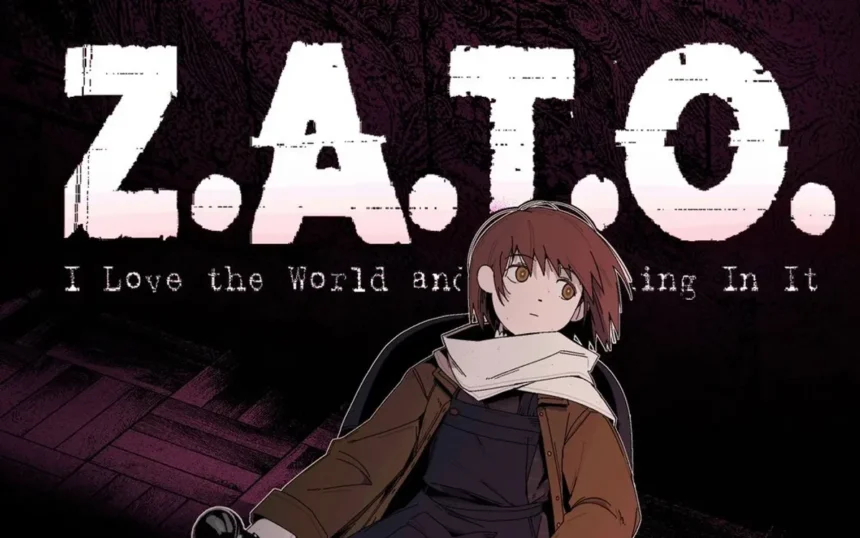
Somewhere in the Soviet Union sat a handful of cities that didn’t officially exist, scrubbed from maps, sealed off from the rest of the country, home to people whose entire existence the state simply declined to acknowledge. Z.A.T.O. // I Love the World and Everything In It builds its entire foundation on that real, obscure concept, a Zakrytoye Administrativno-Territorialnoye Obrazovaniye, and drops me into one such city, the fictional Vorkuta-5, in 1986, where a girl named Ira Grachevskaya has gone missing and, more unsettlingly, nobody in the entire city seems to particularly care.
Asya Shubina, the protagonist whose internal monologue carries the overwhelming majority of my time with the game, read at first like a fairly conventional visual novel lead, observant, a little detached, easy to sympathize with without necessarily being easy to fully understand. That impression didn’t last. As the mystery around the missing girl unfolds, the story reveals itself to be considerably less interested in a straightforward whodunit than in something far stranger and more introspective, an extended meditation on perception, identity, and what it actually means to exist in a place, and in a life, that seems determined not to acknowledge you.
Belarusian artist and musician Ferry // Nopanamaman built this almost entirely solo and released it for free, and that solo authorship shows in how tightly the whole thing holds together tonally. Structured as a fully linear kinetic novel with no choices and a single fixed ending, over a runtime that ran me somewhere around six to eight hours, the game asks me to simply sit with its unfolding logic rather than steer it, and that structural commitment turns out to be essential to how effectively its later revelations land once the story’s true shape comes into focus.
Getting there takes patience, and that’s the most honest criticism I can level at it. The pacing takes real time to build momentum, and Asya’s dense internal monologue occasionally circles the same observations and anxieties long enough that I felt the repetition drag by the story’s midpoint. That density is clearly deliberate, reinforcing just how stuck in her own head Asya is, but it doesn’t make the slower stretches any less of a slog to push through in the moment.
Once the payoff actually arrives, though, it hit me harder than I expected going in. The thematic throughline tying the story’s title directly to its ultimate message, that loving the world and everything in it is inseparable from learning to love yourself, recontextualizes nearly everything that came before it once the full picture clicks into place. It’s the kind of ending that made we want to sit quietly for a while before doing anything else.
Character writing benefits considerably from that thematic focus, even within a small, tightly bounded cast. Asya’s internal voice, dense and occasionally repetitive as it can be, is also where the story does its most substantial work, and side characters like Marina and the various boys entangled in Vorkuta-5’s quiet dysfunction get enough specific, grounded characterization that the setting reads as a lived-in place rather than a purely symbolic backdrop for the philosophy layered on top of it.
Presentation earns close to universal praise from me regardless of how I felt about the pacing. Character portraits carry expressiveness and distinct personality despite a visibly small-scale, self-funded production, and the backgrounds, built around grainy, vaporwave-adjacent photographic textures, do effective double duty establishing both a convincing mid-Cold-War Soviet atmosphere and a spatially coherent sense of Vorkuta-5 as an actual place I could navigate if I had to. Visual distortion effects used to represent psychological strain are striking and thematically well-integrated, though worth flagging again given the earlier content note: there are no built-in accessibility options to soften these effects for anyone sensitive to rapid visual changes or flickering.
The soundtrack, assembled from freely available music the creator is transparent about not having composed herself, still manages to feel deliberately chosen and emotionally precise rather than like stock filler, reinforcing the story’s shifting moods across its runtime.
Verdict
Z.A.T.O. // I Love the World and Everything In It is a remarkably ambitious, free debut visual novel that trades conventional mystery-thriller pacing for a slow, patient descent into existentialist philosophy, and for me, that trade paid off with real emotional and intellectual weight by its conclusion. A repetitive internal monologue keeps it from being a flawless experience, and its complete lack of choices or accessibility options for its more intense visual sequences won’t suit every reader’s preferences.