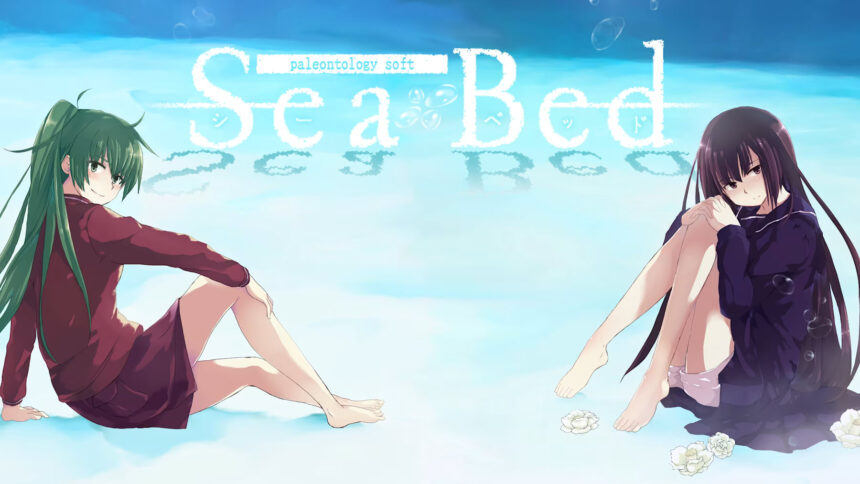
SeaBed once won a “serene” category award at a doujin game showcase in Japan, and going in, I honestly wasn’t sure what that word was supposed to promise me. Developed by the doujin circle Paleontology, written and illustrated by hide38 and programmed by AKIRA, this yuri mystery visual novel first released in Japan in January 2016 before Fruitbat Factory brought it to English audiences on Steam in December 2017, later followed by a Nintendo Switch release in 2020 that added two new scenes not present in the original. By the time I finished it, I understood exactly what that award was pointing at, even if “serene” undersells how much quiet dread sits underneath the calm.
The story follows three childhood friends whose lives have drifted into very different places. Mizuno Sachiko is a designer plagued by vivid hallucinations of her former partner, Takako, who vanished from her life without explanation. Narasaki Hibiki, a psychiatrist and another childhood friend, tries to help Sachiko make sense of what’s happening to her. And Takako herself narrates her own chapters from somewhere else entirely, steadily losing her memories of the relationship that defined so much of her life. All three are searching for the same thing from different angles, trying to separate truth from illusion and make sense of lives that no longer add up the way they once did.
SeaBed is a kinetic novel, meaning there are no choices to make anywhere in its runtime, and it commits to that linearity with real conviction. The prose itself is written without dialogue boxes or character tags, letting lines of speech blend directly into the surrounding narration rather than being clearly marked as belonging to one speaker or another, a choice that took me a little while to adjust to but that ended up suiting the story’s dreamlike, memory-blurred structure well once I settled into it.
This is a meditative reading experience, prose thick enough to fully absorb me into the rhythms of these three women’s inner lives, building dread and intimacy in equal measure through sheer accumulated detail. I can also see, clearly, why that same density reads as a genuine slog to plenty of other readers, hours of quiet banter and repetitive internal rumination that could have been trimmed considerably without losing anything essential. Both reactions are, in a real sense, correct, because SeaBed isn’t trying to hedge its bets or appeal broadly. This is a visual novel built entirely around trusting the reader to sit with ambiguity for a very long time, letting small, seemingly throwaway details accumulate into a picture that only fully resolves near the very end, and it makes zero concessions toward readers who want momentum, urgency, or frequent plot progression along the way.
Where it succeeded for me is in how completely it commits to that patience as a storytelling philosophy rather than a stylistic tic. Small inconsistencies between what characters say and what the accompanying art actually shows aren’t sloppy writing, they’re planted clues, and I found myself actively puzzling over those gaps rather than passively absorbing text, turning up genuinely satisfying “aha” moments scattered throughout well before the ending formally pulled everything together.
Character work benefits enormously from the three-perspective structure, and the writing style itself shifts subtly to match each narrator’s specific voice. Sachiko’s fractured, anxious interiority reads noticeably differently from Narasaki’s more clinical, analytical remove or Takako’s dissolving grip on her own memories. Secondary characters occasionally land as more immediately charming or vivid than the three central figures, a minor but real structural imbalance in a story this dependent on its central trio carrying every scene. The prose’s Japanese cultural roots occasionally sit oddly alongside more Westernized dialogue choices in this localization, a small but noticeable friction point I found slightly disorienting rather than seamless in a handful of scenes.
Visually, this is a genuinely inconsistent package, alternating between real-world photographs run through a soft watercolor filter and comparatively crisp, pre-rendered 3D backgrounds, a jarring shift in visual fidelity I couldn’t fully square with any deliberate artistic intent, even accounting for the story’s dreamlike ambitions. Character sprites carry a rough, sketch-like quality that mostly works in the story’s favor, giving the cast a fittingly unpolished, human quality rather than typical anime gloss, though anatomy occasionally reads as slightly off in ways that took real getting used to. Where the presentation earns close to unanimous praise from me is in sound design. Every small action carries a distinct, carefully chosen sound effect, and the music shifts fluidly from warm, everyday melodies into mournful solo piano as the story’s darker undercurrents surface, doing enormous atmospheric work in a game with no voice acting and minimal visual movement to lean on otherwise.
Verdict
SeaBed commits fully to a slow, choiceless, deeply introspective storytelling style that either casts a genuine spell or tests patience past the breaking point, with very little middle ground for anyone who’s actually finished it. Its inconsistent visual presentation and a first chapter that asks for real trust before rewarding it are legitimate, recurring criticisms rather than outlier complaints, and this is emphatically not a visual novel for readers who want frequent plot momentum or meaningful interactivity. For readers willing to surrender to its unhurried, richly atmospheric rhythm, though, this delivers one of the more genuinely distinctive, emotionally rich yuri visual novels available, a story that earns its most devoted fans by refusing to compromise on exactly the qualities that alienate everyone else.