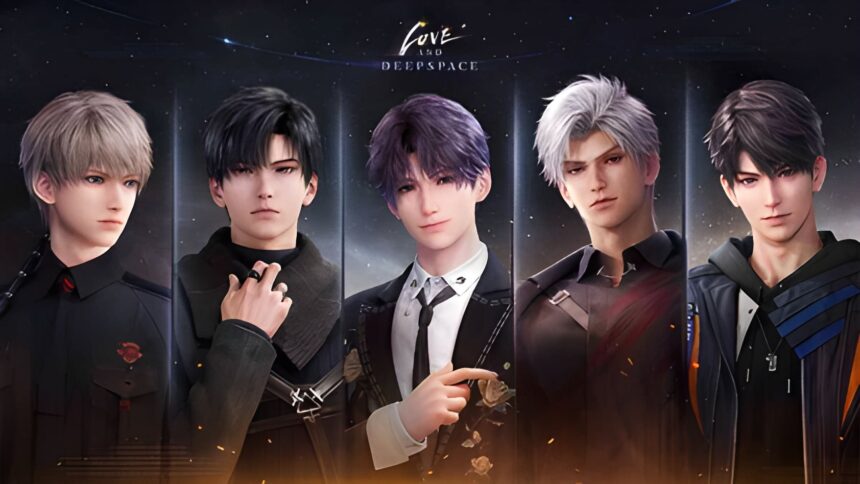
Most gacha games that bolt combat onto a story treat the fighting as a distraction from what players actually came for. Love and Deepspace treats it as the whole point, dropping a fully customizable protagonist into Linkon City, a technologically advanced future metropolis under constant threat from monster incursions called Wanderers, and building its entire otome romance around watching her partner with a rotating cast of men who each carry their own combat specialty and their own tangled backstory. This is a genuine hybrid game as it is part visual novel, dating sim, and part real-time action RPG. The sheer ambition of combining those genres this thoroughly is what separates it from most of the gacha otome titles it’s competing against.
What struck me first was how much production value went into the presentation. Rather than static character sprites layered over backgrounds, key story moments render through full FMV-style cutscenes featuring 3D character models, and the effect gives conversations with each love interest a level of physical presence that traditional 2D otome art simply can’t replicate. The action-RPG combat woven between story beats earned real praise from me too, surprisingly robust and responsive rather than a token minigame bolted onto the romance for the sake of variety, with distinct battle modes, Bounty Hunt, Deepspace Trial, Core Hunt, Hunter Contest, and Abyssal Chaos, each carrying its own particular focus rather than simply reskinning the same combat loop repeatedly.
The five, now six, romanceable men earned my attention for real personality differentiation rather than interchangeable archetypes wearing different hairstyles. Rafayel reads as the most openly affectionate and demonstrative of the group, Sylus carries a cold exterior masking real warmth underneath, Zayne stays serious and grounded, and Xavier leans into a clingier, more emotionally dependent dynamic that gives the cast real range across the typical otome personality spectrum. That range extends to the actual writing quality too. The underlying sci-fi romance narrative held up as well-constructed and engaging on its own merits, strong enough that the frequent interruptions for gacha progress gates felt like a real, frustrating tax on a story worth actually finishing.
And that gacha structure is the single biggest problem holding this game back from its full potential. Progressing through the main story requires leveling up character-specific Memories, the game’s card-based collectible system, and as the story advances, the level requirements climb steeply enough that free-to-play readers can find themselves waiting days or even weeks for enough materials to simply continue reading, regardless of how much daily activity they put in. New limited-run gacha banners typically stay available for only seven to eleven days before disappearing from the pool entirely rather than joining a permanent rotation, creating real, sustained pressure to spend real money during narrow windows rather than patiently saving currency at your own pace. I felt that frustration most clearly well past the game’s initial honeymoon period, watching event cadence slow, downtime between content stretch longer, and material costs for upgrading five-star cards balloon to levels that effectively force picking a single favorite character to focus resources on rather than meaningfully engaging with the full cast.
Where the game does show real restraint compared to some genre peers is in how much non-monetized content exists to fill that downtime. A fun cat-matching card minigame, a claw machine modeled after real arcade cabinets, text message exchanges, phone calls, and a virtual photo booth all gave me real activities to engage with between story gates, even if none of it substitutes for the actual narrative progression most players came for in the first place. Full voice acting runs throughout every major scene, and the game offers a choice between English, Japanese, Korean, and Chinese dubs, letting me pick whichever cast fit the tone I wanted for a given character. The soundtrack backs that up with an ethereal mix of orchestral and electronic music, leaning softer and more melancholic during intimate character scenes and shifting to stronger, more driving themes once combat kicks in. I truly enjoyed listening to the music. It was awesome.
Verdict
Love and Deepspace succeeds at something genuinely difficult, building a mobile otome dating sim with real production ambition, a well-written sci-fi romance, and combat substantial enough to stand on its own rather than existing as filler between story beats. Its gacha structure remains the clear, persistent obstacle keeping that ambition from being fully realized, gating narrative progress behind grinding and steep material costs that push free players toward long waits or real spending, especially once limited-run banners and their narrow availability windows enter the picture. For readers willing to accept that trade-off, and to play patiently rather than chase full completion, this delivers one of the more accomplished mobile otome experiences currently available.