


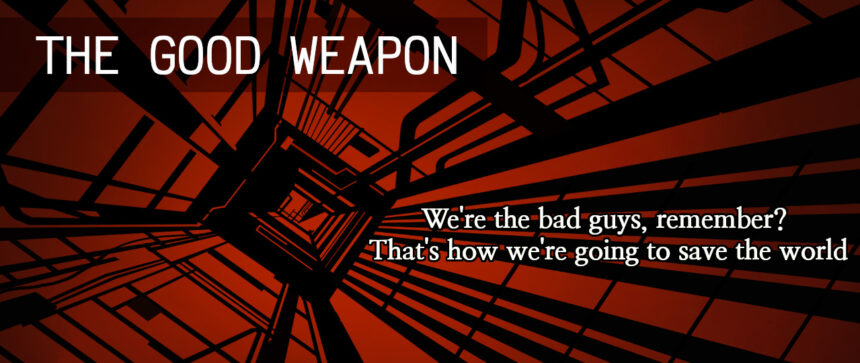
The difference between saving the world and ending it sometimes comes down to a single button, and nobody hands you a warning label for which version of that story you’ll end up living in. The Good Weapon opens on exactly that ambiguity, a bunker, a countdown that’s already started, and three people who each swore to end a threat outside no matter what it costs them. Something fathomless and impossible to reason with has been eating away at the world a little more each day, and the only response anyone in that bunker has left on the table involves nuclear weapons.
Maddie built the whole thing under the name ninecoffees, writing and coding it in Ren’Py before putting it out for Windows, macOS, and Linux. It’s a pay-what-you-want release, free if that’s what a reader wants it to be. The game went on to pick up a pair of finalist nominations at the 2024 New Zealand Game Awards, in the categories the ceremony calls The Poetic Serving for excellence in narrative and The Diverse Delight for excellence in representation. That same year it also found its way into a paid charity anthology and a short-games showcase, small proof that its reach went beyond just the awards circuit.
Three people carry the whole story between them, walled up together with nothing but each other and the thing they’ve promised to kill. The game’s own marketing calls all three villainous, though maybe redeemable, which turns out to undersell how differently that villainy sits on each of them. One of the other two goes by Sleep. Where the group’s leader carries the weight of command, Sleep’s presence in the room reads more like someone who has already made peace with what has to happen, an unsettling kind of calm sitting right next to a leader who hasn’t. The story itself is broken into numbered nerve clusters instead of ordinary chapters, a structural choice that turns each new section into something closer to a pulse than a scene break.
That leader is the one who starts cracking first, right as the stakes reach their highest point, suddenly unwilling to actually pull the trigger on the weapon the three of them agreed to use. The player has to decide whether to talk her back into it or take the decision out of her hands entirely. Choices carry real consequence here rather than just cosmetic flavor text, each one folding back into how the rest of the confrontation actually plays out. Watching that hesitation ripple outward through Sleep and the third member of the group gave every scene after it a kind of tension that sat with me even between sessions.
Built backward from how most narrative games get made, the whole thing was written and laid out start to finish with placeholder art standing in before an artist was ever brought on to replace it. That order shows in how confidently the prose carries scenes on its own, never leaning on art to cover for a beat that isn’t landing. It’s the kind of writing-first instinct that a lot of small visual novels don’t have room to develop.
Every piece of art in the game is hand-drawn, built out in layered Photoshop files rather than anything generated or templated. It shows most in how specific each character’s expressions get without ever repeating a stock pose. The text placement does just as much work as the art itself, breaking away from a fixed dialogue box in ways that made certain scenes feel closer to watching something unfold on a page than reading a normal visual novel screen.
Music sits underneath nearly every scene, and it’s doing more structural work than background games usually ask of a score. It eases or tightens alongside the story’s own escalating dread rather than just looping politely behind everything else. I noticed it most in the quiet stretches right before a choice locked in, where the absence of dialogue let the music carry the tension on its own for a beat or two longer than felt comfortable.
Even once the stakes are already about as high as they can get, the pacing refuses to rush toward its own climax, letting tension build across those nerve clusters instead of cashing it in early. I won’t say how the confrontation over the weapon actually resolves, only that the slow burn earns real weight by the time it gets there, the kind that comes from a story trusting its reader to sit in discomfort a while longer than expected.
Verdict
The Good Weapon takes a familiar apocalyptic premise and grounds it in three people whose villainy never sits the same way twice, hesitation and command sitting uneasily next to Sleep’s unsettling calm. Deliberate pacing, hand-drawn art, and text placement that never plays it safe give this short, pay-what-you-want visual novel more polish than its scope would suggest. It’s a confident, emotionally intense piece of work that stuck with me well past its two nominations at the 2024 New Zealand Game Awards.



