


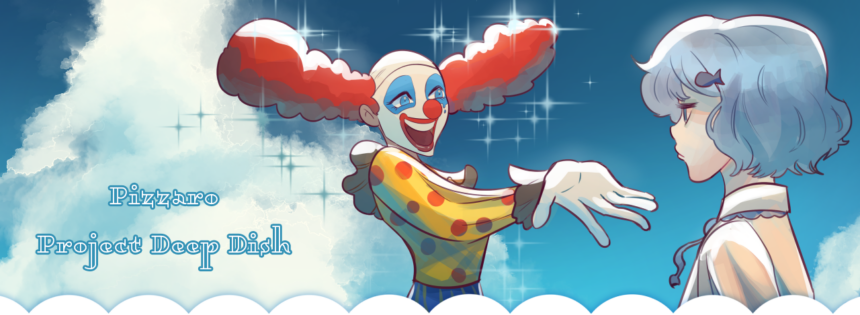
Pizzaro Project Deep Dish started life as an April Fool’s joke, releasing on April 1, 2020 as a collaboration between batensan, fenori, and zzzbookwormzzz, and it wears that origin proudly across all twenty thousand words of it. I’m playing Anne Chovy, a twenty-three-year-old woman working her family’s fish market in a fictional setting called the Cal Zone, yes, the pun names start immediately and never really stop. After chasing off some kids messing with a down-on-his-luck street performer, Anne hands him spare change for a meal. That single act of kindness is enough to convince a poverty-stricken, vegan, lactose-intolerant clown named Pizzaro that he’s found the love of his life.
Pizzaro’s whole situation traces back to a failed career as an underwater basket weaver, a path that apparently didn’t pan out and left clowning as the fallback plan. That kind of absurd specificity runs through even his saddest beats. Anne takes him to a restaurant called McGoofy’s once she realizes how hungry he actually is, only to discover he can’t eat most of what’s on the menu. Watching the two of them work around his dietary restrictions became one of the game’s earliest, smallest signs that this was going to be a story about actual care dressed up as a punchline.
What surprised me is how much actual dating sim structure got built underneath the absurdity. The very first chapter, tellingly titled The Sauce, wastes no time setting that structure in motion once Anne reports back to her wealthy childhood friend Cilantro about the clown she’s just met, only for Cilantro to grow visibly jealous and start digging for more information herself. Pizzaro isn’t the only one competing for Anne’s attention from there on. A whole cast of suitors trades barbs and tries to one up each other for her heart, even while Anne herself mostly seems baffled that any of this is happening to her. It plays the format completely straight on a mechanical level, quizzes, choices, competing love interests, while the actual content thrown at a reader is as unhinged as it gets. That contrast is where most of the game’s best jokes live.
Self-awareness runs hard through the writing, and it mostly earns it. Characters comment on how ridiculous their own routines are, the fourth wall gets broken constantly, and the pun density climbs impressively once side characters start showing up with names built entirely around pizza and seafood wordplay. Even a background cashier working the counter at McGoofy’s gets folded into that same commitment to bit, one of the three creators’ own original characters slipped in as a cameo rather than left as a nameless extra. A few gags land better than others, and there’s a visible seam where some jokes referencing real, recognizable media got edited around for obvious reasons, but the hit rate stays high enough that I rarely went more than a scene or two without laughing out loud.
Where the game actually loses the plot, in the best way, is its final stretch. The first half sets up something resembling a coherent romantic comedy, and then the last two chapters just detonate it. Twists stack on twists with no interest in staying internally consistent, side characters get pulled into increasingly deranged subplots, and the whole thing turns into something closer to a fever dream than a dating sim. The game also branches into multiple distinct endings depending on how a playthrough goes, which turned finishing it once into an excuse to immediately go back and see how differently things could have landed. I won’t spoil where any of it ends up, but by the time the credits hit on my first pass, I’d fully stopped trying to predict anything and just let the chaos carry me.
Pizzaro himself is the clear MVP of the cast. He could have been a one note gag, the whole you can date a clown hook doing all the heavy lifting, but the writers gave him a genuine, if absurd, backstory and enough sincerity buried under the pratfalls that his affection for Anne actually lands as sweet rather than purely as a punchline. Anne holds her own too, playing exasperated straight woman to the chaos around her without ever feeling like a flat audience insert.
A lot of the game’s charm comes from the art itself. Character portraits are clean, expressive, and clearly built with real care despite this being a passion project made in a short window of time, and the presentation around the menus and start screen has a level of polish that punches well above what I’d expect from a free, pay what you want release.
I can’t speak with confidence to specifics on the score, since detailed information on the soundtrack wasn’t something I could verify, but nothing about the audio pulled me out of any scene, which for a project this size is its own kind of success. There’s no voice acting here, which tracks for a small free indie VN of this scope.
A companion art book runs forty six pages and sells separately for six dollars and sixty six cents, unlocking a secret password redeemable in-game for an extra scene and CG, a nice bit of additional content for a project that never had to offer one beyond the free twenty thousand word main story it already delivers in about an hour. Batensan, the creator behind the collaboration, had already built a body of work before this, titles like Magical Otoge and Moon Observatory among them. That experience shows in how confidently Pizzaro Project Deep Dish commits to its bit rather than treating the joke premise as an excuse to cut corners.
Emotionally, this is not a game built to wreck you the way a longer dramatic VN might, but it pulls off a neat trick anyway. Underneath the puns and the escalating nonsense, there are a couple of quieter beats between Anne and Pizzaro that genuinely catch you off guard with how sincere they are, precisely because the game has spent the runtime training you to expect a joke instead. That whiplash between absurdity and real warmth is the whole game’s best asset.
Verdict
Pizzaro Project Deep Dish knows exactly what it is, a gloriously unserious April Fool’s passion project that commits so hard to its own joke premise that it ends up being charming rather than just a novelty. The plot goes completely off the rails by design, and the pun dense writing won’t land for everyone, but the character work underneath the chaos, especially Pizzaro himself, gives it real heart. Twenty thousand words built around a single dumb premise has no business working this well, and yet here it is, doing exactly that.



