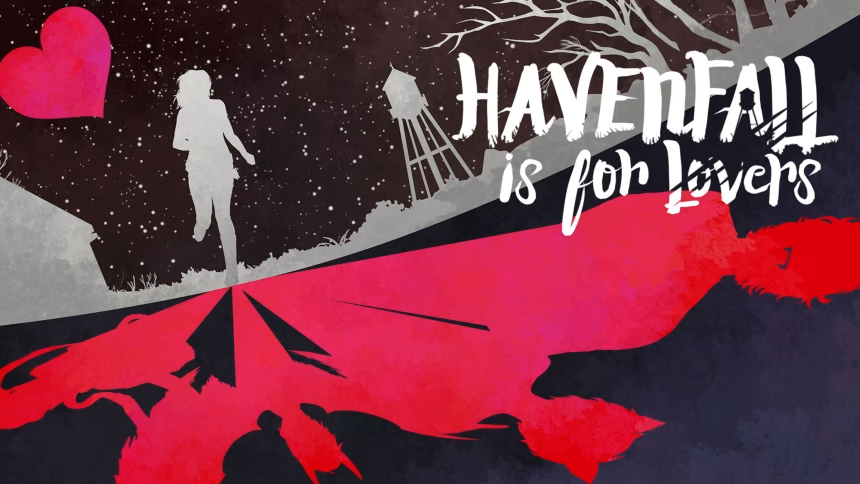
Havenfall, Indiana gets described as a one-stoplight town, the kind of place where staying feels like settling and leaving feels like the only real ambition worth having. The heroine of Havenfall Is for Lovers has already made peace with never getting out herself, pouring everything she has into making sure her younger sister Grace gets the college shot she never did, right up until Grace vanishes without a trace and every quiet assumption about the town gets pulled out from under her.
Diego plays the town doctor by day, five hundred years into a life nobody around him knows is a lie, and I liked how his calm read less like a personality trait and more like something he’s had five centuries to practice. Mackenzie, Havenfall’s sheriff, carries a werewolf’s protective instincts into everything she does, growling at anyone who threatens what’s hers long before she’d ever admit to caring that much. Razi runs the bowling alley where the heroine works, and his djinn illusions get used more for damage control than spectacle, quietly keeping the supernatural side of town hidden from humans who have no idea what’s living next to them. JD, cast specifically as Havenfall’s own Jersey Devil, works the same bowling alley shift as the heroine and brings a delinquent-teenager energy that undercuts just how dangerous their family situation actually is, while Vanessa, awkward in a way that undercuts her own warnings about danger, and Antonio, a vampire with a colder edge than Diego’s, round out a six-person cast where nobody plays a single note for long.
The heroine herself reads as openly bisexual, and the route list actually backs that up rather than just gesturing at it. Mackenzie and Vanessa are both offered as female love interests alongside the four men, JD is written as non-binary, and both Razi and Antonio are confirmed queer characters in their own right, Razi pansexual and Antonio bisexual, rather than just conveniently available regardless of who’s asking. That range doesn’t stop at the six romanceable leads either. Grace, who reads as bisexual herself, ends up in her own relationship with a new friend in town named Gwen, and further out in the supporting cast, Mothman is written as bigender, Roshni as pansexual, Rahim as gay, Evangelina Vasquez as a trans woman, and Annabelle as bisexual, which gave Havenfall’s queerness a settled, everywhere kind of presence rather than something limited to whoever the heroine happens to be dating. Every one of them gets treated as a person carrying real fear and loneliness under whatever mythological label they wear, and that choice does more to sell each romance than any of the monster mechanics manage by themselves.
The five of them earned the nickname Havenfall’s Finest early on, and I liked that the name actually came from inside the story, pulled from a group chat JD started rather than handed down as some official-sounding team title. That small detail set the tone for the whole friend group, since even the way they organize themselves feels like something a handful of twenty-somethings would actually come up with rather than something a writer imposed on them from outside.
Razi’s older sister Roshni, closer to a century old herself and every bit as formidable as her brother when a fight breaks out, spends part of the story navigating her own slow-building relationship with a Havenfall local named Mothman, and their dynamic gave the story some of its lighter, more patient beats between the louder crises. Rahim, another member of the Nassar family, shows up when the group actually needs backup rather than just for a cameo, and Annabelle, a werewolf in Mackenzie’s circle, quietly reads as a comic book collector too self-conscious to talk about it openly, a detail that gave a supporting character real interior life instead of just a role to fill in a fight scene. Hikari Hayashi complicates JD’s family situation further as their half-sister, another of Lucifer’s kids working through the same complicated inheritance JD carries, and watching the friend group slowly wear down her guard, one reluctant hangout at a time, gave the found-family theme some of its most earned payoffs.
What actually keeps the mystery from feeling like scaffolding around six separate romances is the heroine’s own voice, sharp and self-deprecating, cracking jokes about horror-movie tropes and government paperwork even while she’s clearly terrified about Grace, which kept me anchored in her perspective no matter which route I was following. That humor threads through even the ordinary hangout scenes, karaoke nights turning into a Havenfall’s Finest in-joke contest and movie dates doubling as excuses for pop culture references the heroine doesn’t always catch, and it kept scenes between crises feeling like time spent with actual friends rather than filler between plot beats. The people the heroine initially suspects of taking Grace turn out to be exactly the ones willing to help her, and the real culprits belong to a separate, actively hostile group working against the whole cast rather than any single love interest she’s already grown attached to.
D.E. Chaudron wrote well over 180,000 words across the original run, and that scale shows even now, since reaching this release means picking up six full seasons per route on top of a dedicated special story and Date Night short for every love interest, plus one additional bonus short shared across the cast. The series first launched September 18, 2017 with Mackenzie and Diego as the only two routes available, and everything from there grew into the full six-person roster this release now carries in one package.
Choices throughout run on a heart-point system carried over from the original app, where a handful of premium options in every episode need a set number of hearts to even appear, sitting alongside the free choices everyone can pick regardless of how much affection they’ve built. I liked that the premium options never felt mandatory to follow a route properly, more like an extra layer of intimacy for players willing to invest the extra time, than a wall blocking real content behind a paywall the way that structure can feel in weaker examples of the genre.
Character art leans into a clean, expressive style that handles the shift between someone’s human face and their supernatural true form well, though I did catch at least one inconsistency in how a background character’s claws get drawn between scenes, a small technical wrinkle in an otherwise well-kept visual continuity. Every route builds toward its own set of CGs marking the story’s bigger beats, and stacking one route’s key art against another made it obvious how differently each relationship escalates even while the underlying kidnapping plot stays the same across all six.
Lovestruck, the app this story originally lived on, shut down completely in March 2022, and losing that platform meant losing access to the entire story for years. Voltage brought Havenfall Is for Lovers back on Nintendo Switch on May 21, 2026, digital-only at 2,980 yen with an ESRB Teen rating and English-only text, adding rewind, save, and load options the original app never had along with full TV compatibility, and a Steam release is on the way as a second life for a story that could easily have stayed lost for good.
Getting turned, permanently and irreversibly depending on which knight or monster she ends up choosing, is where the heroine’s arc lands its heaviest stakes, and I stayed invested in exactly how each route earns that transformation without the story ever tipping into resolving it the same way twice. The six seasons of buildup behind each choice gave every one of those final turns real weight instead of feeling like a rushed payoff tacked on at the end.
Verdict
Havenfall Is for Lovers uses a missing sister and a small town full of hidden monsters to build six full routes that each treat their supernatural love interest as a person first, and that choice carries the story further than the mystery plot alone could manage on its own. Six seasons of content per route give this the scope of a finished show rather than a single stretched-thin route, and an honestly wide range of who the openly bisexual heroine can actually end up with, backed by a found-family cast that stays queer and lived-in even at its edges, makes the whole thing feel considered rather than filled out for variety’s sake.