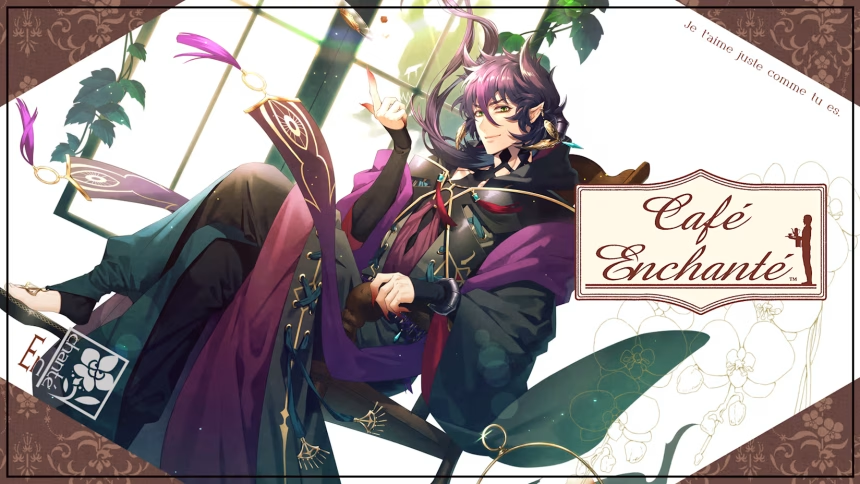
Café Enchanté is a sincere if overlong chronicle of a young café owner’s slow discovery that her regulars aren’t human, one that eventually earns the emotional weight it spends its first several hours setting up but takes its time getting there. Developed by Otomate and localized by Aksys Games, this fantasy otome casts Kotone Awaki as the new proprietor of a shop that turns out to be a meeting point between Tokyo and a handful of other worlds, and its formulaic slice of life opening and a common route padded well past what the premise needs keep the first stretch feeling more like a pleasant warm up than the story it eventually becomes.
That said, this holds up better against Otomate’s other recent fantasy otome, Piofiore: Fated Memories, which never quite manages the same balance of cozy setup and genuine gut punch once its routes get going. Café Enchanté’s individual paths lean into body horror, screaming, and real emotional devastation in a way that gives this game more bite than most other entries in the admittedly crowded subgenre of supernatural café romance, and I never felt this one losing its footing the way Piofiore occasionally did.
As the heroine, Kotone Awaki has the independence and practical steadiness the format usually denies its self insert protagonists. She pushes back, makes her own calls in group decisions, and never feels like she’s being dragged through the plot by five men with more personality than her. She never quite gets to show her own romantic feelings developing on the page, though, and in a couple of her routes I found myself accepting that she’d already fallen before the story bothered to earn it.
The common route runs about five hours before individual paths branch, and I felt every one of those hours by the end. That length is a real, valid complaint on its own, though the cozy, low stakes atmosphere it builds makes the wait easier to sit through than a comparably long setup elsewhere might, and the patience pays off once the story actually needs the goodwill it spent that time building.
The marketing and the opening hours sell a wholesome coffee shop fantasy, and that framing turns out to be something close to a bait and switch. Once individual paths kick in, the tone shifts hard toward heavy, sometimes gruesome material, and even the routes that end happily pass through real devastation to get there. That contrast reads as intentional rather than a tonal accident, using the earlier comfort as a setup for exactly the gut punches the marketing never hints at.
Il’s route handles that shift with the most care of the five. His character reads to me as someone who processes the world differently from everyone around him, and the writing treats that difference with real patience rather than playing it for easy comic contrast. His storyline’s confrontation with an unpleasant, indifferent depiction of a higher power gives his route stakes that go well past the usual romantic obstacle.
Misyr’s route sits behind every other ending as the true final path, and it earns that position through how much of the wider mystery it resolves. The actual ending left me more unsettled than satisfied, though, a resolution that makes sense within the story’s own internal logic but still feels like less than what the format usually delivers for its central, endgame love interest.
Character art and CG work from illustrator Yuuya carries most of the visual weight here, and the café themed interface, right down to a working in game music player, gives the whole package a personality beyond the character designs alone. The soundtrack does quieter, functional work in the background rather than announcing itself, effective without ever becoming the thing I remember most about a scene.
Full Japanese voice acting brings real texture to routes that lean as hard into tragedy as these do, and Il’s voice work in particular carries his quieter, more unsettling scenes further than the text alone would manage.
The English localization carries some real rough patches too, a line here or there that reads clumsy enough to pull me out of a scene, along with smaller punctuation and spacing errors scattered throughout. None of it derails the story, but it’s noticeable enough across a game this text heavy to mention directly.
What stayed with me longest wasn’t any single twist but how much the earlier, funnier stretches ended up mattering once the routes turned dark. Scenes I’d shrugged off during the common route came back with real weight once I understood what they were quietly setting up, and that’s a rare kind of payoff for a game this patient about earning it.
Verdict
Café Enchanté succeeds through strong character writing and striking presentation, using an unusually long, patient common route to earn emotional payoffs that hit harder once individual routes reveal the darkness hiding underneath its cozy café premise. Misyr’s ending left me more unsettled than satisfied, and Kotone’s romantic arcs don’t always build as visibly on the page as they should, but neither issue undid how much I ended up caring about this cast. For otome fans willing to sit through a slow opening in exchange for a well realized cast and real emotional stakes, this remains one of the stronger fantasy entries the genre has produced.