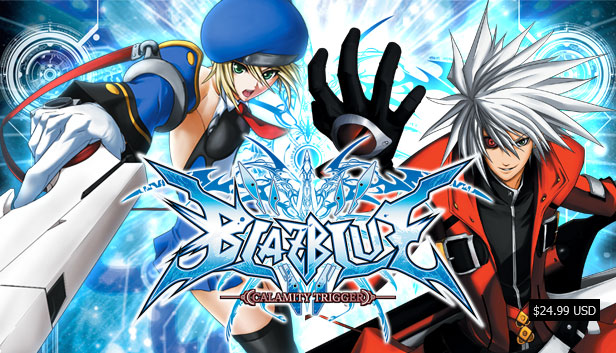
Fighting games have a reputation for treating their stories as an afterthought, a loose excuse strung between round two and round three. Calamity Trigger doesn’t quite escape that reputation, but it puts up a real fight against it.
Humanity nearly went extinct between 2100 and 2110 at the hands of a creature called the Black Beast, until six warriors fused old sorcery with science to create the Magic Formulas, arming ordinary people to finally overthrow it. Arc System Works built the whole game around what happens generations later, when the organization born out of that victory, a governing body known unofficially as the Library, has drifted from savior into something a lot of people in this world now see as just as controlling as the threat it originally defeated. The developers themselves described the project as a spiritual successor to Guilty Gear, and composer Daisuke Ishiwatari, who scored that earlier series, came along to handle the music here too, with Aksys Games picking up western publishing.
Ragna the Bloodedge carries the loudest grudge against the Library out of anyone in the cast, and watching his specific brand of exhausted, foul-mouthed defiance play against his younger brother Jin Kisaragi’s colder, more controlled resentment gave their shared scenes a charge none of the other rivalries in the roster quite matched. Noel Vermillion stumbles into the middle of both of their stories carrying a quiet uncertainty about her own past that the rest of the cast keeps circling around without spelling out directly. Taokaka bounds through nearly every route with a hunger-driven, cat-brained energy that plays as pure comic relief until a scene forces her into something heavier, and Carl Clover’s grim determination, doll in tow, sits close enough to Litchi Faye-Ling’s own more composed grief that the two ended up feeling like mirror images of each other by the time I’d worked through both their material. Arakune’s near-total loss of coherent speech, Iron Tager’s blunt physical presence, and Bang Shishigami’s over-the-top ninja theatrics round out the cast’s louder end, while Hakumen and Nu-13 carry a colder, more mechanical weight that keeps the whole roster from tipping too far into slapstick. Rachel Alucard stands apart from all of them, fully aware of the time loop the rest of the cast is stuck reliving without noticing, and that awareness gives her a weary, faintly bored edge that colors nearly every scene she turns up in across other characters’ routes.
Combat stays fast and thoroughly anime-inspired, playing out over detailed, multi-layered backgrounds, and every character carries a signature Drive attack, tricky to land cleanly but devastating the moment the timing actually clicks. Astral Heats, the game’s over-the-top finishing moves, only come unlocked from the start for Ragna, Rachel, and Nu-13, and everyone else has to earn theirs by clearing that character’s own Arcade Mode first, which turned finishing off a fight in style into something I had to actually work toward rather than something handed to me on day one.
Story Mode gives every roster member an individual route, and the whole thing plays out inside that single repeating time loop most characters never notice they’re stuck in. Most routes close on either a straightforward normal ending or a lighter, joke-filled Alternate Truth ending that doesn’t carry much narrative weight on its own, and only Ragna’s specific path leads to the canonical True Ending, told across two connected variations that set up everything the sequel, Continuum Shift, builds on. Rachel’s perspective threading through the other routes gave every one of those loop iterations a strange, secondhand weight, watching her carry the exhaustion of remembering events everyone else was living through for what felt, to them, like the first time.
Toshimichi Mori directed and produced the game, with Nanako Arima and Seiji Fukumoto helping shape the scenario alongside him, and the console version added an original anime-style opening from J-Pop artist Kotoko called Ao no Iconoclast on top of the arcade release’s content. Bang’s theme, Omae no Tettsui ni Kugi wo Ute, came from veteran anime vocalist Hironobu Kageyama, and Noel’s Japanese voice actress Kanako Kondo contributed an original song of her own, Love So Blue, that plays at points throughout Story Mode, a nice bit of cross-pollination between the cast and the soundtrack that I wasn’t expecting going in.
The Japanese cast, Tomokazu Sugita as Ragna, Tetsuya Kakihara doubling as both Jin and Hakumen, Kanako Kondo doubling as Noel and Nu-13, Kana Ueda as Rachel, Chiwa Saito as Taokaka, Kenji Nomura as Iron Tager, Chiaki Takahashi as Litchi, Takashi Hikida as Arakune, Tsuyoshi Koyama as Bang, and Miyuki Sawashiro as Carl, carries real range across an unusually varied roster, and the English dub mirrors that same doubling pattern deliberately, with David Vincent voicing both Jin and Hakumen and Cristina Valenzuela voicing both Noel and Nu-13 the way their Japanese counterparts do, a quiet nod to how closely those pairs of characters end up tied together. Patrick Seitz, Jamieson Price, Philece Sampler, Mela Lee, Spike Spencer, Lauren Landa, Tony Oliver, and Michelle Ruff round out the rest of the English side, and the dub holds its own well enough that switching between languages mid-story never felt like a downgrade either direction.
Calamity Trigger first hit arcades in Japan on November 19, 2008, before Arc System Works brought it to PS3 and Xbox 360 in Japan and North America in June 2009, added a PSP port called Calamity Trigger Portable in 2010, and eventually landed on PC through Games for Windows that September before later making its way to Steam. That PC version specifically still ships with broken music during Story Mode, a bug that’s been sitting there long enough that fans have had to patch it themselves rather than wait on an official fix. Europe didn’t get the game until April 2010, nearly a full year after North America, though Aksys and Arc System Works threw in every piece of console DLC for free as compensation. The European Limited Edition swapped in a ninety-six page landscape artbook and moved its tutorial videos to DVD, but dropped the soundtrack entirely, while the US Limited Edition went the other way, bundling a two-disc soundtrack full of DJ Oh No remixes alongside a smaller Gamestop-exclusive artbook. The PS3 version also picked up Remote Play support, letting it stream to a PSP or Vita over USB or Wi-Fi, something no other mainline BlazBlue release on that console ever added.
Verdict
BlazBlue: Calamity Trigger backs up its flashy, anime-fueled combat with an ambitious Story Mode, even if the fighting game format keeps that story from ever fully stretching its legs. Rachel Alucard’s loop-aware weariness gives repeated character routes real emotional texture, and the full roster’s shared conflict against the Library gives an otherwise wildly mismatched cast a common thread worth following. It’s a technically strong fighter whose storytelling ambition outpaces what the genre usually bothers attempting, held back mostly by a rocky PC port that never got the fix its Story Mode really needed.