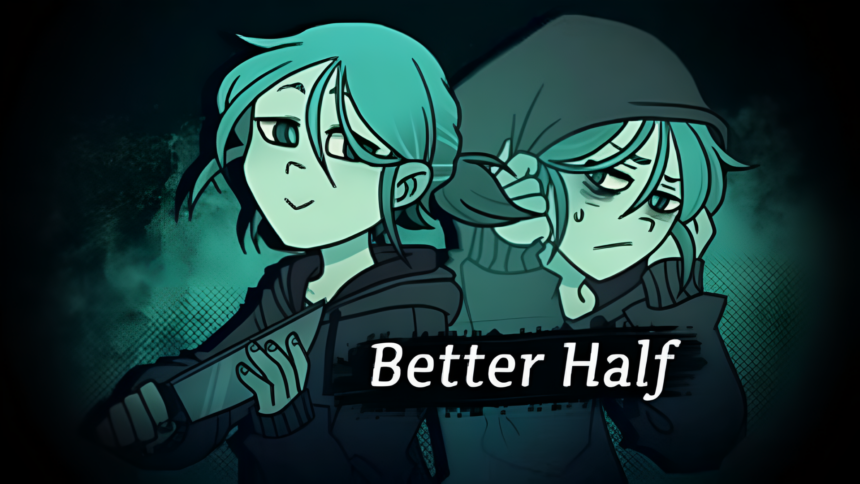
Better Half follows Thiu after a spell meant to erase the negative emotions shaped by an abusive father and years of severe depression splits him into two people instead of freeing him from any of it. One version keeps the warmth and optimism he’d lost sight of somewhere along the way. The other gets stuck holding everything he’d been trying to escape, and the story builds itself entirely around what happens once those two people have to actually share a life.
Nemlei developed the game, the third title in a small catalog that also includes No Good Noelle, Candy Scabs, Divilethion, Jack in a Castle, and later The Coffin of Andy and Leyley, built here in Ren’Py with a small team of contributors and released free on itch.io on March 29, 2021. The developer’s own tagline for it, a miserable comedy about self-loathing, undersells how precisely that description actually fits once the story gets going.
Running around twenty three thousand words, the story branches toward three main endings plus an additional darker outcome, giving a fairly compact read real reason to revisit once the first ending rolls credits. That length works entirely in its favor. There’s not an ounce of padding stretching the premise thinner than it needs to be, and the pacing never once made me feel like a scene was lingering past the point it had already made.
The writing throughout stays sharp and unflinching, dark and aggressive in places, but never in a way that reads as performative edge for its own sake. There’s real, uncomfortable humor threaded through it too, the kind that lands harder specifically because it sounds like something someone who’s actually lived through this would say. The one place the writing loosens its grip is in a side thread involving the wider world of mages, which never quite ties as tightly into Thiu’s own arc as the rest of the script does, leaving a few of its own questions hanging by the time the credits actually roll.
Watching the two halves of Thiu try to coexist gave the story its real backbone. One carries the humor and lightness he’d stopped letting himself feel, while the other is stuck holding the self-loathing, the trauma, and the weight of everything he’d hoped the spell would simply remove. Neither version gets to be the whole picture on his own, and putting them in the same space forces a kind of reckoning that erasing the pain outright never could have managed.
Lua, the mage responsible for the botched spell in the first place, keeps circling back into the story well after the split itself, and the demands that follow give the plot a second source of pressure beyond whatever Thiu’s two halves are working through on their own. That thread never resolves as cleanly as the central relationship does, but it’s rarely dull even when it wanders, and it kept me curious about Lua’s own motivations even while I was mostly there for Thiu.
Character art leans into round, soft shapes that recall early-2000s cartoon design, rendered in desaturated blues, purples, and greens that keep the tone from ever tipping into something too bright for what the story is actually about. Sprites stay kinetic and expressive throughout, multiple poses and head angles giving even quiet conversations a real sense of cinematic framing rather than static portraits waiting their turn to talk. That visual restraint matches the writing’s own refusal to soften anything for easy comfort.
What actually stayed with me wasn’t a single scene so much as the accumulated weight of watching someone forced to face the parts of himself he’d spent years trying to erase, treated with real seriousness rather than shock value. I won’t detail how any specific ending resolves that tension, only that the story earns the difficulty of what it’s asking Thiu, and by extension the reader, to sit with. Every line of dialogue stays in text, no voice acting anywhere in the experience, and the game remains free to download across Windows, macOS, and Linux, with nothing held back behind a paywall or a separate edition.
Verdict
A premise this easy to play for laughs instead gets treated with real weight here, Better Half using a literal split self to ask what it actually means to live alongside the parts of yourself you wish weren’t there. Thiu’s two halves carry real emotional weight against each other, backed by writing sharp enough to earn its dark humor rather than lean on it for shock, even where the mage subplot lets that grip loosen slightly. This is a short, demanding read willing to sit with a genuinely painful premise instead of resolving it too neatly.