


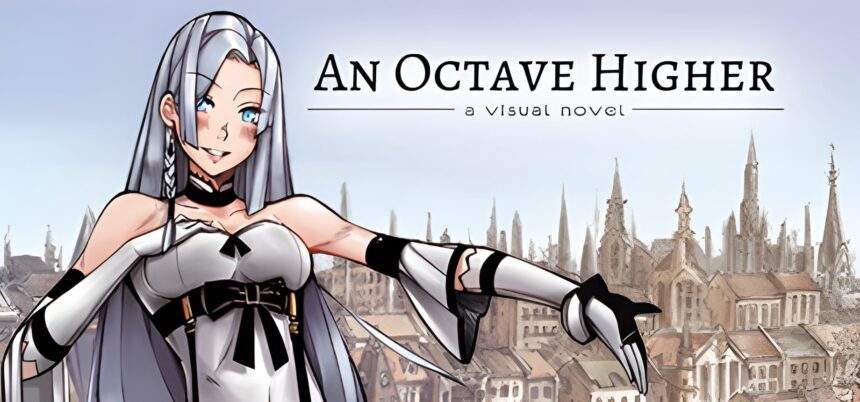
A broken piano sitting out in a factory yard is what actually pulls An Octave Higher’s three separate protagonists into the same orbit. Elise wants nothing more than to heal it back into working order, while Franz needs to prove that healing magic can work on inanimate objects at all if he’s going to defend his senior thesis and graduate.
Most fantasy visual novels treat magic as pure spectacle, something wondrous and largely unexamined. Kidalang takes the opposite approach entirely, building an entire scientific framework around it and using that rigor to power a thoughtful story about industrial revolution and class conflict rather than just window dressing for a typical fantasy adventure. The city of Overture runs on a rigid three tier social structure built directly around access to magic. Aristocrats control the industries that produce it, a Bourgeois middle class can afford both magical education and the mana potions needed to actually use it, and a working class stays effectively locked out of the system that increasingly defines every aspect of daily life.
Kidalang, an Indonesian studio, developed and released the game on March 27, 2015, published by AGM PLAYISM. The game went on to win an Indie Prize for Best Narrative.
The magic system itself works closer to mathematics than typical fantasy spellcasting, abilities functioning like actual mathematical functions that can be composed together. An entirely optional segment later in the story even has a character walk through her own cutting edge research building logic gates directly out of magic. None of that complexity translates into player controlled spellcasting, since this stays a visual novel rather than an RPG, but the depth is there specifically to make Overture’s magic feel like an actual field of study rather than a vague fantasy convenience.
Rather than filtering that conflict through a single hero’s perspective, the game splits its narrative across three distinct protagonists. Elise, a factory worker living the sharp end of that inequality, faces a particularly grim version of what her class actually costs her, living at a brothel and expected to join its ranks within a matter of months. She stays stubbornly cheerful throughout regardless, wanting nothing more than the chance to play the piano she’s trying to fix. Franz, a senior student at the prestigious Conservatoire, finds his entire academic future riding on proving a theory most of his peers consider a lost cause, chasing grant funding that ends up tangled directly with Elise’s own situation once his approach to an aristocrat’s son backfires. Fredric, an aristocrat and the athletic son of a businessman who holds a monopoly over a large share of Overture’s industry, carries his own complicated relationship to a system he benefits from without ever fully choosing it.
Overture’s own musical theming runs deeper than just its name. Franz’s name likely nods to composer Franz Schubert, whose actual public domain recordings turn up in the game’s soundtrack, and several other characters carry names pulled from real musicians, composers, and songs, a small, consistent touch that rewards paying attention to the cast list as much as the plot.
What elevates the writing above typical genre fare is how seriously it engages with real political economy, questions about whether a fulfilling life requires certain material access, the impossible tradeoffs baked into policymaking, and who actually bears responsibility for the long term fallout of political decisions. That’s unusual territory for a fantasy visual novel to explore with real substance rather than surface level gesture, and Elise, Franz, and Fredric’s believable flaws and relatable struggles keep the political material from ever feeling like a lecture layered on top of the story.
Overture systematized magic three centuries before the story begins, using that head start to exert outsize political influence over large parts of the wider world. The game takes real care outlining how that history actually shapes daily life too, down to specifics like what working a shift in a magic powered factory involves. Despite all that worldbuilding, the pacing stays breezy rather than bogged down in exposition, the narrative moving at a clip that never once made the political and technical detail feel like homework.
The full story runs to roughly 120,000 words across six different endings, one of them designated the true ending, with the narrative jumping between the three protagonists’ perspectives liberally enough that following exactly who knows what at a given moment takes real attention in places.
Music throughout draws on public domain classical recordings sourced from projects like Musopen and Set Chopin Free rather than an original score composed specifically for the game, an unusual but fitting choice for a story this steeped in musical theming from its title on down. An extended soundtrack collecting eleven tracks from the game later released separately for anyone who wanted to keep it outside the story itself.
Where the game stumbles is its endings. Despite strong buildup and real investment in its characters and central conflict, the various conclusions don’t meaningfully resolve the plot threads the story spent so much time developing, a real disappointment given how much care clearly went into everything leading up to that point. The game also occasionally over explains its own carefully constructed magic system, spelling out mechanics a reader had likely already pieced together on their own, and some of the music cues repeat often enough by the later hours to notice, minor rough edges that come with the territory of a smaller indie studio’s production.
A broken piano turning into the hinge point for a story this ambitious about class, magic, and political responsibility says a lot about how deliberately Kidalang built Overture’s world around small, human specifics rather than abstract worldbuilding for its own sake.
Verdict
An Octave Higher earns its reputation by treating its magic and industry premise with real scientific rigor, building spellcasting out of function composition and logic gates rather than vague fantasy convenience, and using three distinct class perspectives to build a fantasy story with real political substance. Its worldbuilding stands out as a real strength, immersive enough that Overture’s three centuries of magical history never once feel like backstory dumped for its own sake, and its willingness to grapple honestly with class conflict and political tradeoffs sets it apart from typical fantasy visual novel fare. Weak, unsatisfying endings are a real flaw given how much investment the story builds beforehand, but for readers looking for a substantive, non-romance-focused OELVN with real intellectual ambition, this remains a standout example of what the format can accomplish.



