


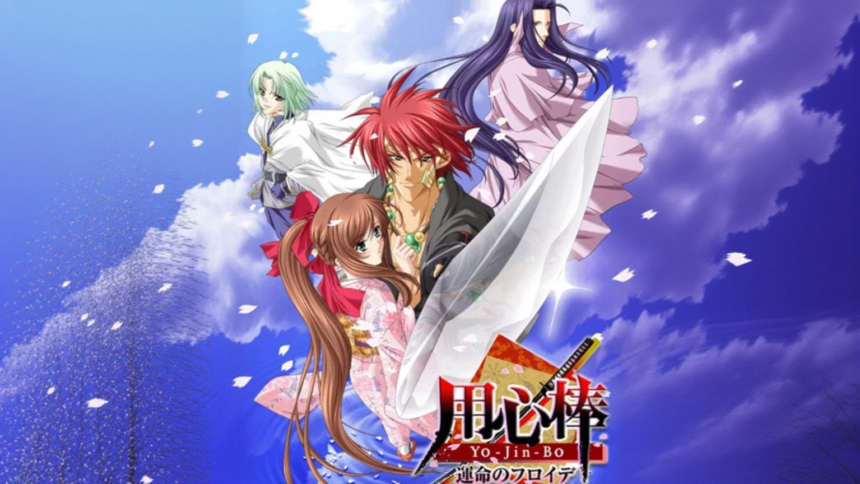
Trading places with a dead princess is a strange enough problem on its own, but Yo-Jin-Bo adds a war of succession and a body count on top of it before Sayori even has time to process what happened to her.
An ordinary high school student on a history club dig, she picks up a jade pendant half-buried near a castle’s ruins, and that same night the ghost of Princess Hatsuhime begs her for help before Sayori wakes up the following morning inside Hatsuhime’s own body, a Mochizuki clan princess murdered a hundred and fifty years earlier.
Two-Five developed the original in Japan, releasing it for PC on July 29, 2005 before a PlayStation 2 port followed under the title Unmei no Freude the next year. Hirameki International brought it to English-speaking players on October 30, 2006 as part of their AnimePlay PC line, making it the first otome visual novel ever officially localized into English, and JAST USA gave it a second life with a 2009 re-release once the genre had built up a bigger audience in the west. The Windows version also ran natively on Mac, a real rarity for a Japanese visual novel release at that point in the format’s history.
Six bodyguards arrive to protect Sayori through the succession crisis, and the title itself is a pun built from three of their nicknames, Yo, Jin, and Bo, stitched together into the word for bodyguard in Japanese. Yo, born Shiranui Yozaburo, comes from a ninja family and chafes constantly against being treated as the group’s kid brother despite pulling his weight in every fight. Jin, Murasame Jinnosuke, is the first bodyguard Sayori actually meets, red-haired and rough-edged but fundamentally good-natured underneath the bluster. Bo, properly Tsubaki Tainojo, plays against both of them as an androgynous, elegant bishonen from a proper samurai family, carrying himself like the group’s resident prince even while insisting he isn’t especially fond of women, which gives his flirtation with Sayori a prickly, contradictory edge the other five don’t share.
Ittousai sits at the far end of that same spectrum, a suspicious, scarred figure the other bodyguards themselves treat more like a hired assassin than a protector, glasses on even when bathing, a detail that tells you almost everything about how deliberately guarded he keeps himself. The fact that Jin had apparently tried to kill him once before and failed says everything about how uneasy his place in the group actually is. Mon-Mon, Kadokura Monzan, plays the group’s Buddhist priest, strong enough to stitch a sword wound closed with real medical precision despite an act built entirely around a self-given cute nickname nobody quite takes seriously. Muneshige, Tsukuba Muneshige, rounds the group out as Hatsuhime’s own loyal vassal, forever landing terrible jokes and worse impressions at exactly the moments that call for neither.
The tone stays consistently light and funny even while the plot keeps Sayori’s life on the line, leaning on anachronisms and pop culture references that gave feudal Japan a looser, sillier energy than the premise’s actual stakes would suggest. Twelve endings total split evenly across the six bodyguards, one good and one bad apiece, and the range between the game’s happier resolutions and its outright character-death bad endings kept every choice feeling like it actually mattered rather than just flavoring the same outcome differently.
Presentation leans hard into a manga-style format, with a smaller portrait beside the dialogue box tracking each character’s shifting emotions while a larger, more static image holds the main scene. Full-on action gets rendered through simple effects, like a glowing blade streak across a dark background, rather than any actual animation, and that restraint fit the game’s overall tone well enough that I never once felt like the static action scenes were a budget shortfall rather than a deliberate style choice.
Every bodyguard gets a full Japanese voice performance while Sayori herself stays unvoiced, letting the reader project onto her the way these otome games usually intend. Masakazu Morita voices Yo, Hideo Ishikawa gives Bo his elegant, faintly cold delivery, Hideki Ogihara plays Ittousai clipped and guarded, Tetsu Inada leans into Mon-Mon’s performed cuteness, and Jurota Kosugi carries Muneshige’s terrible-joke energy with real comic timing. Hearing Ishikawa’s read of Bo land so differently from Ogihara’s version of Ittousai sold the gap between the two characters faster than their introductions alone managed.
Watching Sayori go from an ordinary high schooler with no stake in a centuries-old succession war to someone actually invested in saving people she’d only just met gave the story’s better endings real warmth, and that arc made reaching one feel earned rather than assumed. As one of the earliest otome visual novels to make it into English at all, Yo-Jin-Bo still holds up as a solid entry point for anyone curious about the genre, even with nearly two decades of other releases to compare it against now.
Verdict
Yo-Jin-Bo turns a body-swap premise into a varied cast of bodyguards, letting Bo and Ittousai’s opposite personalities anchor a group that never settles for stock samurai archetypes. A full Japanese voice cast and a manga-style presentation give the historical setting real charm despite its static action scenes, and a spread of twelve endings from happy to outright tragic makes every choice along the way feel like it carries real weight.



