
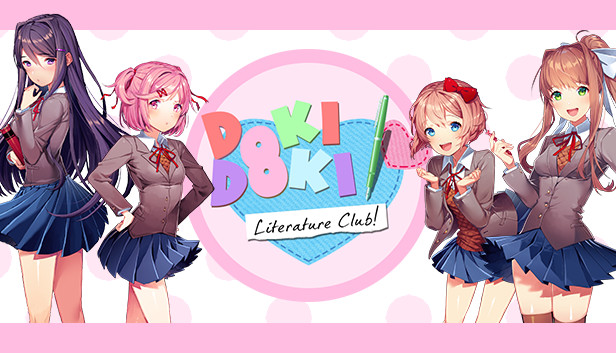
Doki Doki Literature Club! spends its opening hours playing a completely straightforward high school dating sim, joining a literature club and getting closer to its members exactly the way the genre promises. That surface holds for a while. What’s underneath it is a different story entirely, one the game would rather a reader discover for themselves than have spoiled in a review.
Sayori plays the protagonist’s oldest friend and neighbor, the club’s vice president and the one who talks him into joining in the first place. Her cheerful, clumsy energy reads as real warmth on a first pass through the story. Natsuki brings a sharper, more defensive edge from the moment she’s introduced, all bark before any bite gets explained. Yuri’s quiet intensity around literature marks her out as the club’s most withdrawn member, someone who’d rather let a book speak for her than say much herself. Monika rounds out the group as club president, introduced as the most composed and together of the four, the one keeping the whole club structured and on schedule.
Satchely’s character sprites carry those early scenes with a warmth that matches how each of the four gets introduced, small, expressive details doing a lot of work before the story asks anything harder of them. VelinquenT’s backgrounds, built originally as three dimensional models before being processed into the game’s finished look, keep the classroom and clubroom settings feeling lived in rather than like empty stage dressing behind the cast.
The one real interactive hook running through all of it is a poem-writing minigame, repeated at the end of most early days, where a reader picks twenty words out of a rotating pool of roughly a hundred to build a poem shared with the club the next morning. Each word carries hidden weight toward one specific character, and whichever club member ends up liking the finished poem most gets a little more time and story attention the following day. I found myself picking words less for how they sounded together and more for who I was quietly trying to win over, which is exactly the kind of small, personal complicity the game seems built to exploit later on.
None of that stays fixed for long, the poem game included, which starts glitching in small, uncomfortable ways once the story’s tone turns. Depression and self harm factor directly into the story as it progresses, and the game treats that material with a weight that never once felt exploitative to me, even during the moments I found hardest to sit with. I won’t describe how those threads actually resolve, only that the game earns the seriousness it asks a reader to bring to them rather than using them as a cheap shock tactic. Sayori’s warmth from those opening scenes reads entirely differently in hindsight once that weight becomes clear. I won’t say what that recontextualization actually reveals about Monika either, only that everything about how she’s first introduced gets undone by the time the credits roll.
Salvato’s own score follows that same arc on its own terms. The introductory theme leans on piano and flute over string accompaniment. A companion piece called Okay, Everyone exists in five different versions, four of them built around an instrument tied to one specific heroine, piano for Monika, pizzicato and harp for Yuri, xylophone and recorder for Natsuki, ukulele for Sayori. That warmth holds until tracks like Sayo-nara and Just Monika arrive and make it clear something has gone seriously wrong. Jillian Ashcraft voices the game’s one fully sung piece over the credits, Your Reality, and hearing that voice arrive this late, after so much of the game stayed instrumental, gave the ending its own kind of unease.
Even the cast’s names carry a version of that same trick. Every main character besides Monika got a Japanese name chosen to fit a pseudo-Japanese anime-VN atmosphere, Sayori’s own name built out of a blend of two existing Japanese names, while Monika alone kept an English one, a small, deliberate signal about how differently she sits inside the story compared to everyone around her.
Watching a story this willing to break its own rules made me second guess nearly everything I thought I understood about it by the time I reached the end. That unease stuck with me longer than most straightforward horror games manage.
None of what actually happens here came from a team with years of visual novel experience behind it. Dan Salvato wrote, designed, programmed, and composed the whole thing himself in Ren’Py over roughly two years, and this was his debut game, following prior work on the FrankerFaceZ Twitch extension and modding for the Super Smash Bros. Melee community project Project M. He’s said the horror elements underneath the club’s cheerful surface drew inspiration from Yume Nikki and Eversion.
That came shaped by a mixed, love-hate relationship with anime, and a specific frustration with how often the genre leans on cute-girls-doing-cute-things plotting without asking more of it. Early builds of the cast were made with a free online anime-avatar creator. An artist named Kagefumi handled initial concepts next before leaving the project, with Satchely eventually brought on to finish the character sprites that actually shipped. Doki Doki Literature Club! released for free on itch.io on September 22, 2017 before reaching Steam, and it went on to rack up more than thirteen and a half million downloads and, across every platform and rerelease combined, more than thirty million total players worldwide, a number that makes the amount of craft packed into a free release even more impressive in hindsight.
A later expanded rerelease, Doki Doki Literature Club Plus!, brought the game to consoles for the first time through Serenity Forge on June 30, 2021, adding a full HD visual upgrade, six new Side Stories exploring the same cast outside the main plot, more than a hundred unlockable images including concept sketches, and twenty six total music tracks built around a new in-game music player, thirteen of those songs newly composed by Nikki Kaelar alongside guest contributions from Jason Hayes and Azuria Sky. Physical Switch copies followed that August, with PlayStation versions arriving that October. Plus! sold half a million copies in its first two weeks alone and crossed one million copies worldwide by its fifth anniversary in 2023, and Salvato has said he’s committed some of that funding to supporting mental health nonprofits, a detail that lines up with how seriously the game treats its own heavier material rather than reading as an afterthought tacked onto a press release.
Verdict
None of Doki Doki Literature Club!’s early warmth turns out to be the whole picture, and that gap between what Sayori, Natsuki, Yuri, and Monika first seem to be and what they actually turn out to be is the entire point. Satchely and VelinquenT’s art and Salvato’s own soundtrack both carry that same quiet unraveling without ever announcing it, and the game earns the weight of its heavier subject matter instead of leaning on it for cheap shock. A free release built almost entirely by one person becoming this unsettling says more about the craft behind it than any budget number could.