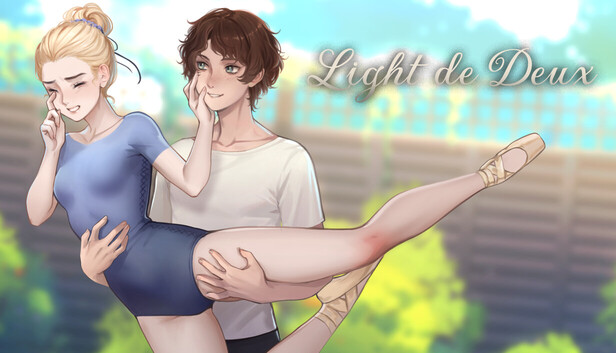
Light de Deux opens on an assignment with no ceremony attached to it at all, an instructor pairing two dancers together for a routine neither of them asked for. Mark took up ballet as a kid after catching a male dancer on television and deciding, at twelve years old, that the elegance and control on display was about as masculine as anything he’d ever seen. Classmates made fun of him for it, so he quit, then picked it back up a decade later once he’d stopped caring what anyone thought, working as a handyman in the years between, having lost his own father young and spent much of his youth just trying to climb out of poverty. Susanna arrives at the same studio from somewhere entirely different, a college student with money behind her and a father who’s never quite present in the ways that matter, someone who gave her every material comfort and almost none of the affection that would have actually meant something.
That gap between them does most of the early character work. Mark teases her with the kind of jokes that read as goofy rather than sincere, and for a long while Susanna reads him as exactly that, someone not serious enough to take seriously. She keeps her guard up through sharp, clipped replies that Mark never seems to take personally, patient in a way that has nothing to do with waiting her out and everything to do with just being consistent. I found that patience the most quietly convincing thing about him, since nothing about his early scenes plays as a performance meant to wear her down, just someone who plainly doesn’t need her approval to keep showing up. Neither of them push past dance partners and rough acquaintances for close to two years, which made every small crack in that routine land harder once it actually showed up.
Two years is a long stretch for a story this short to cover, and the pacing handles that gap by leaning almost entirely on repetition with small variation, the same rehearsal room, the same guarded banter, until a tiny shift in tone or word choice signals that something underneath has actually moved. That technique asked more patience of me early on than I expected from something running just over an hour, but it paid off exactly when the story needed it to.
Shreibikus wrote, developed, and published the whole thing themselves, and it shows in how tightly the structure serves the story rather than the other way around. The kinetic format means there are no choices to make, just a single path told twice over, once from Mark’s side and once from Susanna’s, switching narrators scene by scene in a way that let me sit with each character’s private read on the same moment before the other one’s version corrected or deepened it. A full run lands at a little over an hour, short enough that I played it twice in one sitting without meaning to. The game released on Steam on October 25, 2024, priced at 150 hryvnia, and it launched alongside a newly organized Ukrainian Visual Novels collection meant to bring together games from Ukrainian developers under one banner, a genre corner that still doesn’t have many dance-focused entries in it at all, which makes Light de Deux stand out on subject matter alone before its execution even enters the conversation.
Visually this is the strongest work I’ve seen out of Shreibikus, clean linework paired with real expressiveness in the characters’ faces and posture, animated just enough to sell the physicality of a rehearsal room without overselling it. The dancewear stays true to the setting, leotards and practice gear rendered with the same care as everything else, nothing about it feeling like an afterthought bolted onto a romance plot. Small posture details carry more weight than the dialogue does in a few key scenes, the way Mark’s shoulders drop half an inch once he stops performing for an audience, or how Susanna’s hands settle instead of clench once she actually starts to trust the room she’s in. Shreibikus has also confirmed directly that no AI tools went into producing any of that art, worth mentioning given how often that question comes up around smaller visual novels these days.
Every spoken line comes through in Ukrainian voice work that carries real warmth, particularly in how Mark’s easy humor lands differently out loud than it does on the page, while the internal narration stays silent text on screen. That contrast, hearing the banter but reading the private doubt underneath it, does more to separate what these two say from what they actually feel than either device could manage alone, and it’s the single choice in this whole production I found myself thinking about longest after finishing. Around six tracks handle the mood shifts, built from synthesizer textures layered under what sounds like sampled piano, simple compositions that never try to outshine a scene but consistently land exactly where they should.
What finally pushes things forward isn’t some grand declaration, it’s an amateur dance competition Susanna wants to enter to prove to her father, once and for all, that she takes this seriously. Asking Mark to be her partner for it forces a kind of proximity neither of them had let themselves have before, and watching two years of careful distance start to wear thin under that pressure gave the back half of the game an emotional pull the opening hour hadn’t quite earned yet. The mechanism behind that shift stays grounded the whole way through, built entirely out of rehearsal hours and small physical trust rather than any single dramatic turn, and the quiet buildup made the eventual payoff feel earned rather than rushed.
An hour is a real limitation here, and I closed the game wanting another act’s worth of these two before the credits actually rolled. Ballet itself gets described in plain, accessible terms throughout, enough for someone who’s never set foot near a studio to follow every scene without feeling lost, though that same accessibility means the story never goes especially deep into the technical or cultural texture of the sport it’s built around. That’s a strange complaint to hold against something this well made, but it’s the honest one, and it left me hoping Shreibikus gets the resources at some point to come back to Mark and Susanna, or to this same subject, with more room to stretch.
Verdict
Light de Deux takes a familiar setup, two mismatched dance partners circling something neither wants to name, and executes it with more patience and craft than the premise alone would suggest. The dual narration and Ukrainian voice work give Mark and Susanna’s slow thaw real texture, even if the story wraps up just as it’s finding its footing, and its place inside a still-thin catalog of dance-themed visual novels gives it a foothold beyond just its own two characters. A short, sincere romance that earns the warmth it’s going for.