
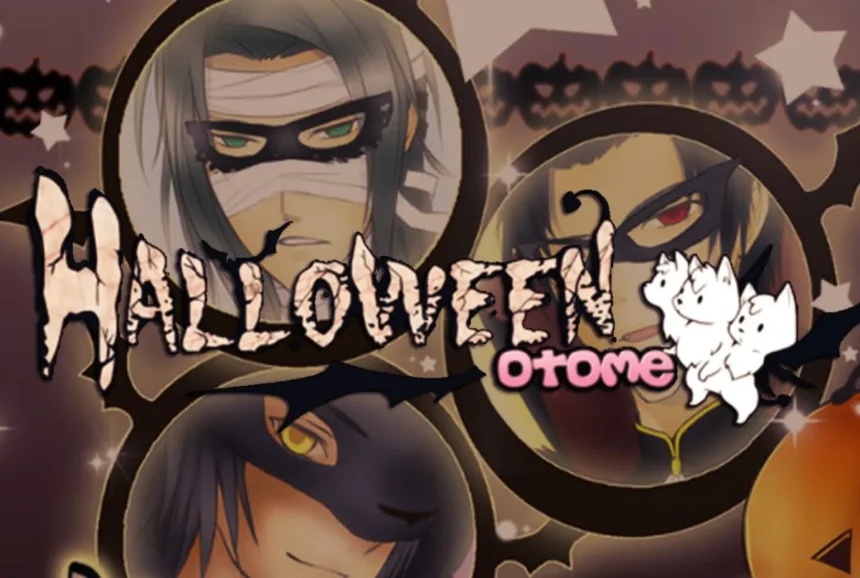
Winning a radio contest rarely comes with strict rules about hiding your own identity, and that specific wrinkle is what gives Halloween Otome its distinct charm from the outset. Emma finds herself the only non-famous guest at an exclusive, celebrity-only Halloween getaway hosted by actor Erik Valdemar, and the costume party’s insistence on anonymity means Emma gets to blend in among the rich and famous without anyone judging her ordinary background. What follows is a two week competition, Emma placed into a team with three other guests, and the story follows her falling for one of them while the group works through an ongoing, mysterious game Valdemar’s parties are apparently known for.
The three romanceable teammates carry real distinct personality across their routes. Mr. Wolf, also known as Tyler, sings for a living and comes across shy and easily frightened, prone to blushing hard enough at even mildly inappropriate comments that his whole face and neck turn red. Mr. Bandages works as a model, competitive and cranky on the surface with a mouth full of sass that makes nearly every scene he’s in entertaining even when Emma’s on the receiving end of his teasing. The Count plays the charming, quick witted actor of the group, his own odd sense of humor and constant costume changes giving him a magnetic, hard to pin down presence compared to the other two.
Fans of the game tend to recommend a specific order for working through all three routes, the general shared path first, then Mr. Wolf, then Mr. Bandages, saving The Count for last. His route carries a heavier concentration of story reveals than the other two, retroactively recontextualizing odd, previously unexplained details scattered throughout the earlier paths, the kind of payoff that rewards playing through the full cast rather than settling for a single favorite.
Emma herself carries the protagonist role well, an everyday girl with a voracious appetite, a playful personality, and a wicked sense of humor that keeps her from ever reading as a blank self insert. Erik Valdemar, presiding over the whole affair as host, brings enough charisma to the role that even scenes without any of the three romance options still feel worth paying attention to.
Presentation carries real polish, crisp, professional grade anime art with lavish backgrounds and distinct character designs for the whole cast, elevated further by a soundtrack of original songs that stand out enough to be worth listening to outside the game itself. Fanart included in the extras menu adds another layer of care to the overall package.
Light mini games, mazes and simple puzzles, add mechanical variety to the point and click structure without demanding real difficulty, and while they factor into an overall competition ranking, the story itself changes only minimally based on performance, keeping the experience accessible even for readers who’d rather skip them entirely.
Where the game undersells itself is its own title. Halloween Otome sounds generic and unassuming enough that it’s easy to nearly pass over the game entirely, assuming it’ll be a cheap, low effort entry rather than the well crafted, well written experience it turns out to be.
A handful of convenient plot coincidences, particularly around Emma already knowing all three of her teammates before the competition even starts, are worth a mild raised eyebrow, and the story’s final stretch takes a darker, scarier turn that lands as effective more often than jarring against the game’s otherwise lighter tone.
Synokoria has since built on this world too, releasing a direct sequel called Valentine Otome that picks up after Halloween Otome’s own events and follows Emma’s best friend Mira Cosgrove as its protagonist instead. A free companion fan book collecting extra art and material rounds out the wider release.
Reaching whichever ending grew out of a given playthrough left me thinking about how much a genre this crowded can still surprise a reader willing to look past an unremarkable title.
Verdict
Halloween Otome earns its devoted, years long fanbase through excellent writing and gorgeous, professional grade presentation that far outpaces its unassuming, forgettable title. Its three love interests each carry real distinct personality, with The Count’s route delivering a satisfying concentration of story payoff that rewards exploring the full cast rather than settling for a single playthrough, and Erik Valdemar’s magnetic hosting gives the whole competition real personality beyond the central romance. A few convenient coincidences and a tonal swerve into real darkness during the final stretch are worth knowing about going in, but as a free, beautifully crafted otome that’s since spawned its own sequel, this remains a beloved standout well worth the unassuming name.