


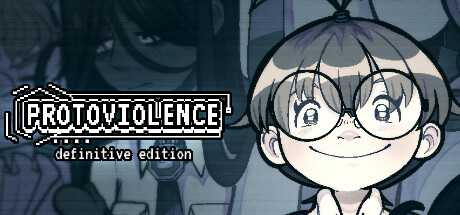
Twenty years of groundbreaking research rarely gets interrogated by the person who actually did the work, and that’s exactly the reckoning Mado builds this entire visual novel around. Dr. Deidre Destrange spent two decades producing field defining cybernetics research under STOP, a global security organization, only to watch that work curdle into the Youth Training and Development Initiative, an unethical program turning children into cyborg soldiers. Believing her own legacy gives her the standing to actually dismantle what she helped create, Deidre focuses her efforts on a single upcoming case study, and the entire game rests on the question of whether she can actually save that one test subject from the system she built.
protoViolence serves as a direct prequel to Mado’s earlier malViolence, which released as a free Definitive Edition on Steam in May 2023 after starting life as Mado’s directorial debut for the NaNoRenO 2023 game jam. That earlier game put a captured STOP agent through a series of escape room puzzles set by a mad scientist named Cautionne, branching across three main endings plus a wider spread of bad ones depending on how a reader handled each room.
protoViolence drops those escape room mechanics entirely in favor of pure reading, supplemented by interactive diary and record entries that let a reader dig into the wider world and Deidre’s own history at their own pace. That structural shift suits the material well, since the story’s real weight comes from sitting with Deidre’s mounting horror at what her research actually enabled rather than solving puzzles to progress.
At roughly two hours with a single ending, this is a tightly authored, complete experience rather than a sprawling branching narrative. The game earned an Honorable Mention after being shortlisted for 2023’s Spooktober Visual Novel Jam before its own full Definitive Edition release that following February, free on both Steam and itch.io.
What earns the most specific attention is how deliberately the presentation itself tracks the story’s emotional arc. The art style shifts gradually across the game, starting bright, clean, and polished before slowly turning dim and grey as the grim reality of Deidre’s situation sets in, an effective visual storytelling technique that mirrors the protagonist’s own psychological unraveling rather than existing as mere aesthetic flourish. High quality sprites and CGs with real blinking, speaking animation and dynamic camera movement give even quiet scenes real cinematic presence.
Voice acting covers the cast partially rather than completely at launch, though Mado expanded that coverage further in an anniversary update released that October, giving more of Deidre’s own internal reckoning an actual voice to carry it.
An original, immersive soundtrack does real work setting mood throughout, later released on Bandcamp for anyone who wanted the score outside the story itself.
The accessibility features on offer, including image captions, sound captions, and text legibility options, are thoughtful inclusions that even larger commercial productions don’t always bother with.
Mado has kept supporting the series past this single release too, patching protoViolence into 2025 and building toward interViolence, a fandisc style entry made in RPGMaker that leans toward relaxed, low stakes daily life material in the vein of To The Moon or Alicemare, introducing a new character named Mo alongside the answers it plans to give about Cautionne’s fate and Deidre’s own life in the gap between these two earlier games.
A scientist confronting the exact system her own life’s work made possible gives protoViolence real stakes well beyond its short runtime, and Deidre’s mounting realization that redemption might not be as simple as she believes it is carries the whole experience.
Verdict
protoViolence succeeds by using a tight, focused runtime and deliberate art shifts to tell an affecting story about complicity and the horror of watching your own life’s work turn monstrous, anchored by Deidre’s mounting realization that redemption might not be as simple as she believes it is. Its shift away from malViolence’s puzzle mechanics toward pure narrative reading suits the material’s emotional focus, and its cinematic presentation, from dynamic camera work to an original soundtrack and accessibility features that punch well above the game’s free price tag, gives the whole thing real polish. At just two hours with a single ending, it’s a brief experience, but a complete and well crafted one that’s building real momentum for the wider Violence series it belongs to.



